Appendix 1. The field location at Wappenbury shows a huge
“serpent” shape, to accompany a “lunar calendar” in crops which
codes for a date of September 22, when a “Feathered Serpent”
will metaphorically descend the Pyramid of Kukulcan at Chichen
Itza
A
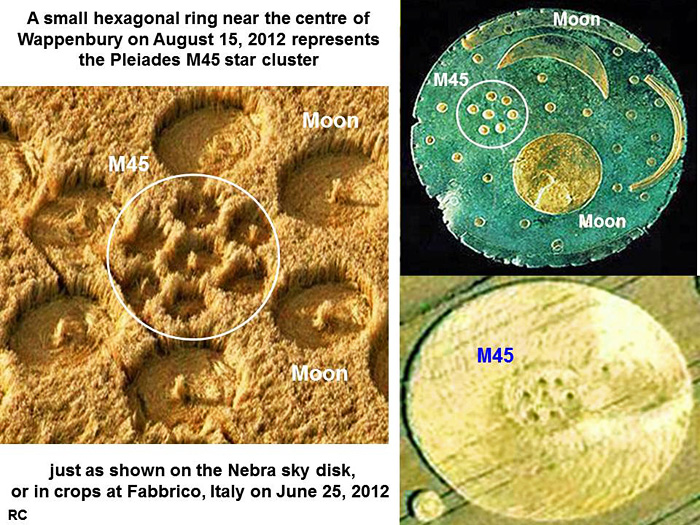
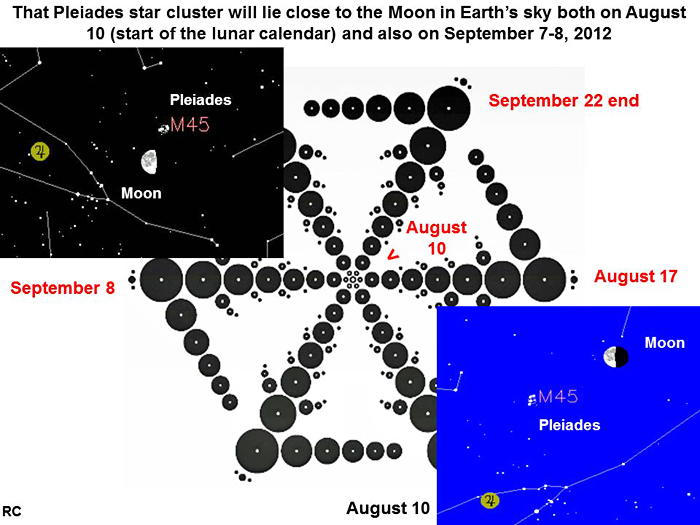
“lunar calendar” was drawn in crops near Wappenbury on August
15, 2012. It seems to show a six-week lunar calendar beginning
on August 10 (with a Moon-Pleiades conjunction), then ending on
September 22 (with a last-quarter Moon and also an autumn
equinox).
On
that day, seven triangles of light and shadow will
metaphorically descend the Pyramid of Kukulcan at Chichen Itza,
in order to symbolize a return from sky to earth of a beloved
Mayan leader of the same name (sometimes called “Quetzalcoatl”
meaning “Feathered Serpent”).
Why
did the crop artists have to go all the way up to Warwickshire
to draw a “lunar calendar” in crops? A plausible answer is
provided below. There we can see the field image of a huge,
comical-looking “serpent” (outlined in blue), very
close to where the crop picture appeared:

What
a great joke by the crop artists! Humans on Earth
solve for the symbolic meaning of that Wappenbury crop picture
after considerable effort, then look to see exactly where it
appeared using Google Earth? Immediately the humans see a huge
“serpent” shape nearby, informing them that their “lunar
calendar” interpretation is correct!
Four
of the most recent crop pictures in England have dealt with this
same theme: namely a metaphorical descent of the
Feathered Serpent along a northern stairway of the Pyramid of
Kukulcan, in Chichen Itza on September 22, 2012 (an autumn
equinox).
Longwood Road of August 5 showed “seven triangles” of shadow and
light, closely resembling what will appear along a northern
stairway of the Pyramid of Kukulcan on September 22. Devil’s Den
of August 12 showed “36 stairs” from a Mayan step pyramid,
divided into five parts as 7-8-7-7-7, in order to represent a
Mayan lunar calendar with seven days for each part of the phase
cycle. After 36 days from August 17 (a new Moon) to September 22
(a first-quarter Moon), the metaphorical descent of a Feathered
Serpent will be seen on an autumn equinox at the Pyramid of
Kukulcan.
Uffington White Horse of August 14 showed a “coiled serpent”
next to a “crescent Moon”, perhaps to symbolize a descent of the
Feathered Serpent on a first-quarter, crescent Moon of September
22. Wappenbury of August 15 showed a Mayan lunar calendar
extending for six weeks from August 10 to September 22, with the
image of a huge “serpent” in the landscape nearby! What other
amazing things shall we see, before the Mayan Long Count
calendar ends on December 21 or 23, 2012?
“We
need to listen to the Mayans. It is very important. No matter
what the source, this message is true and it touches
all of
mankind”---Martin
Keitel, August 23, 2002
(see
www.martinkeitel.net).
Appendix 2. Who was the man Quetzalcoatl in a historical
sense?
Many crop circles over the years have shown images of a
“feathered serpent”, “planet Venus”, “feathered headdress”
or a “jester’s hat”. All of those are traditional symbols
for a legendary god-teacher called “Quetzalcoatl” or “Kukulcan”.
The native people of central, south and north America once
reverenced him as we reverence Jesus today. So who was he in
a historical sense? And why are so many of his symbols
appearing in crops?
We seem to have two direct likenesses of Quetzalcoatl from
central America 2000 years ago, carved as small statuettes
or as large statues. The first of these is called “La Venta
Stela 19” and is shown below:
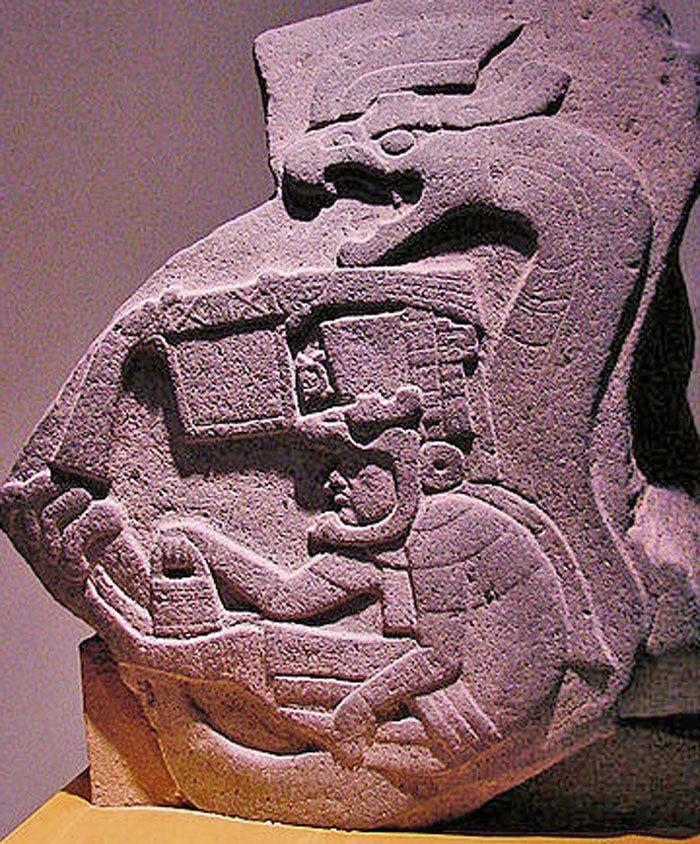
Here we can see an aviator of some kind, maybe
an airplane pilot or maybe an astronaut. He is sitting in a
pressurized suit with a helmet and an earphone, in the
cockpit of some unknown craft. In his right hand, he holds a
controlling device. Behind him, we can see what looks like
an instrument panel, including a square-screen TV. The craft
in which he is flying has been pictured metaphorically by
the sculptor as a “flying snake” or “feathered serpent”.
Quetzalcoatl supposedly arrived by boat along the coast of
the Yucatan in a year “One Reed” (60 AD) with twenty of his
companions, having sailed across the “sunrise ocean”
(Atlantic). They proceeded to teach the Olmecs and/or Mayans
how to set up an advanced civilization: how to farm crops,
how to process ores, how to build pyramids, how to study the
planets or stars, and how to do mathematics.
Such knowledge was not known elsewhere on Earth at the time.
Could Quetzalcoatl and his friends have arrived in ancient
central America from another star system, or from another
time in Earth’s history?
A second authentic likeness of Quetzalcoatl is shown below.
It is part of a large statue on display at La Venta Park in
Tabasco, Mexico. Here we can see him wearing a three-lobed
jester’s hat, and greeting a local native leader:

If we look closely at his head and upper body, we can see
some interesting details:
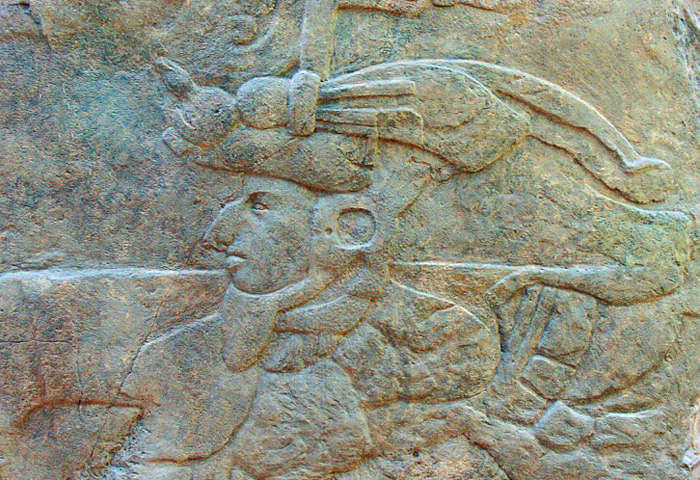
Quetzal had “white European” features, including a long
Roman nose. On his ear he is wearing headphones, while on
his head he has a three-lobed hat (later to be associated
with court jesters in medieval Europe).
The Mayans built a spectacular Temple for him in
Teotihuacan, along with a Butterfly Palace (see
www.richard-seaman.com). Later in 800 AD, they built the
Pyramid of Kukulcan in his honour. The image of a “serpent”
comes down from “sky to earth”, along the northern stairway
of that pyramid, twice every year on the spring or autumn
equinox (see
Chichen Itza). So where did he come from, and why have
symbols for Quetzalcoatl (or other Mayan themes) been
appearing in crop pictures all across Europe for the past
ten or twenty years?
Images for the Pleiades appear regularly in crops, say at
Fabbrico or Wappenbury in 2012. Could Quetzalcoatl have been
a star traveller from the Pleiades M45 star cluster?
Was he a friend of Jesus, who taught peace and non-violence
in Israel at almost the same time? Jesus said in the New
Testament, “This is not the only place where I have sheep”.
At the end of Revelation (in Aramaic), Jesus says: “I am the
root and offspring of David, and my companion the Bright
Morning Star (Venus)”.
Could Quetzalcoatl have been a time-traveller from our
future? Could he have come from some parallel dimension,
where the Mayan civilization did not collapse, but
flourished all the way into our modern era?
Whichever of these possibilities might be correct, we will
perhaps learn soon. The Long Count calendar which he taught
to the Mayans will end its current cycle of 5200 years on
December 21 or 23, 2012, Quetzal always promised that he
would “return” during the first year of a new calendar
cycle called “One Reed”. It will be very exciting if
that turns out to be the case!