|
LANDSCAPE GIANTS

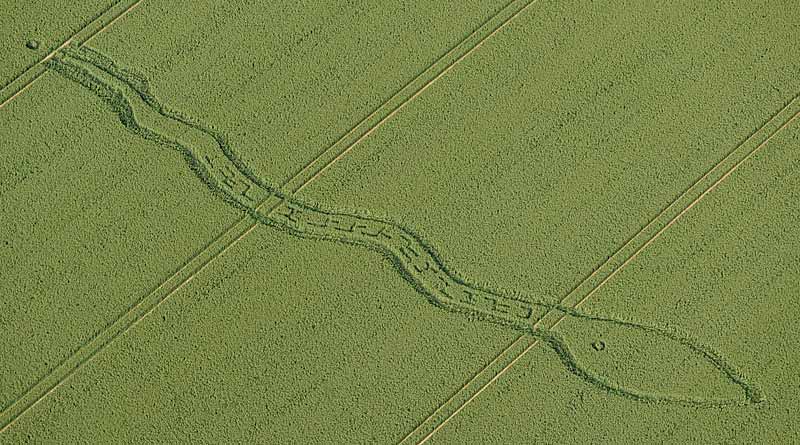
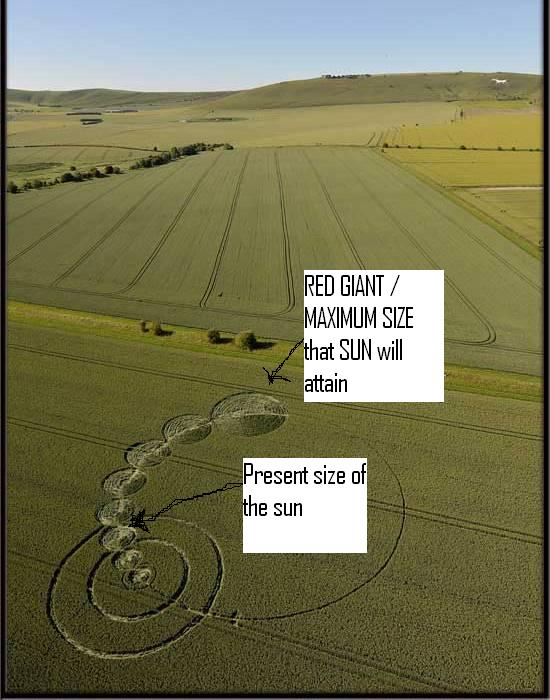
Wilton Windmill, nr Wilton, Wiltshire.
Reported 1st June 2011.

Fig.
144. The Isle of Wight (The White Bulls Head)
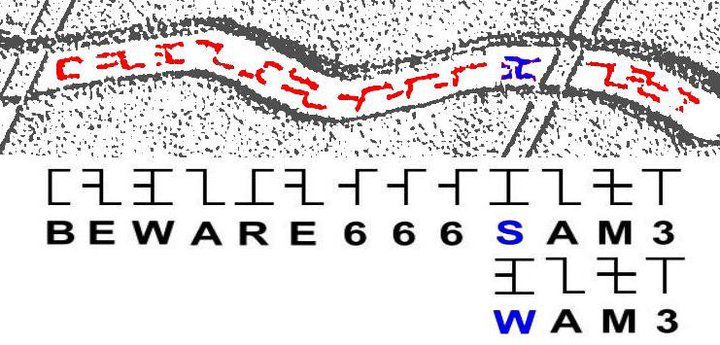
Notice the
bends on this map with the crop glyph; you may need to look at a more
detailed map.
Notice
that Rue street crosses between S and A
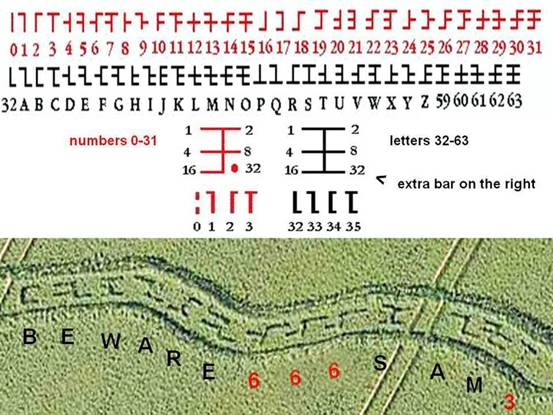
What about
the tractor track between S and A. Notice the space between S and A
Rue Street
I think
that we are dealing with co-ordinates here.
And these
letters and numbers are also features found within this landscape Dragon
on the Isle of Wight.
This high ridge forms the backbone
of the Isle of Wight and provides clues to the island's many mysteries,
and with this giant head that forms England. The ridge of the Downs on
the Isle of Wight which runs from east to west forms the shape of a
landscape snake, and crossing this snake is the Roman Road called Rue
(Ra) Street. The intersection point (centre of the cross) falls upon a
Roman Villa at the islands Capital at Newport. This Roman villa must
have played a very important role with this crossing point (Temples
being built upon sacred landscape).
There are three known holy sites on
the Isle of Wight and these sites at one-time were considered sacred to
the Druids who once lived on this island, these three sites are known as
the pinnacle of Ur, the long stone of Mottistone and the Oak Grove of
Gabhanodorum. All three sites fall upon this Dragon (Snake) shaped
ridge.
At the centre of the Isle of Wight
at its capital the town of Newport stands upon the River Medina, the
original name of the town was Medina, and medina is Arabic for town.
Where the River Medina flows into the sea now stands the famous yachting
town of Cowes, and next to that at the island's most northern extension
is to be found Egypt Point.
The word Cowes possibly came from
the Egyptian Khau, signifying regal dignity. And Rue Street, which runs
straight toward the mid-day Sun at the mid-summer solstice, should be Ra
Street, the road of the Sun. There are also two rivers called Yar, the
word Yar is the root of the name of many rivers, and it means a river or
water in ancient Semitic languages.
But how would Egyptians have come
to the Isle of Wight? The prehistoric inhabitants of Britain (called
Celts on the basis of their language) were apparently a fusion of
Mediterranean, Alpine, and Nordic strains that included a dark Iberian
and a light-haired stock. Archaeological evidence points to contacts
with the Iberian Peninsula (2500 BCE) and Egypt (1300 BCE) the race
generally called 'Iberian' or Mediterranean, gave Egyptian civilisation
its first impetus. Similarly it took on special attributes in Britain,
with the Cult of the Dead which they carried with them to our island, as
they did to Egypt, culminated into the sublime and intellectual system
of Druidism, which survived in Britain long after it had perished
elsewhere, which has affected the entire process and history of British
mystical thought even to the present time.
Either the ancient Egyptians
themselves came here first, or a closely speaking race related to the
same language made their way up to this island before the Egyptians. The
solution to this question is revealed in the next chapter. but at the
moment with this theory it would help to explain how the megalithic
monuments on this Island have also their counterparts in France,
Scandinavia, Germany, Spain, and Crete, we know that Stonehenge was
erected more than 500 years before the pyramids: perhaps the Egyptian
colonists learnt the art's of cutting, moving and erecting great masses
of stone in Britain and then they took their knowledge to Egypt. And
this theory also supplies one small additional piece of evidence that
ties up with what we know was at one time a persisting cult of bull
worship on the Isle of Wight; for what are Apse Heath and Apes Down
named after but Apis, the Egyptian bull god? First there was the island
itself separated from the mainland of Britain by the Solent (the gate of
the Sun) then came the Egyptians, who perhaps were the first to
recognise the islands importance, and treated the whole Island as a
temple. The ancient Egyptians also worshipped the sun and the bull, the
Druids also carried on this practice, later came the Romans, with there
cult of Mithras, who was the god of light and the companion of the Sun
and who is shown in ancient wall relief's sacrificing the redeeming
bull. For thousands of years this island was a temple of the Sun,
possibly even the great temple of Apollo that is described by the Greek
writer Hecateus in the 4th century BC in his history of the Hyperboreans.
Secret rites were a part of the
worship of several Greek deities, such as Hera, queen of the gods,
Aphrodite, goddess of love, and Hecate, goddess of the underworld. Many
foreign religions adopted by the Greeks and Romans had mysteries
connected with the worship of the divinity; these religions included the
worship of the Phrygian goddess Cybele, the “great mother” of the gods;
the Egyptian Isis, goddess of the moon, nature, and fertility; and the
Persian Mithras, god of the sun. The worship of these deities spread
throughout the Graeco-Roman world and was extremely popular in the early
centuries of the Roman Empire.
The Babylonians were sun
worshippers, and in ancient Persia worship of the sun was an integral
part of the elaborate cult of Mithras. The ancient Egyptians worshipped
the sun god Ra; they also apotheosized the moon and the star Sirius.
Other Egyptian deities included the constellations and the circumpolar
stars.
With the departure of the Romans
from the Isle of Wight the villas fell into disrepair and eventually
were buried in rubble and soil. It was not until late in the 19th
century that the first serious excavations were undertaken and show that
the village of Brading was indeed the site of a temple of Mithras.
The Dragon in myth throughout the
world in all myths, has a main influence as being a guardian of the
Earth and the profound reverence in which ancient man held this primeval
creature is evident in prehistoric monuments such as spirals and coiled
mazes, that led to a bull related symbols at their centre. Or as vast
structures like the serpent mound in Ohio, or with the avenue of
standing stones that looks like a snake that leads to and from the stone
circle at Avebury. Throughout Europe, early Christian churches were
built over sites that had been sacred places for thousands of Years.
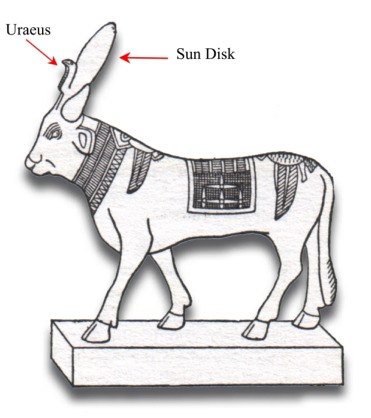
Fig.
145. Apis Bull. Depicted wearing a sun disc with a Uraeus between its
horns; the head of this bull resembles the same design of the Isle of
Wight.
The many churches that are
dedicated to St. Michael and St. George that stand on hilltops and on
Ley lines in England indicate how the connection between the Dragon and
the forces of the Earth were recognised by these early temple founders.
The Mottistone long stone (Standing
Stone) on the Isle of Wight is believed to have been the meeting place
of the Druids who once lived on the island. It is said that they
sacrificed white bulls to their god here. At Brading which also falls
upon this snake, the Druids in legend worshipped here at the Hexal stone
of Yar, and it was also here at Brading that St. Paul brought
Christianity to the island. According to one Isle of Wight legend
Stonehenge once stood at the top of Arreton Down and served as a Druid
temple. The Arch Druid himself was believed to have lived on the stone
of Ur, a jagged pillar of chalk that once formed part of the needles
(Fangs) of this landscape snake (Uraeus) which is protruding from this
landscape head that forms England (see Fig. 144.) Lord Tennyson a famous
poet and author lived on the Isle of Wight for 30 years.
The Tennyson Trail runs along this
landscape snake. It's interesting to know that Lord Tennyson was very
much involved with poems of King Arthur Pen dragon. And Queen Victoria
also considered the Isle of Wight to be her favourite place…
The Egyptian Apis Bull (see Fig.
145.) whose head bares striking similarities with the shape of the Isle
of Wight could be the amazing connection with the worship of the White
Bull by the Druids on the Isle of Wight, and why the practice of
Mithraism by the Romans was held important here. Is it because the Isle
of Wight resembles the head of a Bull (see Fig. 144.) with a Uraeus on
its Brow and a sun disk (Solent) behind its head? Sol is the ancient
word for the Sun, check it out! Again there is much to be rediscovered
here, but we must know now that the key to these mysteries is within the
landscape itself.
In Egyptian Mythology Hathor had
been an important goddess even in very early Egyptian history. She was
depicted either as a cow or in human form wearing a crown consisting of
a sun disk held between the horns of a cow. Hathor is connected to many
other goddesses, and it can be said that all the goddesses were
different forms of her, (see Fig. 146.)
As the goddess of fertility, Hathor
personified the creative power of nature. In art she was often depicted
with the head or the whole body of a cow, and at times she was depicted
as a cobra (Snake). As the protector of the city of the dead, Hathor
became also associated with the Goddess of the Dead. Hathor took on an
uncharacteristically destructive aspect in the legend of the Eye of Ra.
According to this legend, Ra sent the Eye of Ra in the form of Hathor to
destroy humanity; she sat upon the brow of Ra as a cobra, breathing
flames and venom at the enemies of the god. The heat of the goddess can
only be withstood by god himself as Osiris learns when he places her
upon his head to "appear like Ra", and is struck with a great swelling
upon his brow, which can be healed only by the elder sun-god. Believing
that they were plotting against him, However, Ra changed his mind and
flooded the fields with beer, dyed red to look like blood. Hathor
stopped to drink the beer, and, having become intoxicated, never carried
out her deadly mission. It's interesting to point out that Portsmouth
Harbour is directly behind the Isle of Wight, on the forehead of the
Head that forms England. Throughout England's history Portsmouth harbour
has been for generations England’s most defensive point.
It is interesting also that Hathor
could also be seen as the Southern England giantess again, go back to
the chapter titled ‘The Earth Mother and look at (see Fig. 107-108.)
where it shows you the picture the landscape giantess of Southern
England. You will notice that this landscape giantess sits on this
landscape head that forms England. Hathor took on an
uncharacteristically destructive aspect in the legend of the Eye of Ra.
According to this legend, Ra sent the Eye of Ra in the form of Hathor to
destroy humanity; she sat upon the brow of Ra.
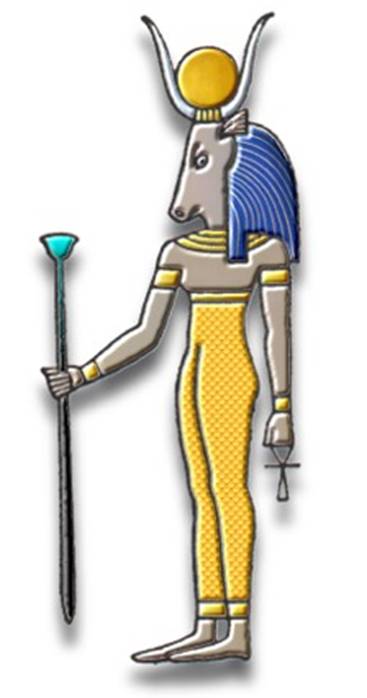
Fig.
146. Hathor, the Cow-Headed Egyptian Goddess
Graham
Russell |