|
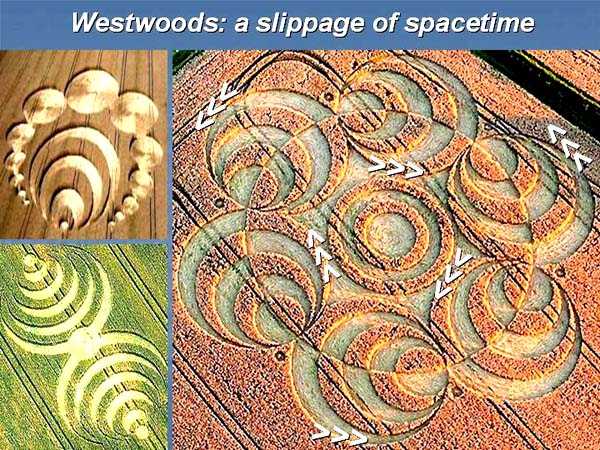
Westwoods: a classic
portrayal of slipped or sheared spacetime
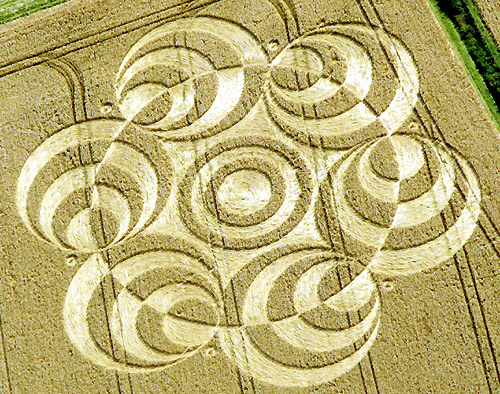
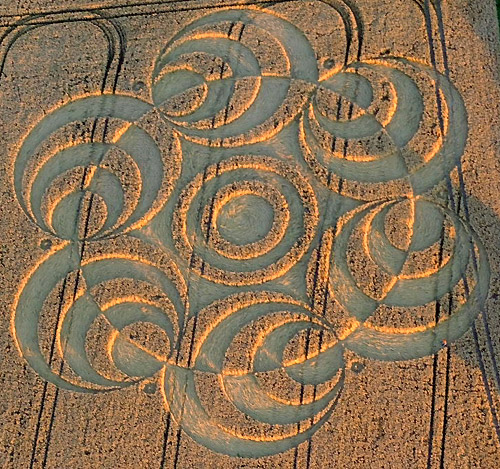
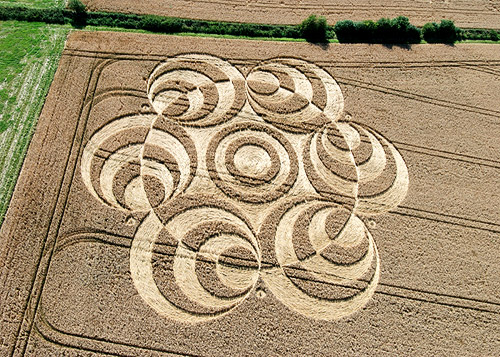
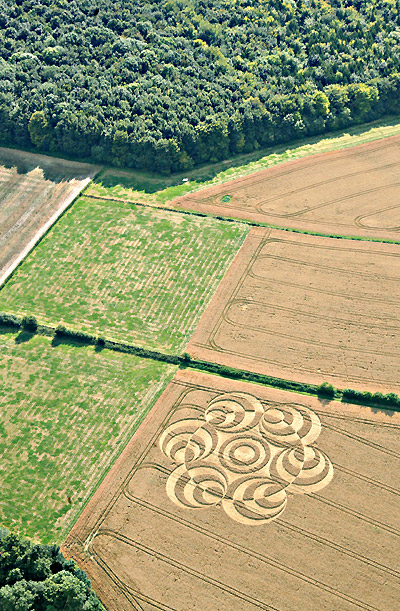
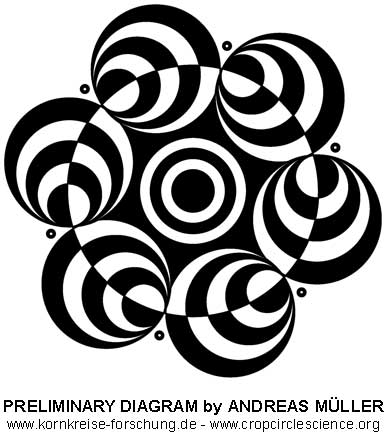
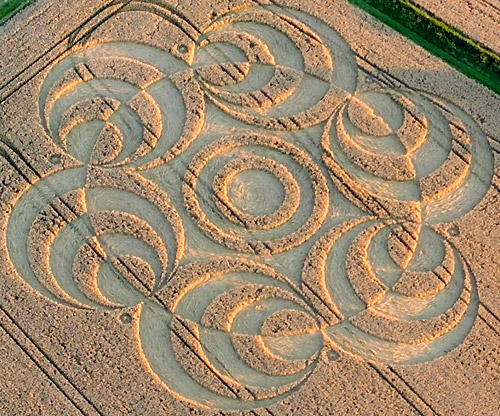
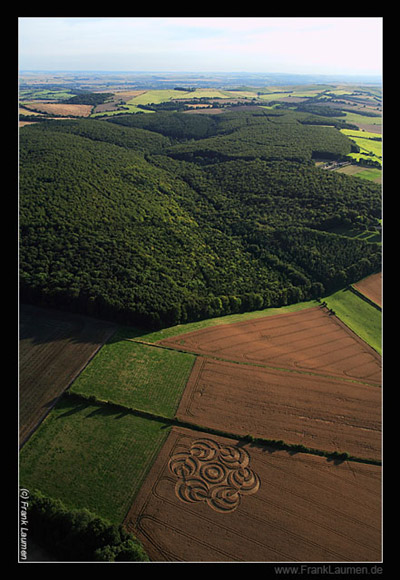
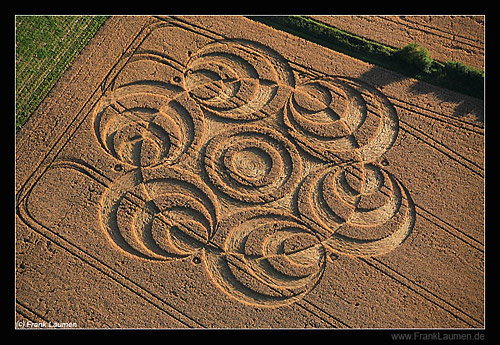
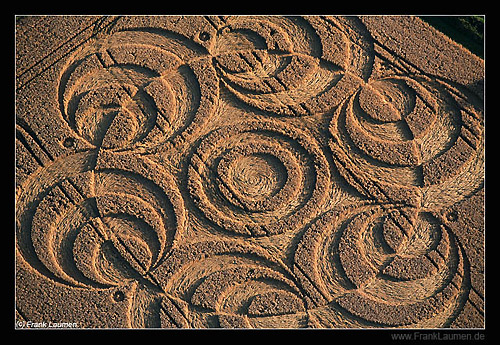
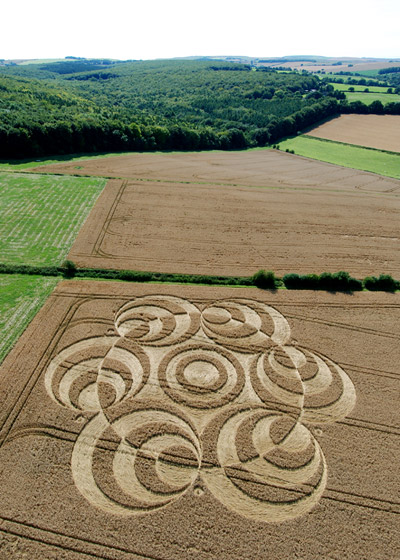
The new crop picture at Westwoods on August 9
could only have been made by an ancient Annunaki space time
physicist, who has a good understanding of gravity-wormhole theory
(just as for the "wormhole" pictures of 2006). It shows planet Earth
in yearly circular orbit about the Sun; but instead of showing a
"round ball" for planet Earth, it shows Earth's intrinsic curvature
of space time in four dimensions---or in other words, its
self-gravity well.
One can see lots of drawings like that on physics websites devoted
to Einstein's theory of general relativity. According to Newton, two
masses m1 and m2 somehow "attract" across a distance
d in three-dimensional space, with no regard for time t.
But according to Einstein, the underlying structure of
four-dimensional space time actually "curves" in the presence of any
large mass m1 (say planet Earth). Then as a consequence of
such curvature, when some small mass m2 (for example Ms.
Ossebaard, upon her discovery of a new crop picture) jumps up in
excitement away from the Earth, her natural free-fall track as she
proceeds forward in time t will curve down into the Earth,
just as shown in that new crop picture.
Such are the major differences between Newton's and Einstein's
theories of gravity. But now at Westwoods, instead of portraying
planet Earth in its yearly circular orbit with a "smooth unbroken
gravity well" (examples of which were shown at Southend and in
Switzerland earlier in the season), our unknown crop artist has
portrayed planet Earth in every possible location of its yearly
orbit with a "slipped" or "sheared" gravity well, as if some outside
force had somehow "broken it into two pieces".
The unknown artist, surely an ancient Annunaki space time physicist,
has portrayed here a rather technical aspect of general relativity
known as its "shear tensor". By that theory, the long-range energy
of gravity may propagate through interstellar space in the form of
"waves" that travel like electricity at light speed c. Then
when such "gravity waves" encounter some other distant mass (say
planet Earth), they may "shear" or distort its local planetary space
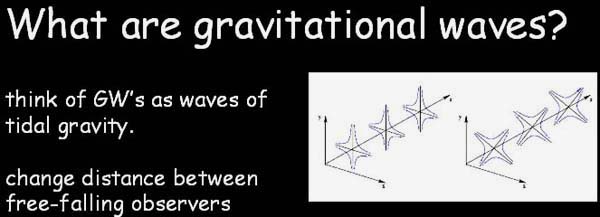
time into several separate sections or pieces. A massive gravity
wave was likewise portrayed at Etchilhampton Hill on August 15,
2006, showing the characteristic four-lobed "quadruple" structure of
a travelling space time vibration (see the LIGO website for more
examples).
Both crop pictures, from Etchilhampton HIll 2006 and Westwoods 2007,
were apparently meant to inform us that travelling gravity waves,
and their expected ability to shear Earth's local gravity-well or
space time, may be highly relevant to our short-term future, whether
in 2007 or 2012.
Some brief technical notes on the
"shearing"
of spacetime in Einstein's theory of general relativity
From Wikipedia:
-
"expansion scalar"
represents the tendency of any
spherical object to
expand or contract (spin
0 symmetry).
-
"vorticity
tensor" represents the
tendency of any
spherical object to
rotate (spin 1 symmetry).
-
"shear tensor"
represents the tendency of any spherical object to become
distorted into an ellipse (spin 2 symmetry).
"The
two spin-2 modes are transverse shear waves propagating at light
speed v = c."
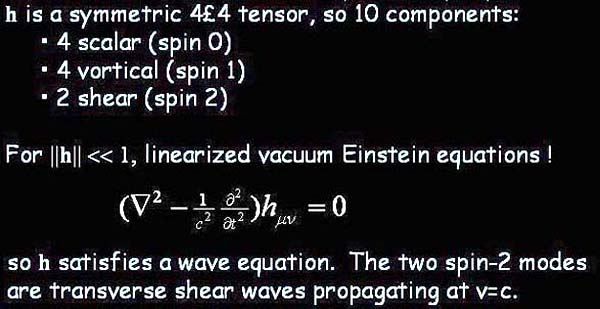
That is what an unknown crop artist
just showed at Westwoods. Evidently he or she is fairly
knowledgeable of advanced space time physics. Furthermore,
those two vibratory wave-modes of "shear" (see
attached diagram) clearly match the four-lobed shape of another
picture that appeared at
Etchilhampton Hill last August 15, 2006, that had "space
time gridlines" running all through it.
Red Collie |