|
 |
 |
|||||||||||||||||||||||||||||||||||||||||||||||||||||
 |
Images Steve Alexander Copyright 2005
Images Lucy Pringle Copyright 2005 Symbol of a Sun God By Allan
MacGillivray, III
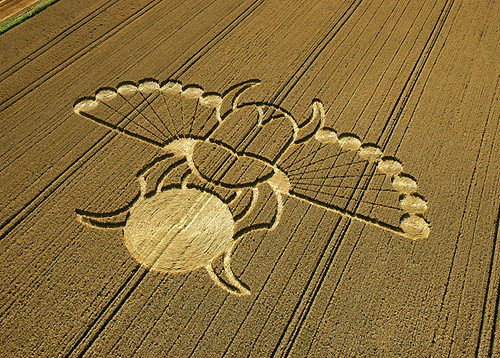
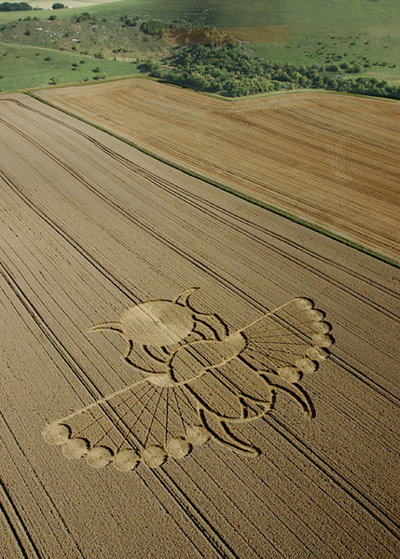
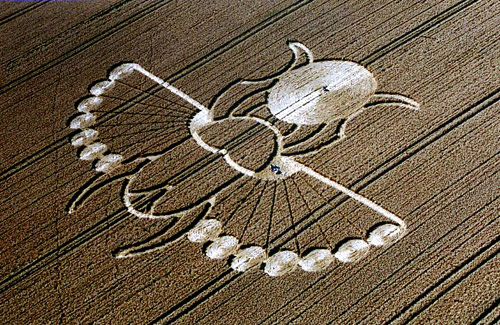
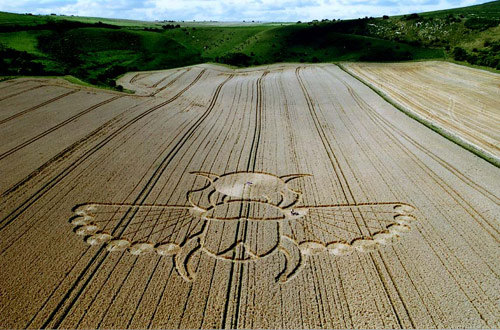
Stretched Image Tommy Borms Kephera: Scarab-Headed
Demiurge By
Michelle Jennings The scarab beetle, as a simple
creature, was thought to lay its eggs
in a ball of dung from which new scarab beetles
emerged. This
perception, and the vision of scarab beetles rolling
spheres of dung
along the ground, gave rise to the belief that the
scarab was able to
generate itself without the need for the interaction of
both
sexes---it was thought to be self-generating and
masculine. Rolling
the balls of dung was compared to the movement of the
sun across the
sky. The hieroglyphic shaped like a scarab carries a
meaning close to
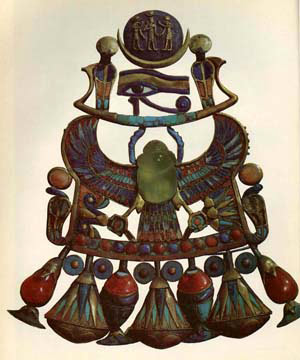
‘to come into existence by assuming a given form’. Kephera, the ancient Egyptian sun god
and demiurge, was attributed the
symbol of the scarab, and was depicted as a hawk-winged
scarab or a
man with the head of a scarab. He was thought to have
generated
himself before he created all other forms. By
association with the
sun and the creative impulse, Kephera represented the
initial spark of
creation, like the East Indian
Hindu.
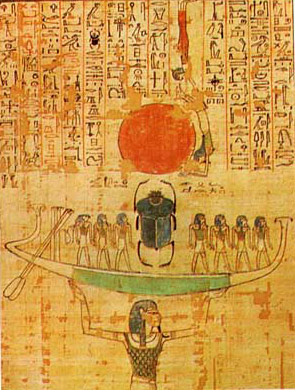
Kephera actually represented the
rising sun, who had just emerged from
the long dark night of the underworld. His travels in
the underworld
require the passage through 12 scenarios or Hours
representing varying
stages of dissolution,
transformation and final
re-emergence or resurrection as the Sun. He rules the
future of the
cosmos as well. He is related to the god Horus, whose
symbol is the
hawk, and also to the god Atum whose symbol is the ram
which is
sometimes used to depict Kephera as well. This
confusion of
representations can be explained by the different times
of day the
solar deities appear: Kephera at dawn after a deathly
night journey,
Re at high noon, and Atum as the setting sun who
then becomes Kephera
at the end of the night.
Scarab amulets were bound to mummies
over or inside the heart cavity
so that the deceased would be guaranteed a favorable
account of his
character and thus gain access to a resurrected and
renewed life. In
the Mediterranean region, scarab amulets were worn to
bring good
fortune. As a Christian symbol, the scarab is
representative of resurrection.
St.
Ambrose, Bishop of Milan (374 – 397 A.D.), gave Jesus
Christ the
title “The Good Scarabaeus”. The scarab is related to
the ladybird
beetle, symbolizing good luck, to the sign Cancer and
to the major
arcana card, The Emperor of the Tarot. In the Chinese
Taoist
tradition, the scarab represents ‘one who generates
himself’ or one
who is capable of autogenesis,
and also the idea of the perfection ( as
in an alchemical transformation) of what seems
imperfect (i.e. gross
matter in the form of dung). In Africa, in the Congo,
the scarab is a
lunar symbol of eternal renewal. The scarab is also associated with
the Cosmic Egg symbolized by the
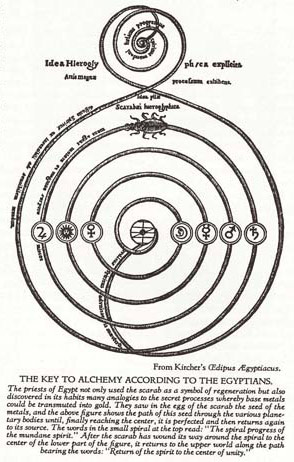
ball that the beetle rolls around. As a Western alchemical symbol, the
scarab has been associated with a
double spiral, moving from the completion of one onto
the other in an
eternal relationship of departure and return.
Western alchemy was apparently
bent on transforming base metals into
gold. In fact all the secret formulas etc. are really
symbolic of the
spiritual process of becoming an immortal, i.e. living
as an
enlightened being on Earth. The diagram of the beetle
following the
spirals of Earth and the planets in relationship to the
Sun is an
example of the thought involved in the process. The
words around the
smaller top spiral are: “The spiral progress of the
mundane spirit.”;
those following the path from the central Sun to the
return path to
Earth are: “Return of the spirit to the centre of
unity.” In this
system of thought,
Consciousness on Earth is
intrinsically tied to and
eternally generated by its relationship to the Greater
Consciousness,
the Sun, as are probably the energies of the planets in
our Solar
System as well. It cannot be denied that the message
of Kephera is that of a solar
deity which includes the ancient Egyptian gods, Jesus
Christ, and even
Eastern metaphysical philosophy. In some parts of the
world, this
symbol is also associated with the moon ,and even the
number of days
required to incubate the beetle’s eggs is 28–that of
the moon’s cycle.
In a way, both feminine and masculine principles are
included in the
symbolism, however they are parts of one whole (the
Androgyne) which
within itself creates new being. The concept of resurrection and life
after death is also intrinsic to
the symbol of the scarab. The alchemical significance
evokes some
kind of astronomical as well as material and conscient
process of
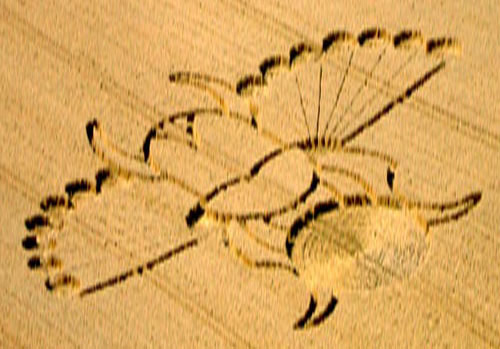
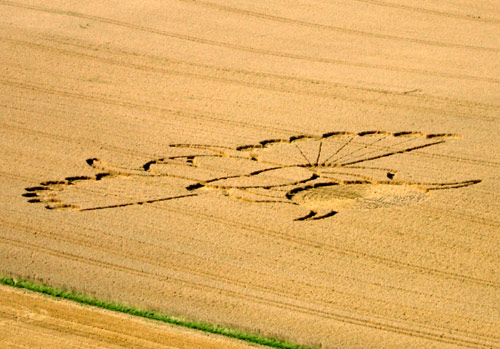
transformation. In fact, this image as a crop
formation, when we look at it in the
context of some of the other crop circles and
formations that have
appeared, brings immediate attention to the whole idea
of The New
Creation as a galactic event which invites Earth and
Her
self-reflective inhabitants into a new way of
existing–one which
requires a death to old paradigms, as Kephera must
travel the night
journey–before the resurrection and renewal of a new
life on Earth. The Mayan calendar crop formation of
last year refers to a date,
December 21, 2012 on which our Solar System will be in
direct
alignment with the Galactic Centre. This date is not
just any old
exciting astronomical date, but a critical point of
complete
Transformation of Matter–a hitherto unimaginable new
paradigm for life
on this Planet. The ancient Maya and Egyptians (among
others) have
anticipated this for millennia and have left enough
evidence of their
futurist thinking to help humanity in its present state
to make the
psychic shift towards the next step in our evolution. It has been about 225,000,000 years
since our Solar System has been in
this exact position in the Milky Way Galaxy; and about
26,000 years
ago when we entered alignment with Galactic Centre
(called Huhnab ‘Ku
by the Maya) where the full complement of photon rays
emitted from
that Centre impact Earth and the Solar System; we are
again entering
this alignment on December 21, 2012. The phenomenon of the crop circles
offers humankind a chance to
synthesize all the knowledge we have accumulated
through the ages and
are still pursuing in the form of mathematics, physics,
astrophysics,
biology, geomancy, computer sciences, astrology,
genetics, psychology,
etc. When seen from a holistic point of view, all this
seemingly
fragmented imagery, information and theory form an
elegant pattern of
interconnectedness and meaning for all on Earth. Is
this not enough
to augur some kind of new understanding of ourselves,
life and the
universe? Michelle Jennings Sources Dictionaries Cazenave, Michel, directeur. Encyclopédie
des symboles. Le livre de
poche. Paris.
1989. Chevalier, J. & Alain Gheerbrant. A
Dictionary of Symbols. trans. J.
Buchanan-Brown.
Penguin Books. London. 1996. Cirlot, J.E.. A Dictionary of
Symbols. Routeledge & Kegan Paul Ltd.
London. 1962. Cooper, J.C. An Illustrated
Encyclopaedia of Traditional Symbols.
Thames & Hudson.
London. 1978. Julien, Nadia. The Mammoth Dictionar
of Symbols. Robinson
Publishing. London.1996. de Vries, Ad. Dictionary of Symbols
and Imagery. North-Holland Pub.
Co. Amsterdam.
1981 (rev.) Tresidder, Jack. Dictionary of
Symbols:an illustrated guide to
traditional images, icons,
emblems. Chronicle Books. San Francisco. 1998. Walker, Barbara. A Woman’s
Dictionary of Symbols & Sacred Objects.
Castle Books.
Edison. 1988. Texts Arguelles, Jose. The Mayan
Factor: The Path Beyond Technology. Bear
& Company
Publishing. Rochester. 1987. Bruce-Mitford, Miranda. The
Illustrated Book of Signs & Symbols.
Reader’s Digest.
Montreal. 1996.
Casson, Lionel. Ancient
Egypt. Time-Life Books. New York. 1974.
Clow, Barbara Hand. The Pleiadian
Agenda. Bear & Company Publishing.
Santa Fe.
1995. Encyclopedia
of World Mythology. Galahad Books. New York. 1975. Hall, Manly P. The Secret Teachings
of All Ages. The Philosophical Research Society,
Inc. Los Angeles. 1977. Hart, George. Egyptian
Myths. British Museum Press. London. 1999. Ions, Veronica. The World’s
Mythology in Colour. Hamlyn Publishing
Group Ltd.
London. 1974. Lawson, David. The Eye of Horus: An
Oracle of Ancient Egypt. St. Martin’s Press.
New York. 1996.. Stevens, Anthony. Ariadne’s Clue: a
guide to the Symbols of
Humankind. Princeton
University Press. Princeton. 1999. Van Over, Raymond, ed. Sun
Songs: Creation Myths from Around the
World. The New
American Library, Inc. New York. 1980.
The Farmer has requested the public to keep to the tramlines and DO NOT
Images CCC Copyright 2005
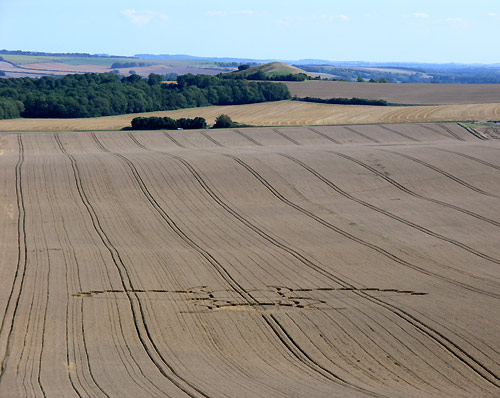
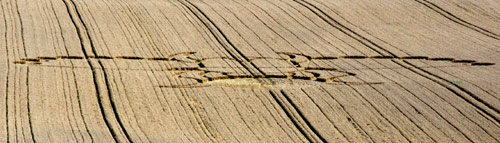
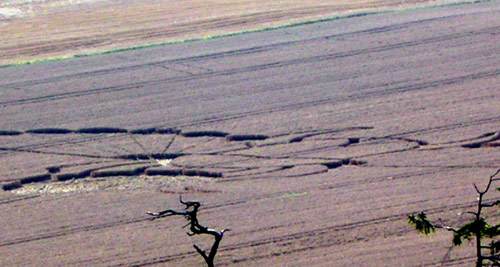
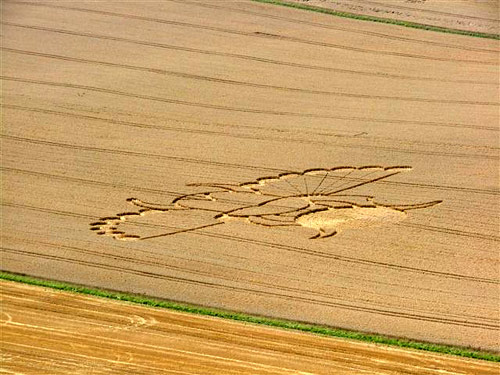
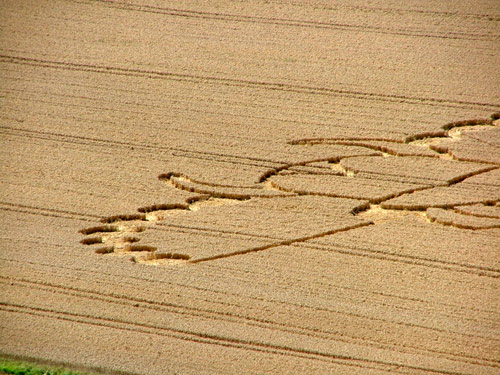
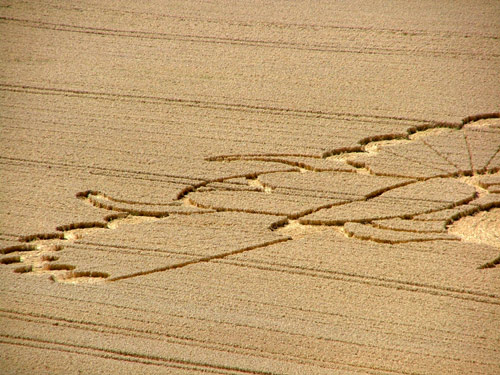
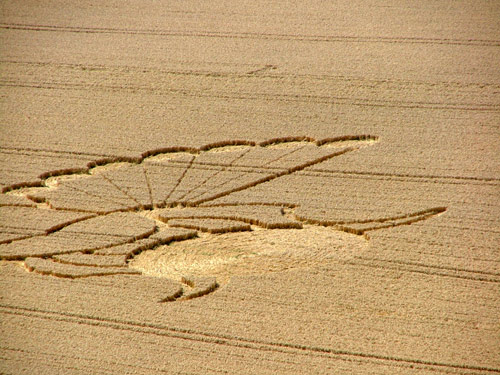
Image Tudor Georgescu Copyright 2005 I was hoping to report a
circle I sighted while camping at Knapp Hill, Wiltshire. It has the
shape of a winged scarab, and I have attached here a picture I took of
the formation. Images Richard Swiderski Copyright 2005 6am Sunday 21st
august 2005 Early Morning Of
21/8/05 21st AUGUST 2005
Discuss this Crop Circle on the Forum
|
|
|||||||||||||||||||||||||||||||||||||||||||||||||||||
 |
|
|
|||||||||||||||||||||||||||||||||||||||||||||||||||||