|
|
|
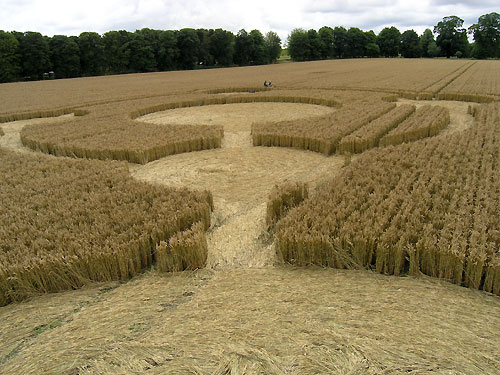
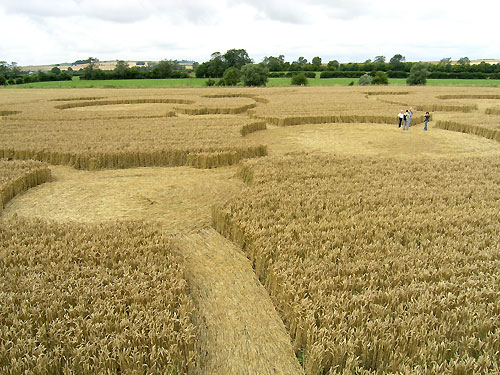
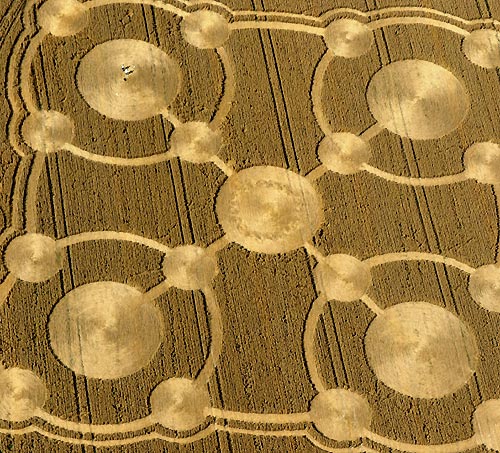
Avebury Manor, nr Avebury, Wiltshire. Reported 27th July.
Map Ref:
Updated Tuesday 11th October 2005

|
|
|
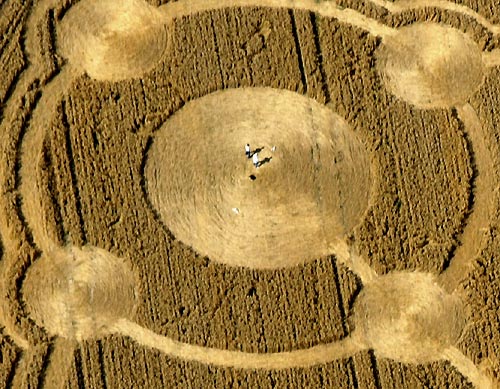
Images CCC Copyright 2005
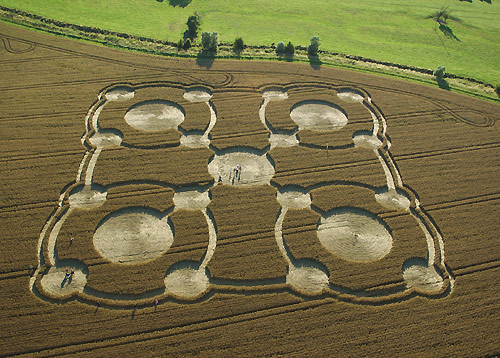
Image Steve Alexander Copyright 2005
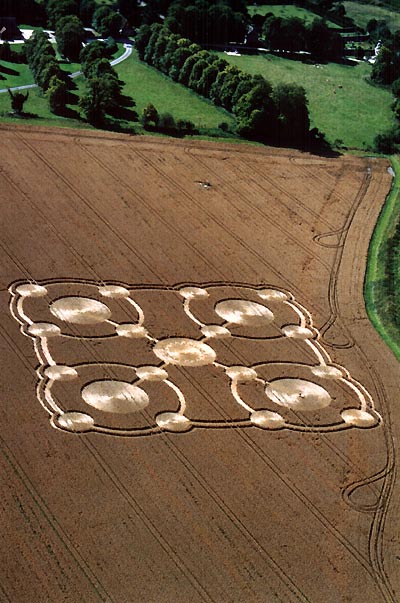
Image Annemieke Witteveen Copyright 2005
Click on thumbnails to enlarge
Image CCC Copyright 2005
|
More
amazing information on Avebury Manor and its 19 mini-circles
Contrary
to contemporary myth that people
of the Stone Age were primitive and savage, they were actually
an organised society of intelligent people who had much experience
and knowledge in terms of technology and engineering;
and highly adept astronomers with
a great system of spiritual and religious
beliefs.
For
example, one important problem in stone-circle astronomy concerns the
19-year "metatonic" cycle of the Moon. As seen from a fixed point on
Earth, the Moon shows an identical phase (full, crescent or new)
once every 29.531 days, but an identical location relative to
background stars once every 27.322 days.
Now
once every 19 years or 6939.75 days, those two periodicities of
29.531 or 27.322 coincide, after 235 or 254 cycles respectively. This
is apparently the astronomical event symbolized at Avebury Manor, which
shows 19 minicircles in its central part.
The
earliest historical record of that lunar cycle seems to come from ancient
Ireland around 3000 BC. There a special "calendar stone",
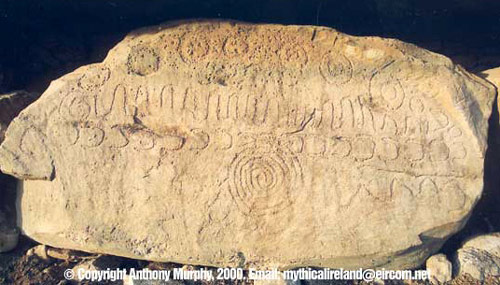
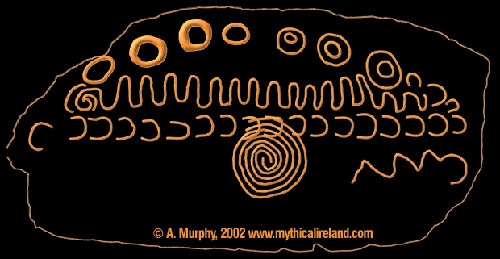
(Figures 1
and 2)
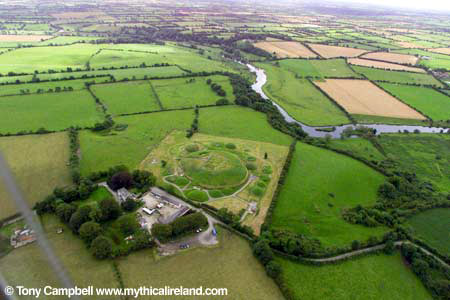
(Figure 3)
was carved
at Knowth showing an approximate version of the same thing.
Thus 29
crescent or circular-shaped marks along the left, top, and lower
horizontal row of that stone represent approximately the number of
days between identical lunar phases. Meanwhile, 31 "sine wave" minima or
maxima along its upper horizontal row tell how many lunar phases
it takes to match an integral number of Earth years.
Counting in terms of 360-day years (like Aztec-Mayan), one finds that 31
x 29 = 899 days or 2.50 years, while 2 x 31 x 29 = 1798 days or 5.00
years. Other examples of lunar astronomy may be found in the Boyne
Valley, where a number of stones are
aligned on "lunar
standstills".
Early astronomical sites such as Knowth
and Newgrange were built according to legend by the tall, fair-haired Tuatha
de' Danaan. Somewhat later, the dark-haired
Celts arrived in Ireland
from Spain. Finally, the 19-year cycle
of the Moon, known approximately since 3000 BC, was subsequently
re-discovered by the Greek scholar Meton, by whose name it is now known
(adapted from the website shown).
By showing us these ancient
astronomical relations in the format of a crop pictogram, the "artist"
seems to be reminding us of important ancient history on Earth, which we
seem to have forgotten.
C. Lewis
|
Reconstruction of the
2005 Avebury Manor formation
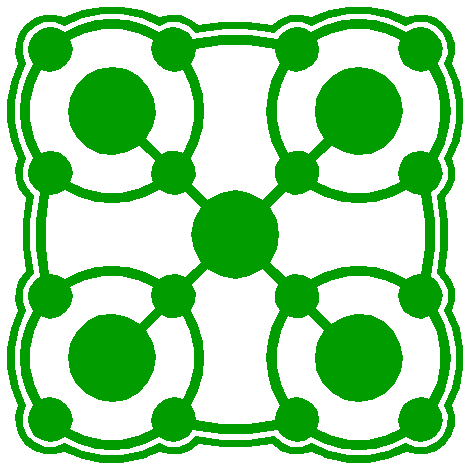
By Zef Damen.
Field Report for Avebury Manor July
28th, 2005 by Mike Callahan
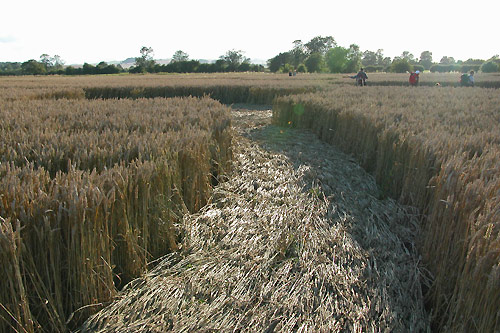
My report was carried out on the afternoon of July
28th. The rain had subsided and the sun was shining again.
As I approached the formation I was really taken
aback by the sheer magnitude of it. I spent a while trying to work out
the shape but it was extremely difficult to do so, all I know is that
it is very impressive and the aerial shots should prove to be awesome.
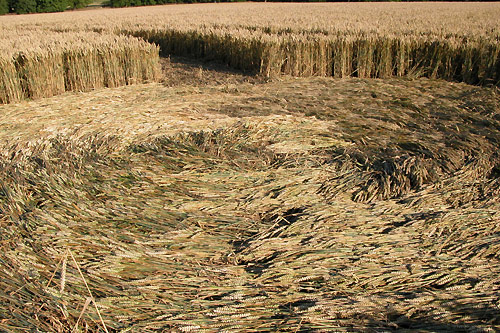
The lay seemed very natural and fluid throughout
this formation. Corners were smooth and the crop seemed to flow like
water. This was much more the case than a few others I’ve been in
recently. There were some standing stems still upright but mostly the
crop was downed. (Rain and/or visitors?).
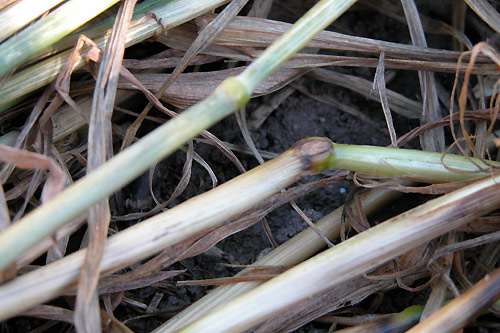
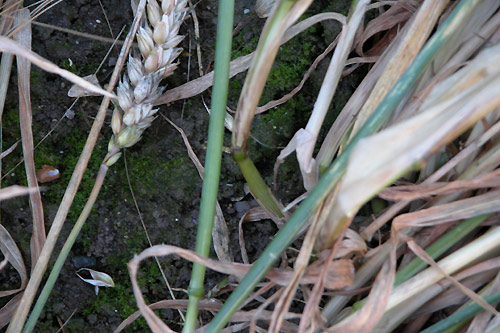
On to the nodes. I found many examples of nodal
bending throughout the formation. These were away from the original
tram lines. I found them in clumps as well as in isolation. I must say
though that they were also present in the immediate vicinity of the
formation. i.e. in the standing crop between the downed crop. On
exiting the field I checked the nodes away from the formation and there
didn’t appear to be bending to the same extent. Regarding node
elongation and expansion I feel I didn’t have enough time to make a
fair comment. I found no expulsion cavities.
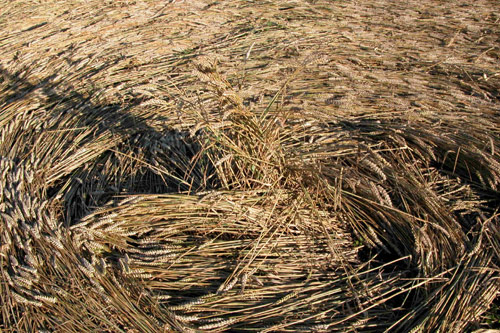
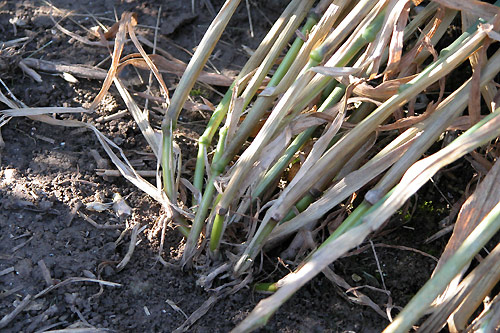
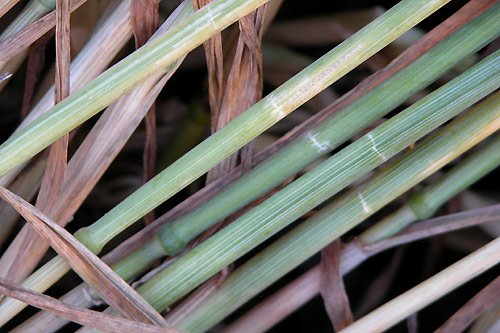
I would like to show a close-up of some crop that
appeared to be ‘virgin’ crop i.e. it had not been walked on and was
resting on the side of the formation. There are marks on the crop that
could be attributed to something of a mechanical nature. However, it is
important not to jump to conclusions. Although there were other
examples of these marks they tended to be where people had walked and
they could have been caused by shoes. The marks were not consistent
throughout the formation (and I did look thoroughly) but they were
there. I do not claim to be an expert on these matters but this is what
I found and I will leave it up to others who are more experienced in
these matters to comment.
Click on Thumbnails to enlarge
I enjoyed my time at this formation. As usual I met
people from different countries and we had a chat. I bumped into ‘Bill’
who is so generous in sharing his knowledge and opinions with me. (Not
to mention his steps!). I look forward to seeing an aerial shot of this
formation!
© Photographs Mike Callahan
|
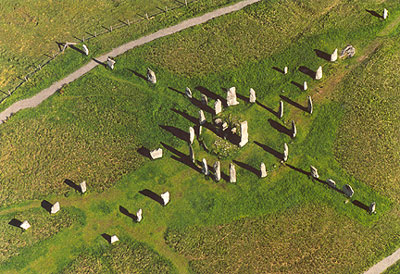
A "Celtic Cross" symbol was used in paleo-astronomy
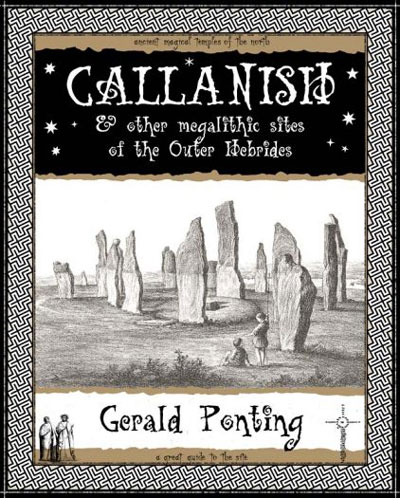
long before the birth of Christ. See for example a photo of Callanish
as attached, where most of the stones were laid out in the form of
"Celtic Cross" around 2900 BC, to measure astronomical positions of the
Sun and Moon.
In that context, the Avebury "Celtic Cross" of July
27 might refer to an upcoming astronomical event: namely a "lunar
standstill" which can be seen from Callanish or possibly Avebury, once
every 19 years. The next time will be on July 11, 2006, one year after
the crop formation was made.
>Did anyone check East-West-North-South alignment of
its four arms?
When compared to Callandish, the crop formation
shows an extra "planet-moon" at the end of each arm, further suggestive
of Earth-Moon orbit.
2006 LUNAR STANDSTILL AT CALLANISH
Due to the northern latitude of the British Isles, especially at the
stone circle of Callanish, on the Isle of Lewis in the Outer Hebrides,
an amazing phenomenon may be seen.
In March and September 2006, the Moon will reach its most southerly
declination. The most impressive viewing will be the full moon of July
11, 2006.
Then we should see the full moon rising out of
"Sleeping Beauty" in the Parc Mountains, skimming the horizon, and
setting in the stone circle of Callanish. This is a rare phenomenon
happening only once every 18.6 years.
Horace.Drew |
NEXT
|
|
 |