Construction and meaning of the crop circle Burrow
Hill Fort Rock Lanenr Corley Warwickshire England, 11th July
the 2012.
First Step of the construction
We see two 12-gon. The inner 12-gon is divided into
12 segments. The segment Z-F-C is the same as C-M-D. So 6 of the 12-gon
segments have been set in the outer 12-gon.
Let say the outer 12-gon has
circum radius
1. Than the area is 3. And 3 is the diameter of a circle true the small
spot outside of the circle.
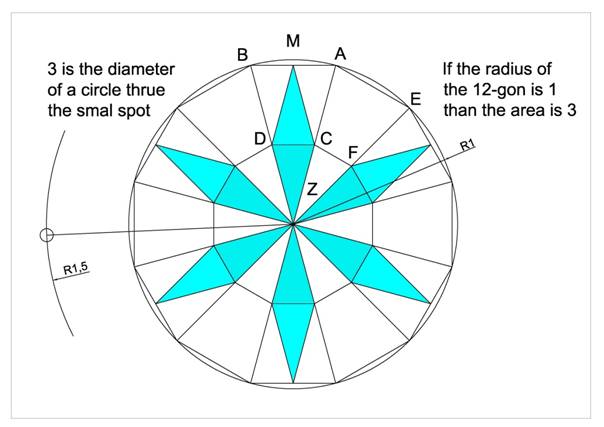
Abbildung SEQ Abbildung \* ARABIC 1
The colored area, the 6 folded star is ¼ of the big
12-gon. One Segment of the 6 folded star is 1/24 of the big 12-gon.
(Same areas are Z-C-D, C-A-M, C-M-D, D-M-B and C-A-B-D, F-E-A-C)
One can see that the outer point of the 6 folded star
is on the inner circle of the 12-gon.
Construction of the circles.
Phase I (see figure)
The inner circle and the outer circle of a
equilateral triangle has the proportion 1:2. I have set the inner
diameter to 1.
Phase II (see figure)
Put a square in to the inner circle and set an
equilateral triangle on it. The top point of the triangle is on the
inner circle of the double outer circles.
Phase III (see figure)
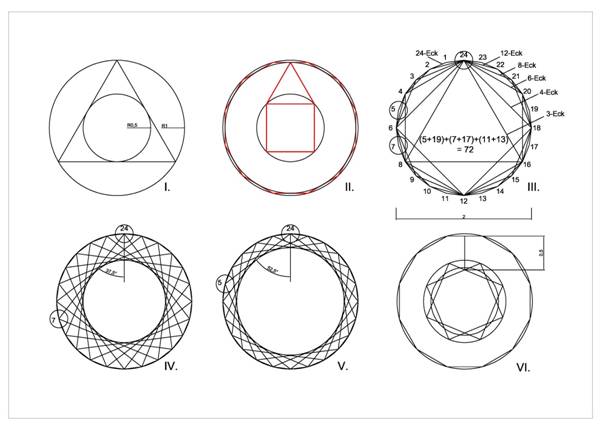
Abbildung SEQ Abbildung \* ARABIC 2
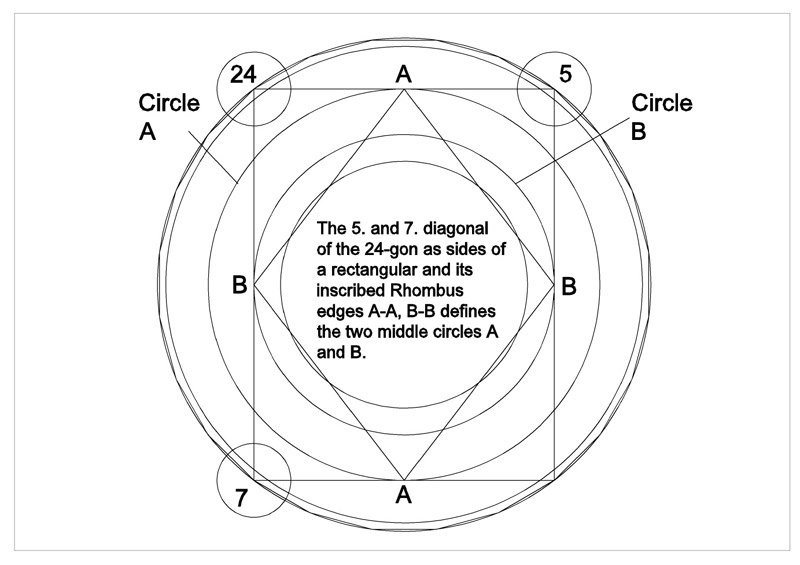
Construct a 24-gon and number the edges as shown.
Than you can set the following polygons in it.
An equilateral triangle, a square, a hexagon, an 8-gon, a 12-gon.
Now the following edges are free: Edge 1, 5, 7, 11,
13, 17, 19, 23. We discuss it later.
The sum of those primes are 48.
Phase IV and V (see figure)
Set a line from point 24 to the free points 5 and 7.
I have set all those lines. The inner circles are those, used for the
crop circle.
Phase VI (see figure)
This is a second kind to construct the circle shown
at Phase IV. The calculation of the diameters are very complex. The
quotient of the two lines (24-7)/(24-5) is
tan(52,5°)=1+(sqrt(3)-1)(sqrt(2)-1). This is not a very useful
mathematical expression.
But is shows the two numbers sqrt(3) and sqrt(2) and this is interesting
in an different sense. Thereto only a short sketch following.
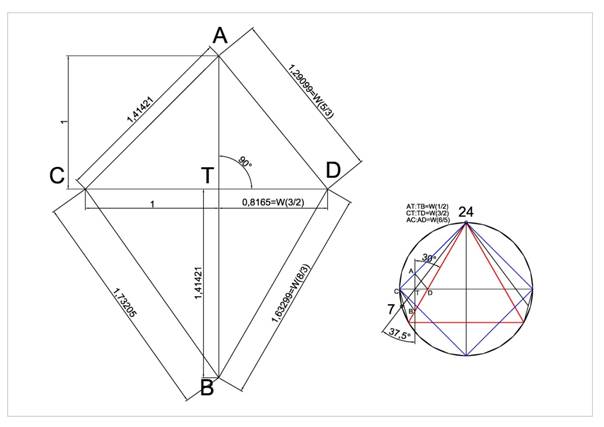
Abbildung SEQ Abbildung \* ARABIC 3
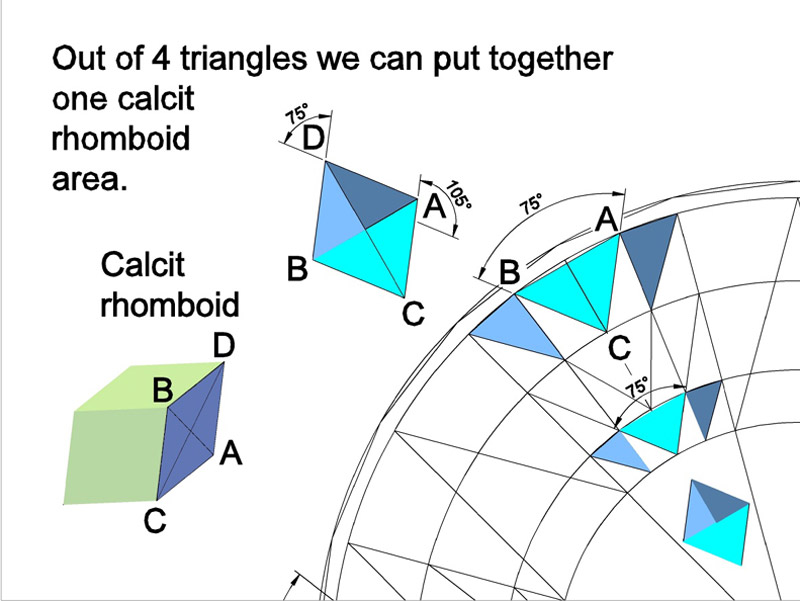
The angle one of the 72 triangle it has the angle 30°
and 37,5°, as shown at the sketch. The line 24-7 divides the horizontal
and vertical lines between the triangle and the square in an interesting
way.
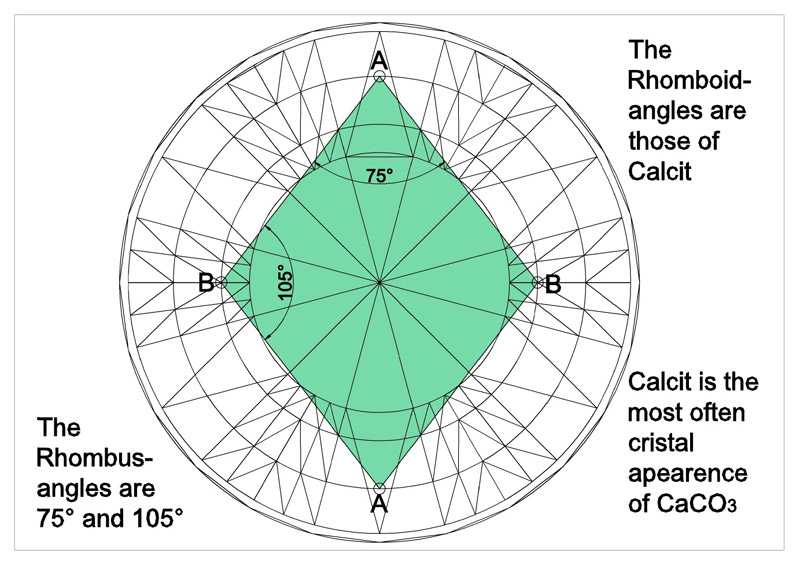
The next picture shows
72 triangles. At the right side you can see the edge numbers which are
used for the two middle circles. This edge numbers are tree twin prime.
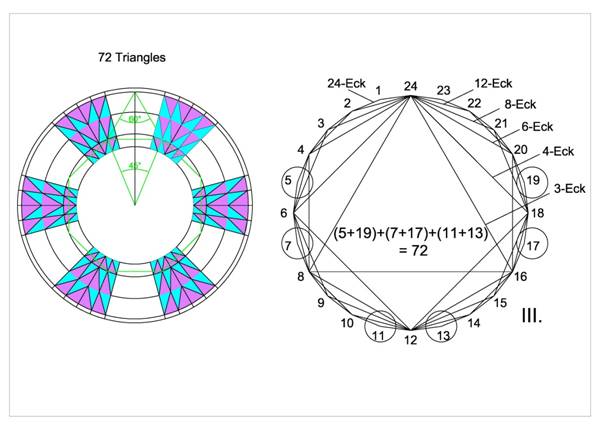
Abbildung SEQ Abbildung \* ARABIC 4
The sum of those three twin primes is 72. This is a
hint of Holger Ullmann (http://www.tetraktys.de)
Any prime is of the form 6n+1 or 6n-1 (if n is an
integer). Therefor all primes are beside the cross points of the 24-gon.
It is at the point 6, 12, 18 and 24.
Each squared prime number minus 1 is divisible by 24,
if the prime is larger 3
5 · 5 – 1 = 24 = 1 · 24
7 · 7 – 1 = 48 = 2 · 24
11 · 11 – 1 = 120 = 5 · 24
13 · 13 – 1 = 168 = 7 · 24
17 · 17 – 1 = 288 = 12 · 24
19 · 19 – 1 = 360 = 15 · 24
...(
Holger Ullmann)
The mathematical proof by Werner Brefeld (http://www.brefeld.homepage.t-online.de/teilbar-24.html):

p-1, p, p+1 are tree
successive
numbers and one of it must be
divisible
by 3.
P can not be
divisible
by 3 because p is a prime greater than 3. Therefor p-1 or p+1 must be
divisible
by 3
p is a prime and an odd number therefor P-1 and p+1
must be
divisible
by 2. Every second number which is
divisible
by 2 must be
divisible
by 4. Therefor (p-1)(p+1) must be
divisible
by 8.
A number which is
divisible
by 3 and 8 is also
divisible
by 24, because 3 x 8 = 24
QED.
The cross totals of the Fibonacci numbers repeated
every 24 times.

21.12.2012
Willibald Limbrunner |