|
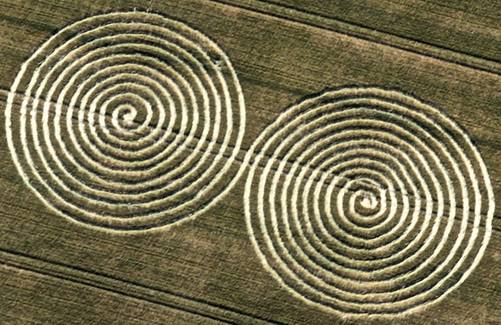
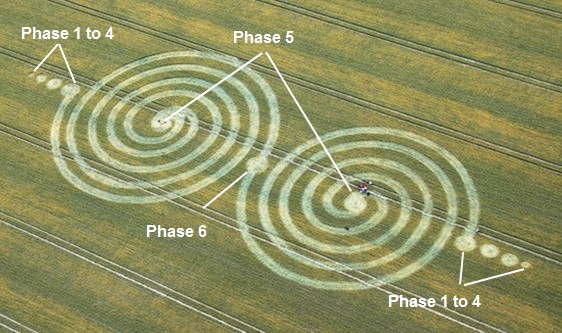
Chaddenwick Hill,
nr Mere, Wiltshire. Reported 13th July.
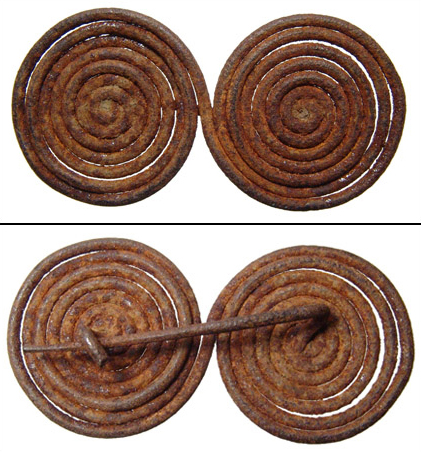
Ancient Celtic iron
"spectacle" or Brillen type fibula
Huge Celtic fibula / toga pin, c.10th - 8th Century BC.
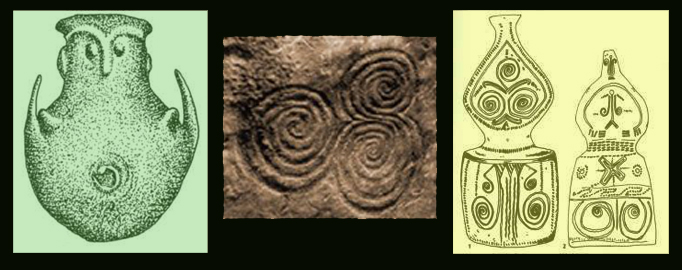
Spirals, double spirals
In
order to reveal the multi-dimensional symbolic meanings of the previous
spirals, a brief survey is given below about the general symbolism of
spiral curves.
The
spiral forms play universal and complex roles among traditional and
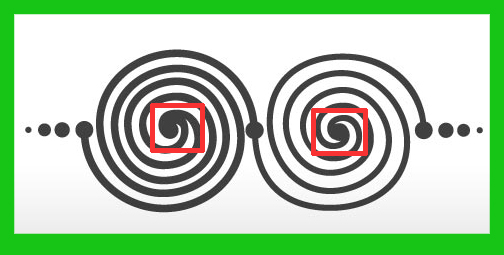
religious symbols. In figure A2/7, a simple (Archimedean) spiral and a
double spiral are shown.
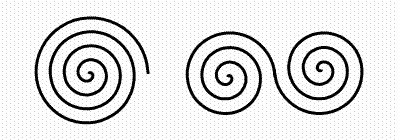
Figure A2/7. Simple and double spiral
These and many similar forms primarily represent the following subjects:
-
In general:
-
way, route: lines of movement
-
power, force: motive power/force
-
spirit, breath, breathing
-
time: cycles and periods (eras, solar year,
lunar month, day)
-
coiling outwards: creation, birth, growth,
development – evolution
-
coiling inwards: withdrawal, contraction,
completion, death – involution
-
Double spirals: two simple spirals of opposite
character (left- and right-handed, coiling in- and outwards),
connected to each other at one or at both ends:
-
unity of opposite powers: action and reaction
-
transition, transformation, inversion
-
space and time: motion in space.
-
Spatial (three-dimensional) spirals:
-
the axis of the world
-
connection between earth and heaven
-
the path to God
-
Decorative elements: all over the world, similar
to other traditional symbols, spirals often occur as ornamental
motifs. They have been known since prehistoric times, and are also
used on objects of different kinds in the present day.
In
China, the spirals, particularly the double spirals, are among the most
widely known and most important symbols. Their origin goes back to the
mythical era: spiral motifs have been found on carved stones and
earthenware from the 3rd millennium BC, and from even before that time.
More discoveries of painted pottery came from excavations in the
vicinity of An-yang, dating from the 14-12th century BC [Bulling: p.
161]. Double spirals of the S-form type also occur in ancient
ideography, forming different ideographs [ibid.].
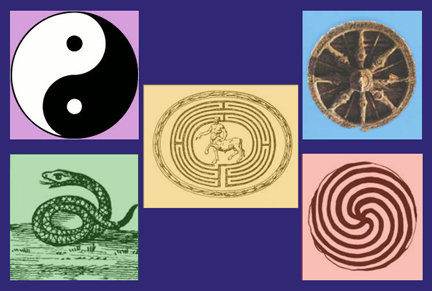
The
most frequently used double spiral can be seen, however, in the
well-known yin-yang (taiji) diagram, as the boundary line between its
two halves (figure A2/8).
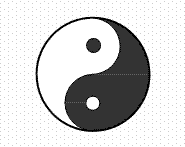
Figure A2/8. The yin-yang (taiji) diagram
It
is worth noting what the views of several philosophers are on this
matter.
-
"The double spiral represents the completion
of the sigmoid line, and the ability of the sigmoid line to express
the intercommunication between two opposing principles is clearly
shown in the Chinese Yin-Yang symbol." [Cirlot: pp. 306-307].
-
"From a cosmic point of view, the double
spiral may be regarded as the flattened projection of the two halves
of the egg of the world, ... or of the Upper and Lower Waters."
[ibid.].
-
"This double spiral ... which can be regarded
as the planar projection of the two hemispheres of the Androgyne,
offers an image of the alternating rhythm of evolution and
involution, of birth and death." A citation from Elie Lebasquais
[in Guénon: p. 31].
-
"The two spirals can be considered as the
indication of a cosmic force acting in opposite direction in each of
the two hemispheres, which, in their broader application, are of
course the two halves of the 'World Egg', the points around which
the two spirals coil being the two poles." [Guénon: p.31-32].
An
important conclusion can be drawn from the above citations:
The yin-yang diagram is an analogous, two-dimensional
form of the World Egg (the 'cosmic egg', or the primordial 'Androgyne').
This
idea was directly expressed by Guénon, in the following words: "It
[the yin-yang diagram] is also, according to another and more general
traditional symbolism, the 'World Egg'; whose two halves, when they
separate, become Heaven and Earth respectively." [Guénon: pp.
29-30].
According to the analysis of the Yi-globe (see:
Ch. III), the yin-yang diagram may
be its planar representation. Assuming this analysis and the above
statement are correct, another conclusion can be formed:
The Yi-globe is also an alternate form of the World
Egg. Its lower and upper hemispheres correspond to the two halves of the
latter.
These latter statements clearly express the close relationship between
the Yi-globe and the other universal symbols of macrocosm (yin-yang
diagram, World Egg). The presence of the spiral forms in Chinese
tradition and the meanings of these forms yield new arguments in support
of the method of the reconstruction of the Yi-globe in the field of
force between the two primal powers (see:
Ch. II). Also, the occurrence of different spirals as new, complex
symbols, such as the 'way of enlightenment' and the forthcoming
'Yi-spiral' and 'Yi-circle', are not strange or unusual events in
Chinese culture.
It
is necessary to mention snakes or serpents again here, as they are among
the spiral forms, and are frequently shown in the different symbols,
coiled around themselves, and thus forming a spiral. In figure A2/6.b a
spherical spiral can be seen on the surface of the Yi-globe, ascending
uniformly from the beginning to the end. If this spiral were replaced by
a serpent, and the Yi-globe considered the World Egg, a well-known
symbol could be reproduced: the serpent surrounding an egg, which is the
symbol of the creation of the world in many traditions (see: e.g.
here).
There is yet another interesting opinion in connection with the meanings
set forth above. As J. E. Cirlot demonstrates, the spiral is also
associated with the idea of dance, "and especially with primitive
dances of healing and incantation, when the pattern of movement develops
as a spiral curve. Such spiral movements may be regarded as figures
intended to induce a state of ecstasy and to enable man to escape
from the material world and to enter the beyond." (my italics) [Cirlot:
p. 306].
Note: This idea may have some relation to the 'Pace
of Yu', i.e., with the stories of the strange, hopping gait of Yu the
Great, the legendary founder of the Xia Dynasty (c. 21st cent. BC).
There is a reference to the Pace of Yu as a dance, for example, in the
book of S. Little who quotes Yuan Miaozung (early 12th cent. AD) as
follows: "The Pace of Yu is a Taoist ritual dance, named for the
mythic emperor Yu ... The dance serve many functions, including exorcism
and purification." A diagram illustrates this dance, the last phase
of which goes around the North Star in the form of a contracting spiral:
three turns go clockwise and then, after a turn of 180 degrees, a fourth
one goes counterclockwise. [Little: p. 200].
The double spiral arrangement of the hexagrams – The Yi-spiral
The
Yi-globe itself is a rather complicated form, but taking its complex
symbolism into consideration, it is still the best solution possible to
convey all the knowledge about the hexagrams and about their roles in
cosmology. With the double spiral on its surface, however, the whole
structure has become much more complicated; it can no longer be
represented in the usual ways.
To
make things simpler, one has to prepare the planar projection of this
three-dimensional spiral and to set the two halves next to each other
and, then, to place the hexagrams on them in their proper positions.
This form will be called Yi-spiral, on the analogy of the Yi-globe
(figure A2/9).
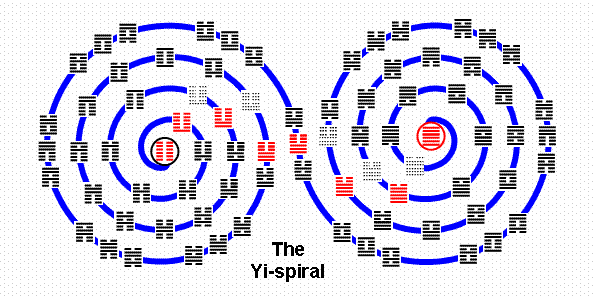
Figure A2/9. The Yi-spiral
This
diagram contains all the 54 hexagrams that are on the way of
enlightenment, on the surface of the Yi-globe. Aside from this, it has
preserved all the symbolic meanings which were enumerated above, and
were present in the three-dimensional variant.
This
arrangement also has quite a few qualities that are characteristic
features of the Yi-globe: the presence of the two poles and their
opposite characters; the direction of development (starting from the two
poles); the circular and cyclic arrangement of the hexagrams; and the
indication of the movements (the changes) and time, etc. Some important
features however, are missing: First of all, those properties that
originate in the spatial form: the sphere itself, the axis and the
center, the hexagrams inside the sphere, and some others as well.
Nevertheless, considering the form and meaning, the Yi-spiral can be
taken not only as the 'way of enlightenment', but as a new, expressive
arrangement of the hexagrams, and as the symbol of the manifested
universe. The two hexagrams of Completion (hexagram 63 and 64) and the
eight doubled trigrams do not have worldly manifestation, and so, they
are separately shown as 'pivot hexagrams' (see figure A2/5).
The
spiral of the 'way of enlightenment' can also be associated with snakes.
Looking at figure A2/5 from above, a form can be seen, which is similar
to a snake coiling around itself in two opposite directions (figure
A2/10).
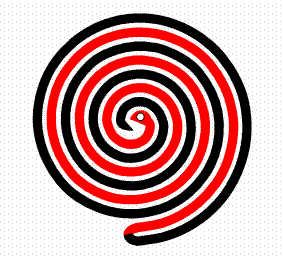
Figure A2/10. Snake in the form of a double spiral
This
picture represents the same as figure A2/5. In the center, the tail and
the head are the two poles, the Receptive and the Creative,
respectively. The black, outwards winding spiral is the evolutionary
phase of development, and the red, inwardly winding half stands for
involution. The transition from one phase to the other goes unbroken.
Besides of this symbol, two other variants can be easily formed, also
relating to this subject.
-
a.) If the snake were shown with his tail in the
mouth, as if swallowing it, it would be an 'ouroboros', representing
the 'eternal return', the eternal circulation. The meaning of this
symbol is that after attaining complete enlightenment, one can be
united with the Supreme Ultimate in the Center, and then, according
to his will, be reborn to the Earth.
-
b.) A snake with two heads, that is one at the
tail end as well, is an 'amphisbaena'. In such a form the two heads
correspond to the two poles and the two directions of the opposite
forces, making it a rather cosmic symbol.
A
special double helix – The Sun-line
A
double helix is a spatial curve that consists of two (typically
congruent) helices with the same axis, differing by a translation along
the axis. In science, this is commonly known as the structure of nucleic
acids such as DNA, and RNA [Wikipedia: helix]. In symbolism, however,
the two helices coil in opposite directions around a (vertical) axis or,
when they are shown in the form of snakes, around each other. Their
symbolic meaning is usually the same as that of the planar double
spirals: duality, complementary opposition, movement, power, etc.
An
example of the double helices is the two 'nadis' ('ida' and 'pingala')
or subtle currents, known in traditional Indian medicine and yoga; they
coil around the 'sushumna' nadi, the central canal of the subtle body.
Another such a configuration is the two serpents of the 'caduceus' (the
'wand of Hermes'). Fu Xi, who is well-known by all the readers of the I
Ching, can be seen in ancient pictures in a similar form, coiled
together with his wife (and/or sister) Nuwa (see: Wikipedia,
Fu Xi).
The
Sun-line on the surface of the Yi-globe was already analyzed in Chapter
III (figure 26). As it can be seen, it is composed from two parts. Each
part is a single turn of a special helix; a left-handed one on the front
(East) side of the globe, and a right-handed on the back (West) side.
They are mirror copies of each other, and interconnected at the end
points of the axis, forming a loop around it (figure A2/11).
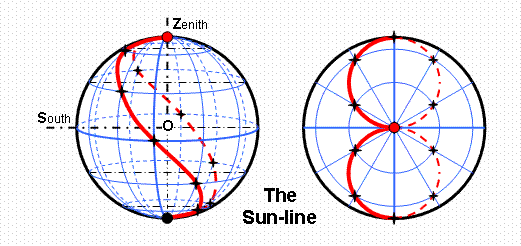
Figure A2/11. The Sun-line on the Yi-globe. Perspective and top view
These helices are very special indeed. None of them have a central axis
- they are curved around a hemisphere - nevertheless, their top view is
a circle (see the figure above).
Note: Applying spherical coordinates, the equations
of the two spirals are very simple:
r = R, and Θ = φ on the front side, where [0 ≤ φ ≤ Π], and
r = R, and Θ = 2Π - φ on the back side, where [Π ≤ φ ≤ 2Π].
Here the basic plane of the coordinate system is the equatorial plane,
the azimuth reference line goes to the South, and R is the radius of the
globe; r, Θ (inclination), and φ are the spherical coordinates.
It
has already been demonstrated that the Sun-line represents the cyclic
character of time and the visible annual motion of the Sun on the sky.
On the basis of the present references to the double helices, it is easy
to see that the Sun-line also represents the field of force between the
two opposite powers, the Heaven and the Earth, where the elements of the
universe have been manifested. Moreover, they also apparently show two
paths: one from earth to heaven, and another in the opposite direction.
In this way, this loop indicates a route of circulation that is,
considering the symbolism of these paths, an ouroboros; this is another
route of the eternal return (figure A2/12).
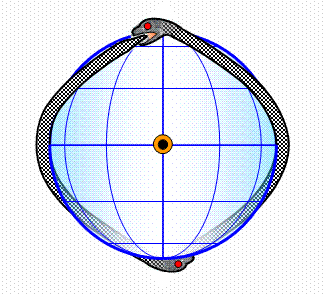
Figure A2/12. The circle of the eternal return – The Yi-ouroboros (view
from South)
Summarizing the contents of the present addendum, the first sentence of
the statement (9) from the end of chapter III (The Analysis) is repeated
here:
The Yi-globe embraces all the cardinal metaphysical
symbols of the peoples of the world, thereby also revealing that the
hexagrams and the I Ching — apart from being unique Chinese creations —
form an integral part of our universal tradition.
This
statement has already been confirmed in this chapter. In addition, some
other universal symbols – spirals of different kinds – though previously
hidden within the structure of the Yi-globe have been henceforth
revealed. Their symbolism may be considered a new contribution to the
material of knowledge regarding the I Ching. The Yi-spiral, this new
arrangement of the hexagrams, might well serve as a subject of
contemplation.
References:
-
BULLING, A: The Meaning of China's Most Ancient
Art. E.J. Brill Pub.1952.
-
CIRLOT, J. E., et al.: A Dictionary of Symbols.
Philosophical Library. 1990.
-
CLEARY, Thomas: The Taoist I Ching –
Introduction. Shambhala, 1986.
-
GUENON, Rene: The Great Triad. Sophia Perennis,
2002.
-
LITTLE, Stephen; EICHMANN, Shawn: Taoism and the
Arts of China. University of California Press, 2000.
Graham Russell |