|
LANDSCAPE GIANTS

STARGATE LAND OF THE JAGUAR, LION
Leo constellation
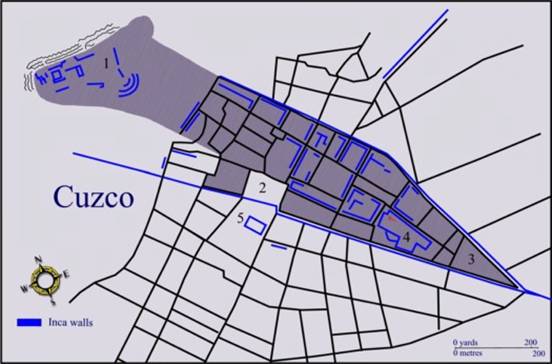
Fig. 100. The City
of Cuzco in the design of the Constellation of Leo the Lion. This
landscape lion 'giant' at Cuzco is one of many giants that forms part of
a large landscape zodiac 'landscape calendar' found in the surrounding
landscape.
The city of Cuzco was
the capital of the Inca Empire in the 15th and 16th centuries. It lies
at the western end and head of a small but fertile valley on the eastern
slope of the Peruvian Andes at just over 11,000 feet. The Inca capital,
the form of which is partly preserved in the colonial layout, had a
modified rectangular grid plan, each block being occupied by an
inward-looking compound called a cancha. The Temple of the Sun was the
oldest and most sacred of Inca shrines. It stands on a levelled piece of
ground between two stream valleys.
The other important area
of Inca ruins is on the hill (head of the Puma) to the north of the
city. The principal structure on the hill is the fortress of
Sacsayhuaman. This occupies a ridge overlooking the town. To the east of
Sacsayhuaman is the amphitheatre of Kenko, the site also of the tomb of
the great Inca Pachacuti. It is said that, in the Inca city plan, Cuzco
itself represented the body of a puma (an animal sacred to the Inca),
while Sacsahuamán formed its head and jaws. As illustrated in these
diagrams, (see Fig. 100-101.) the ancient Inca capital of Cuzco was
designed in the shape of a puma, their holy symbol of strength and
power; the outline is still visible at the heart of the modern day city.
Ramparts at the puma's head (1) held the fortified temple complex of
Sacsayhuaman; royal palaces and administrative and religious buildings
surround a huge plaza set in the puma's midsection (2); and noble
families made their homes in the Puma Chupan, or puma's tail (3), an
area located at the point where two rivers that had been turned into
canals flow together. The Golden Enclosure or Temple of the Sun (now the
monastery Santo Domingo) was the oldest and most sacred of Inca shrines
(4). The Plaza de Armas is the centre of colonial Cuzco (5), and stands
on part of the main plaza of the Inca city. Many of the principal
palaces and shrines stood in this area. It is interesting that the
Andean Legends of the Incas and other Andean peoples reports that their
beginnings began with giants. The chief Inca deity was Viracocha, the
primal creator. He created the first world and peopled it with giants
that he had made from stone.
While studying the City
of Cuzco in Peru, I rediscovered that people in the past have noted that
the city was designed and laid out in this shape of a huge Puma. So
while looking at an aerial view of the city of Cuzco, and marking out
this Puma which others had also marked out. I straight away noticed that
this puma did not look very realistic. It was then that I noticed that
the tail of this puma in the city plan was pointed, this then caught my
attention, because if you look at the sky constellation of Leo, you will
notice that the star Denebola which forms the tip of the Lions tail is
connected with two imaginary joining lines that connects to the two
stars Zosma and Chort (See Fig. 102.) These two joining lines form the
same angle as the two joining lines that form the tail of the Puma of
Cuzco. I then thought to myself that this Puma must be the South
American counterpart of Leo the Lion. So with excitement, I started up
my astronomical simulator (Redshift) on my computer, which is an
astronomical tool that is extremely accurate, detailed and highly
informative.
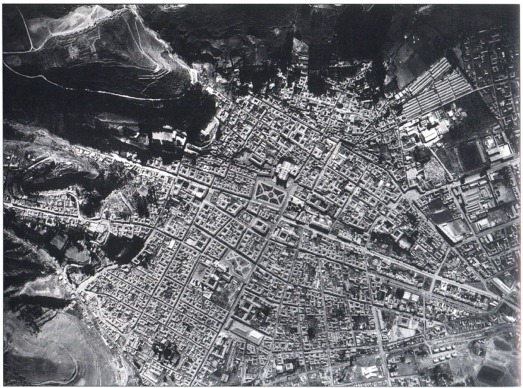
Fig. 101. Aerial
view of the city of Cuzco in southern Peru.
I then orientated myself
to the position of the city of Cuzco found in Peru, which is at
Longitude: 72' 0'W Latitude 13'31'S.
I then orientated the
sky to roughly the date of this city’s construction, which is believed
to have been built around the 11th and 12th century AD, so as to see how
the constellation of Leo looked on this date.
With the heavens now
overhead on my computer, I then proceeded to overlay the constellation
of Leo seen in the sky above Cuzco, to see how the constellation of Leo
would look while being overlaid onto the Cuzco city’s layout, and blow
me down; the stars and joining lines matched amazingly with the layout
of Cuzco city’s construction. The joining lines found in the sky
constellation of Leo are imaginary, but if you look at the Cuzco city
map, you will notice that the Canal River that forms the body and tail
of this Puma replicates these joining lines that form the constellation
of Leo. These lines join up to the stars Denebola, Zosma, Chort Adhafera
and eta Leo.
Have a closer look. It
was then that I realised that I had the size of this lion. While lining
up these lines that form the Canal River of Cuzco, with the lines that
form the constellation of Leo, I then noticed that ‘deep sky objects’
like Galaxies and Nebula fell directly over sacred sites that are to be
found replicated by monuments like churches for example. I am being
brief here, as this is absolutely amazing.
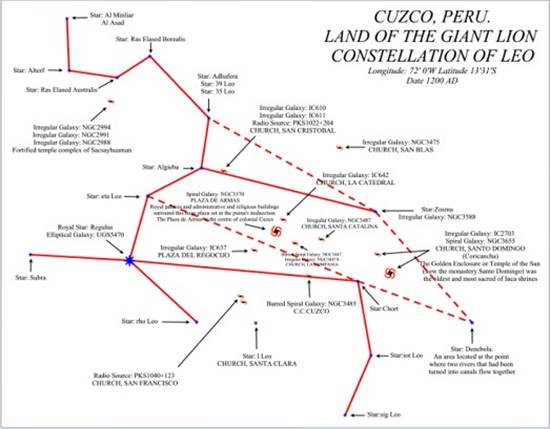
Fig. 102. Notice
that the dashed red lines form the canal route found in the Cuzco city
layout.
I have found that
all these sacred points (sites) within the Cuzco city plan are marked
with deep sky objects.
As we know, we do not
need to live in Greece, Rome etc, to rediscover the secrets of
mythology. Each country has its own mythology, but where ever we go in
the world we will find that all myths are but one and the same myth
‘story’ being retold over and over again.
It is recorded that the
Roads of Rome were remarkably similar to the Inca Highways and that many
of the roads of Rome and the Incas are now buried beneath the earth.
The Royal roads of the
Incas are said to have been highways to the stars and that these
travellers along the ‘highway of the stars’ are mentioned in all records
of past civilisations as the ‘gods’ who rode the starways in ‘flaming
chariots’.
What could this mean?
Many today have
considered this to mean flying saucers. But was it really something to
do with these star points replicated on the earth, which replicate the
heavens above? The remarks would certainly make sense this way. If the
stars and all sorts of deep sky objects were being replicated onto the
earth by ancient peoples, then surely chariots to these highways to the
stars would start to make sense. We are going to look at some of these
ancient legends and traditions and conclude that ancient peoples were
speaking about roads leading to these star points found replicated onto
the earth.
As we know in Classical
Greek Mythology for example, the Greeks speak of the period of the
‘gods’ whom they call the ‘giants’. These giants are recorded to have
been gigantic monsters that were said to dwell in the earth.
The Titans ‘giants’
especially were associated with the starways and that they were recorded
to have been the first builders on Earth and are the immortals of our
legends, the God race or Elder Race that proceeded hu-man beings.
Even the legends of the
Incas belong to such similar mythology, if we take into consideration
that the giant lion that forms the Inca city of Cuzco is one of these
sky giants then surely these legends would start to make sense, it is
interesting that in one legend of the Incas it says ‘In the high places
of our land, dwelt the Giant Gods in the days of our ancient fathers.’ (Huanca
Indian legend of Peru, South America.)
What could that possibly
mean?
It would seem to have
meaning if we knew about the landscape giants, like the landscape Lion
giant which we have rediscovered that has the Inca city of Cuzco built
upon the top of it (See Fig. 100.)
We begin to get clues
that ‘overwhelm’ us. The early Huancas and their conquerors, the Incas,
spoke of many places in the land that had been former homes of the
‘Giant Gods’. ‘We must make our creations great upon the land that the
sky gods may view them.’ (An ancient legend of South America.)
I believe that this
statement from the legend is much more ancient than the Incas
themselves. It must have originally meant, literally, exactly what it
says. In other words, there were actually ‘sky gods’ and somehow they
were connected with the necessary construction of the original city of
Cuzco and with also other places in the landscape. The gods could then
be seen to be the giants ‘constellations’ who reflect the constellations
‘gods’ found above in the sky.
It is known that the
Incas were only invaders and conquerors of earlier civilisations, and
that they received their information from earlier generations of priests
who retained knowledge of astrology and astronomy from generations of
earlier priests who had received arcane secrets from their forefathers.
This ancient knowledge came originally from one of the greatest
civilisations the world has ever known. In the interior of South America
there existed thousands upon thousands of years ago an empire called
‘Land of the Jaguar (Lion) King’, known in the old chronicles as ‘Paititi’.
After the destruction of this Empire by catastrophe, the remnant of her
people travelled over the great Andes Mountains of the west and entered
into the desert areas of the Peruvian coast. The Nazca people were the
descendants of a part of this remnant that had been saved in the very
early days. Therefore the predecessors of the Incas were the original
guardians of this ancient knowledge.
Many legends throughout
the world speak of giants coming from great mountains and also dwelling
on top of such high places. It seems that ‘Giants’ and ‘mountains’ or
‘gods’ and ‘high places’ always go together.
Besides the Huanca
legends of giants in Peru, there are many others. The Quechua Indians
say that their ancient fortresses overlooking Lago de Titicaca were
erected by giants. This would again explain the city of Cuzco being
built upon the landscape lion giant that forms the sky constellation of
Leo.
The giants aided in the
construction of these city’s and fortresses because these cities and
fortresses are built upon these giants ‘landscape giants’.
Some people believe the
earth has a natural source of energy that manifests itself as a magnetic
field or electrical current. This unseen power is thought to have the
ability to affect human bodily conditions and create biochemical
reactions when people are near a prime spot of Earth Energy.
Particularly potent areas are known as vortices, and many enthusiasts
are of the opinion that these points help provide Man with rejuvenating
or beneficial energy. As a sign of proof, they point to the idea that
ancient races were more in tune with natural powers, and built important
structures on sites emanating large amounts of energy. They claim
Stonehenge, the Great Pyramid at Giza and Nazca are all points of strong
natural forces.
The remnants of cultures
throughout the world give evidence of their concern with the complex
regularity of the motions of the Sun, Moon, and stars and with unusual
occurrences such as the appearance of a nova or comet in the sky.
Besides the simple fact that the sky was a dominating feature of the
human world in ancient times; it enabled them to measure the passage of
time, to predict the recurrence of seasonal events (essential for
agriculture), to undertake navigation on long journeys, and to develop
the calendars needed for their complex societies.
But was there something
more to this knowledge, something that is only just being realised and
rediscovered today?
We know that in ancient
Egypt the pyramids of Giza were attended by the astronomer priests of
Heliopolis, the ‘mystery teachers of heaven’, the chief of the
astronomers was believed to be in direct communication with the
celestial powers. The Incas called the high-priest at the Coricancha
uilac-umu, a name that means ‘he who speaks of divine matters’. He was
supported by a caste of learned priests called Amuatas amongst whose
numbers was a college of Tarpuntaes - skilled astronomers. Their task
was to study the astral bodies, note the advance and retreat of the sun,
fix solstice and equinox, and predict eclipses. To this end they made
use of a sequence of monoliths known as sucanas, now unfortunately all
destroyed, which according to the early chroniclers once stood ‘on the
mountainous horizons of the Cuzco valley at strategic points visible
from Coricancha, marking the azimuths of the winter and summer
solstices.
The Incas believed just
as the Egyptian astronomer priests believed that somehow the initiated
could travel to the sky through some ancient form of earth science. It
has been believed and interpreted today that this was only possible in
the afterlife where the soul of the dead would travel amongst the stars
and find a gateway into the heavens.
As we have rediscovered
in the Cuzco Lion, it seems that these ancient peoples were being more
than just accurate about certain bodies found in the heavens, but they
were actually deliberately building accurate temples upon certain points
upon these giants to replicate certain points in the sky.
I am being really brief
again…
Graham Russell |