|
Westwoods : Global Village at the Crossroads
by
Michelle Jennings
Evolution, growth, change
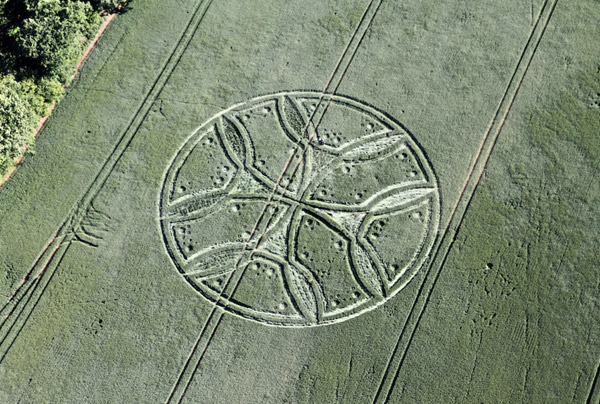
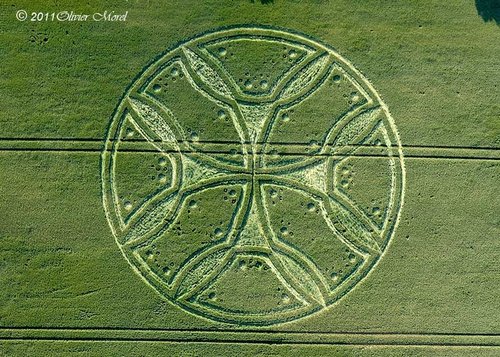
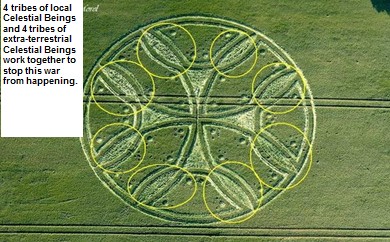
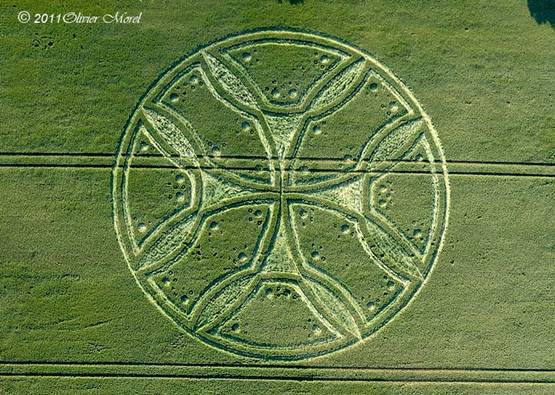
are implicit in this innovated symbol, reported June 21 at Westwoods, Nr
Lockeridge. It is not recognizable as a meaningful traditional artifact,
but when it is analyzed in terms of its parts it can be seen as a
statement of 'newness' for these times.
The basic parts of this
symbol are: the circle, 'four', the Mantuan or Iron Cross, the Vesica
Pisces in rudimentary form, and dots in specific patterns located at
junction points. The contrast between the 'perfect' geometric form of
the cross and the emerging asymmetric vesica pisces are factors to be
considered in this message as well. Two other references that could help
in the interpretation of this design might be: the snake crop circle at
Wilton Windmill, and the Crass logo crop circle at Stonehenge, nr
Winterbourne.
The encompassing circle of
this formation is the archetypal symbol for Divinity; it is
all-encompassing and present within and without, as could be understood
by the large holding circle of the design and the smaller circle dots of
the same lay. The circle is a primary feminine sign.
The number four,
represented by the cross, the 4 pairs of vesica pisces and the patterns
of four dots found throughout the design, symbolizes: stability,
organization, wholeness, Nature in the elements, the seasons, cardinal
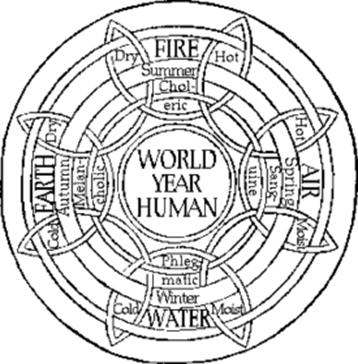
directions, phases of the moon, Earth. The two illustrations below show
the importance of 'four' in the understanding of our relationship with
Nature. Both carry some resemblance to this crop circle.
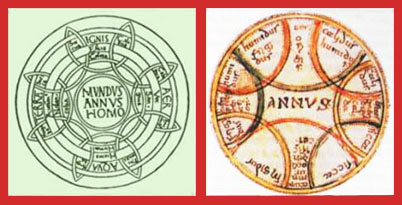
Diagrams explaining elemental dynamics
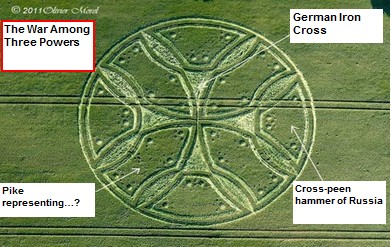
The cross in this crop
circle is the so-called 'Iron Cross' or 'Mantuan Cross' (please see
http://www.faktoider.nu/kreuz_eng.html ). It is derivative of
the cross that was worn by the medieval Teutonic Order of knight
crusaders.
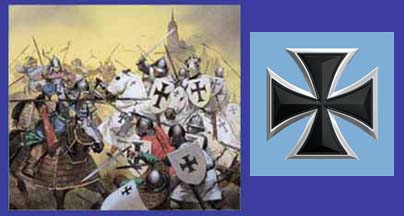
Teutonic Knights and later Iron Cross
To this day, the Iron
Cross is given as an honour for military prowess and heroism in
Germany. It is essentially a symbol for authority, militarism,
aggression, and defensiveness, in keeping with the characteristics of
iron itself, it is: powerful, inflexible and durable. To rule with an
'iron fist' implies the ruler is harsh and unyielding. In some cultures
it represented male strength. This element of the design is geometric
and regular in form. Although the values represented by the Iron Cross
served humanity in the past, perhaps it is time to acknowledge that the
ideas that Crass proposes with its logo, found as a crop circle at
Stonehenge, June 20th, are indeed appropriate for these
times:
"The
aforementioned logo represented an amalgamation of several "icons of
authority" including the Christian Cross, the swastika and the Union
Flag combined with a two headed snake consuming itself (to symbolize the
idea that power will eventually destroy itself)." [see also:
http://en.wikipedia.org/wiki/Crass]
The fourth element of the
design is the asymmetric version of the Vesica Pisces, which apparently
was used in Egypt as the hieroglyph for the letter 'r' and 'l' as well
as for the meaning 'mouth'. It can be found in images for the Goddess
Ma'at who stands for truth, justice and balance, and who weighs the
souls of the dead with her ostrich feather. She speaks Truth.
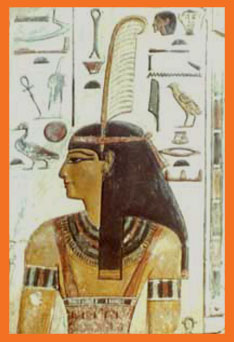
Ma’at, Goddess of Truth and Justice
This element also
approximates the shape of a leaf, or even the shape of long ears of a
rabbit or a donkey. By these associations, an organic aspect can be
implicated–one that is 'growing out of' the more abstract cross form.
When seen as donkey's ears, the symbolism has almost opposing meanings:
humility and wisdom, versus the typhoon-like, but vital, energy of Seth,
dark brother of Osiris. When seen as rabbit's ears, according to
Ukrainian tradition, the symbol denotes the humility of humanity as it
listens to the lessons offered by Nature. These truths must be heeded.
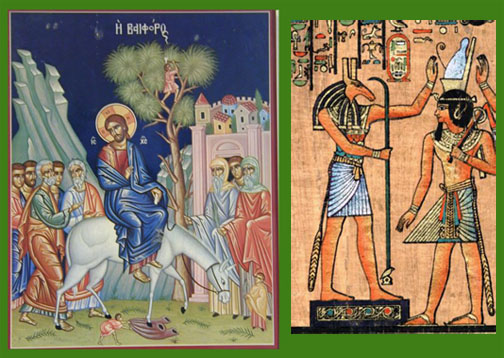
Two
aspects of the Donkey/Ass symbol
The resemblance of each 'vesica'
in the design to the head of the snake in the formation of Wilton
Windmill is unequivocal. Perhaps some common meaning can be derived that
relates to the warning issue found in the snake. If we do not allow the
very definitive and inflexible ways of survival tactics, and material
acquisition to soften into a more organic and life-supportive dynamic,
then we could be in trouble. As well, the 'seed' idea mentioned by Crop
Circle Decoder: H.K.D. Translator: Lisa C. Kuo in the article at
http://www.cropcircleconnector.com/2011/Wilton/articles.html fits
into this paradigm of change and growth.
The final element of this
formation is the most baffling to me. Dots have been significant
ideograms since the time of cave and rock carvings. Whether the dot is
used separately or in conjunction with other forms, "it seems to denote
something that is of short duration, or small, or focused. " (132
Liungman) Although not exactly 'points', these dots are small enough to
evoke some of the symbolism of the point: as the bindu, it is the seed
of manifestation; it is the source of spatial expansion; it is the
resolution of opposing tendencies; it is the still centre of the circle;
it is the completely formless principle from which all beings and all
matter originated. (305 - 306 Chevalier)
So we have a very
structured iron cross, from which flow pairs of organic vesica shapes,
both contained by an all-encompassing circle, riddled within by smaller
circles in regularly placed patterned groups, and repetitions of the
number four in a variety of ways. Taking all of these together, we can
get a sense that the overall picture is about the union of the great
cosmic Divine Oneness with the four square Earth plane, which implies a
growth in consciousness, a change of heart perhaps. When further
investigating the formation, we see that the rigid, well-defined cross
gives way at eight points to a more organic, less easily described
form. That form in turn, is open to the outside perimeter of the great
circle. Somehow movement of consciousness from restrictive,
dictatorial, imposing social and personal ideology (the cross) to a more
open-ended, inclusive and nurturing attitude (vesica) implies access to
the greater reaches of the cosmos and, with the eight vesica, to
"regeneration; resurrection; a new man of grace; transformation of
square to circle and vice versa ; completion; all possibilities in
manifestation; splendour" (118 Cooper).
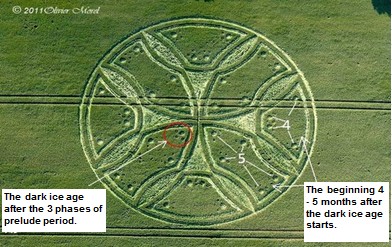
The dots, being small
focal points could perhaps be the actual human beings who serve as
mini-centers of consciousness development and who exist in small groups
around the globe. This idea about the dots was just reinforced for me
because, as I glanced at the formation image from a distance, I noticed
the 'x' shape in the circle described by the elongated forms holding
dots. When I looked this shape up, it proved to be the symbol used as a
determinative in the names of ancient Egyptian towns or cities, as in:
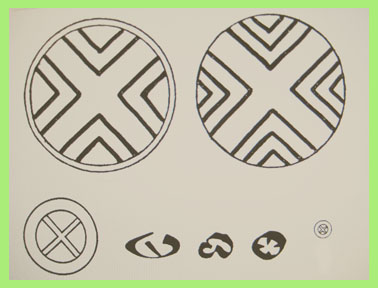
Versions of ‘niwt’, hieroglyphic determinative for ‘town’
It stands for the
intersection of a town's streets, a crossroads. So in this simple added
element, we have the depiction of a city–a Global Village–and the fact
that it is at a crossroads, a time of choice-making, "but also the union
of opposites; the meeting place of time and space" (46 Cooper). This
element, plus the use of ideographic and symbolic elements that have
been used since the dawn of human consciousness, through ancient and
recent history, up to a present innovation, could mean that this
formation is concerned with the evolution of human consciousness and its
relationship to Nature and the Universe.
Is this formation trying
to say that we, tiny, inconsequential, short-lived individual human
beings, could be seeds for a new way of life, a new species, a new
understanding of Life the Universe and Everything? My hope is YES!!!
-
Michelle Jennings
Sources:
Bruce-Mitford, Miranda. The
Illustrated Book of Signs & Symbols.Reader’s Digest. Montreal. 1996.
Chevalier, Jean & A.Gheerbrant.
The Penguin Dictionary of Symbols. Penguin Books Ltd. London. 1996.
Cooper, J.C. An Illustrated
Encyclopaedia of Traditional Symbols. Thames & Hudson. London. 1978.
Encyclopédie de symbols. F.
Périgaut, traduction. Le Livre de Poche. 1996.
Julien, Nadia. The Mammoth
Dictionary of Symbols. Robinson Publishing. London. 1996.
Liungman, C.G. Dictionary of
Symbols. W.W.Norton & Co. New York.1991.
Walker, B. The Woman’s
Dictionary of Symbols & Sacred Objects. Castle Books. Edison, NJ. 1988.
http://radicalgraphics.org/collection/search.php?searchstring=swastika
http://en.wikipedia.org/wiki/Crass
http://www.princetonol.com/groups/iad/Files/Sue-PysankySYMBOLISM.pdf
http://www.njdriftersmc.com/gallery.html
http://www.flickr.com/photos/quadralectics/4350465759/
http://www.crystalinks.com/teutonicknights.html
http://www.faktoider.nu/kreuz_eng.html
http://en.wikipedia.org/wiki/Crossroads_(hieroglyph) |