|
Danebury Hill
Below I’ve constructed a diagram of which seems to be an extension of my
previous axis mundi interpretation on
Castle Hill
There seems to be I feel an “Egyptian theme” running through the
archetypal symbols in a previous CC of which I feel there is a flow of
information in a continuum from one CC to the next.
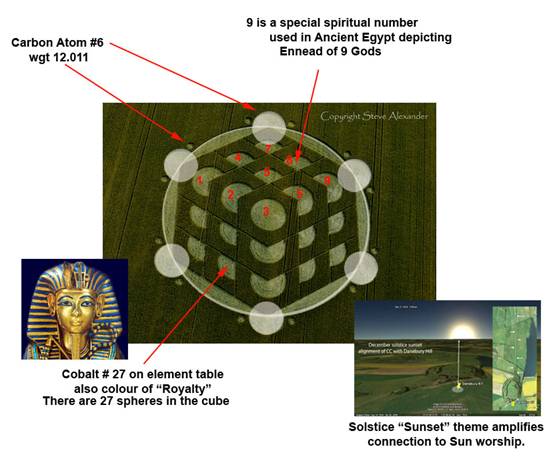
Danebury Hill used the classic “atomic ring” symbol that was found in
Poirino and Codford St Peter. Carbon element # 6 (outer rings)
including the weight in the 12 little spheres. The number 6 in a
“biblical sense” designated as a “man’s” number
The number nine is also an important number, in that, the Ancient
Egyptian ennead of Gods was constructed of nine deities.
The 9 x 3 multiplied to 27, so I checked out the element chart and
“cobalt” came up, which makes sense, especially in regards to the
colour of Royalty back in Ancient Egypt. This colour has pervaded our
Royal “bloodlines” for untold millennia.
Cobalt or Lapis Lazuli and Gold were both heavily used in the headgear
of pharaohs due to their ability of transmutation or inner alchemy. One
can see the rays of “light” springing from the “head” indicating a
relationship with the “Sun” but remember alchemy is the journey of the
“inner Sun”, the real Sun being a “metaphor” for those who weren’t
inititiated into the higher mysteries. These “Sun rays” later
artistically became a “halo” or “aura” in later renaissance religious
depictions of holy people.
The “Cobalt” as a colour or Lapis Lazuli is the closest colour
to “Indigo”, which represented the 6th Chakra (all seeing
eye) on the chakra chain. The Cobalt or Royal blue was also connected
to Kephri, deity of “transformation” or “death and rebirth”.
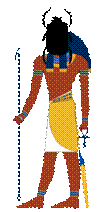
Khepri is often represented as a scarab, or a scarab-headed man,
holding aloft the morning sun
His symbol?… a
blue lotus
If
one reads the wiki link to Royal blue and it’s connections to “blue
bloods” I felt it was incorrect in describing why the colour blue was
used for Royalty. The description has racist undertones, mainly as
“whites” had clear skin and the veins could be seen through the pale
skin? What about dark skinned royals? It had nothing to do with blood,
rather, it was the Indigo or blue colour of the “rainbow” indicating an
energetic archetypal symbol. Anyone who has done enough research
on Ancient Egypt notices many of the noses of the statues have been
“destroyed” or “tampered” with. Some mummies of good quality seemingly
get forensically manipulated into a more Caucasoid looking facial
structure? There is ongoing alternative research by some genuine
scholars for those wishing to go further with this line of enquiry.
Many of the statues seemingly showed Nubian facial structures,
especially in the shape of the “nose” and lips?
This evidence indicates Egyptian history goes a lot further back than
many “scholars” are telling us. The uncovering of the true
understanding of the archetypal symbol behind the royal “blue” indicates
that a king is not designated by “blood”, rather… his
spiritual mastery of alchemy ie.transmuting inner base metals to “gold”
only then becoming a worthy shepherd for his flock…
In Egyptian mythology, Khepri
(also spelled Khepera, Kheper, Chepri, Khepra) is the name of a major
god. Khepri is associated with the dung beetle (kheper), whose behavior
of maintaining spherical balls of dung represents the forces, which move
the sun. Khepri gradually came to be considered as an embodiment of the
sun itself, and therefore was a solar deity. To explain where the sun
goes at night, such pushing was extended to the underworld; Khepri's
pushing of the sun being ceaseless.
Since the scarab beetle lays
its eggs in the bodies of various dead animals, including other scarabs,
and in dung, from which they emerge having been born, the ancient
Egyptians believed that scarab beetles were created from dead matter.
Because of this, they also associated the Khepri with rebirth,
renewal, and resurrection. Indeed, his name means, "to come into
being". As a result of this, when the rival cult of the
sun-god Ra gained significance, Khepri was identified as the aspect of
Ra which constitutes only the dawning sun (i.e. the sun when it
comes into being).
Khepri was principally
depicted as a whole scarab beetle, though in some tomb paintings and
funerary papyri he is represented as a human male with a scarab as a
head. He is also depicted as a scarab in a solar barque held aloft by
Nun. When represented as a scarab beetle, he was typically depicted
pushing the sun across the sky every day, as well as rolling it safely
through the Egyptian underworld every night. As an aspect of Ra,
he is particularly prevalent in the funerary literature of the
New Kingdom, when many Ramesside tombs in the Valley of the Kings were
decorated with depictions of Ra as a sun-disc, containing images of
Khepri, the dawning sun, and Atum, the setting sun
And further…
The scarab beetle became an ancient Egyptian symbol for rebirth, the
ability to be reborn. Each day the sun disappeared, always to rise again
and be reborn the following day. The scarab beetle was also a symbol of
rebirth after death. When the Egyptians mummified a body they
would remove the heart and put a stone carved like the beetle in its
place. The scarab beetle was the most important amulet worn by ancient
Egyptians. It was symbolically as sacred to the Egyptians as the cross
is to Christians
Finally the overall cube
shape has come up often and relates to earth in alchemy. So to conclude
I feel this CC is indicating what many of the other’s have been implying
that we are going though a death and rebirth. The theme is repeatedly
coming up all this year.
Thanks to Luke peacocks
diagram and Steve Alexander’s photo.
There were some other great
photos taken on the ground also, so I’d just like to thank Nils Kenneth
Fordal for some of the great close ups.
John Scott
www.johnscottartist.com |