Woolaston
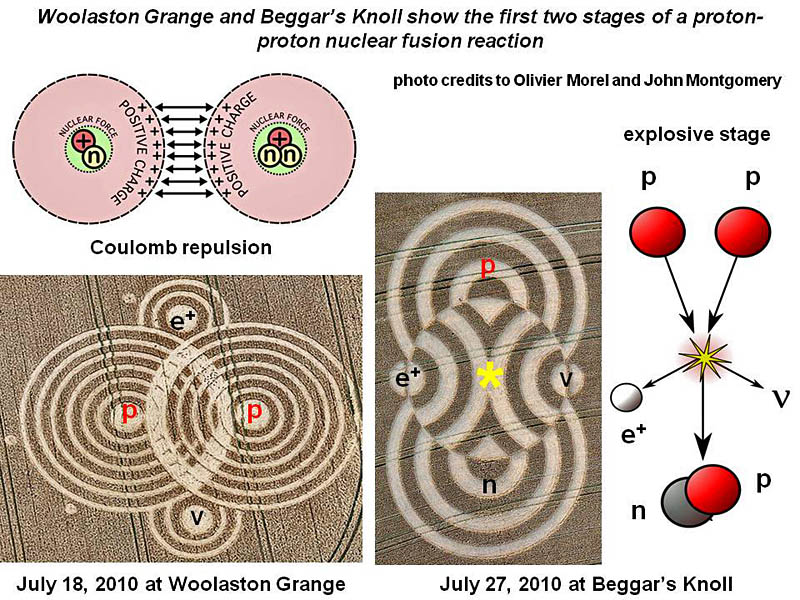
Grange of July 18, 2010 and Beggar’s Knoll of July 27, 2010 seem to
show textbook symbols for the first and second stages of a
proton-proton fusion reaction: what could this mean?
Some
crop pictures seem designed merely to appeal to our aesthetic
senses, whereas others (a rare few) seem somehow to predict future
events. In the past, such future-predictive crop pictures have been
limited mainly to unexpected astronomical events in our solar
system: for example unusual behaviors for three different
comets observed in 1994, 1995 or 2007 (see
time2007i or
scorpious_hour or
time2007a or
time2007g or
time2007h.html).
Last
year in 2009, certain crop pictures predicted small
astronomical events involving our Sun: such as giant
sunspots, bursts of solar wind, solar flares, large solar filaments
or coronal mass ejections (see
eastfield or
badbury or
waylandsmithy3).
Sometimes however, modern crop pictures have seemed to predict
important human events on Earth: for example a novel
decoding of the Antikythera device in 2006 (see
time2007w or
time2007u), or the BP oil spill in 2010 (see the top two slides
on
cropcircleresearch).
Future-predictive crop pictures are one of two “smoking guns” for
their paranormal reality
I walked
personally through one of the “BP oil spill” pictures in July of
2007 at Martinsell, and was impressed with its complex lay of fallen
crop, but had no idea at the time what it might mean. Only with the
slow passage of time from July 2007 to April 2010, did we learn that
two crop pictures from the summer of 2007 (at Maritnsell or Hinton
Downs) had seemingly foreseen what was going to happen in the Gulf
of Mexico three years later.
Likewise
for several crop pictures from the summer of 2005, which predicted
an explosion of Comet 17P Holmes in 2007: we knew (from Lane End
Down) that something “round and spherical” was going to explode soon
in space, and we knew (from Wayland’s Smithy) that it was going to
explode around November 2007, but we could not foresee exactly which
comet it might be, or how spectacular that rare astronomical event
was going to turn out!
Future-predictive crop pictures are thus one of two “smoking guns”
in the modern crop picture phenomenon (the other being “ghosts” of
the same picture in a following year). Those people who are most
sceptical about modern crop pictures, seldom know anything of their
future-predictive aspects.
Have we
just been shown in 2010 two more crop pictures that predict the
future?
Very
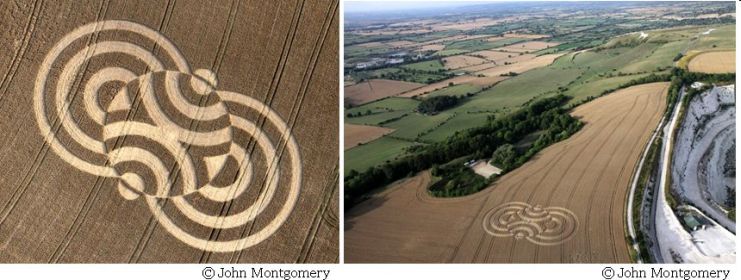
recently, two new crop pictures appeared on July 18, 2010 at
Woolaston Grange (near the Oldbury nuclear power plant) or on July
27, 2010 at Beggar’s Knoll (near a large white chalk pit). Both of
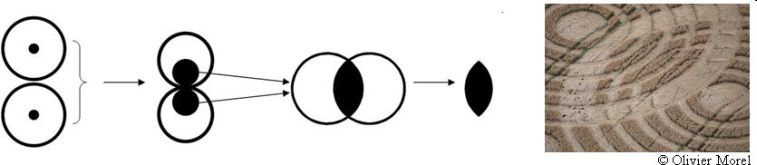
those ostensibly seem to predict the future. The first of those two
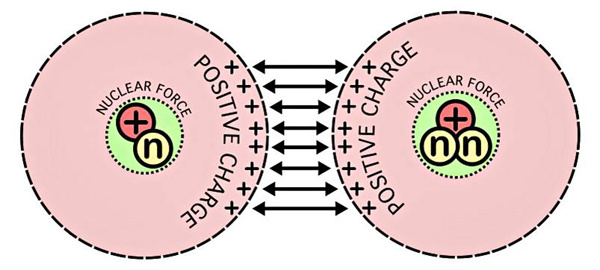
pictures describes what is called a “Coulomb barrier”
to nuclear fusion. Two positively charged protons will repel one
another quite strongly when they come close together, so that any
productive fusion of their two nuclei is greatly hindered (see
Nuclear_fusion or
Woolaston comments):
The
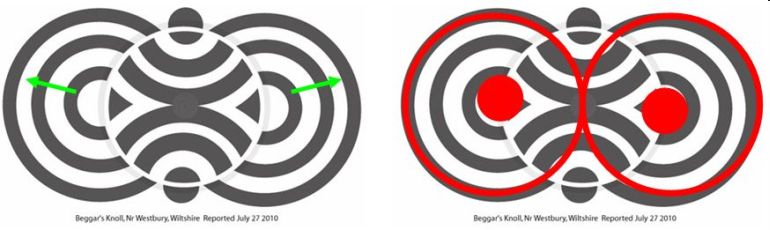
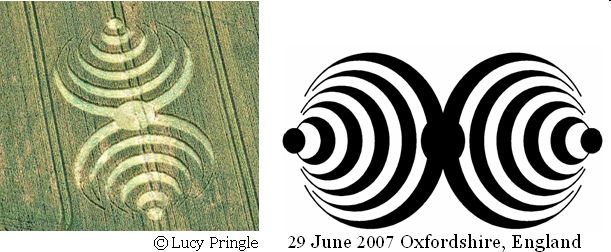
second of those two pictures describes what is called an “explosive
stage” in nuclear fusion (see
proton_chain_reaction or
chalkpit
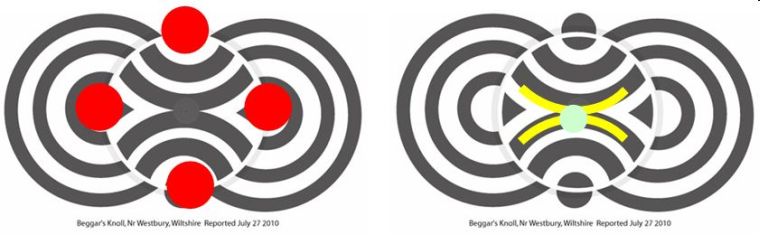
comments). After two protons (p and p) overcome
the Coulomb barrier and get close, their respective nuclei may fuse
(to pn) and release huge amounts of excess energy,
in terms of a positively charged electron (e+) and
a neutrino (v). The released positron (e+)
will quickly react with any normal electrons (e-)
nearby, so as to form two gamma-ray photons that produce heat and
light:

Once we
superimpose those two standard diagrams for “proton-proton fusion”
onto aerial photographs of the two new crop pictures, then a good
similarity between the two sets of data becomes obvious:
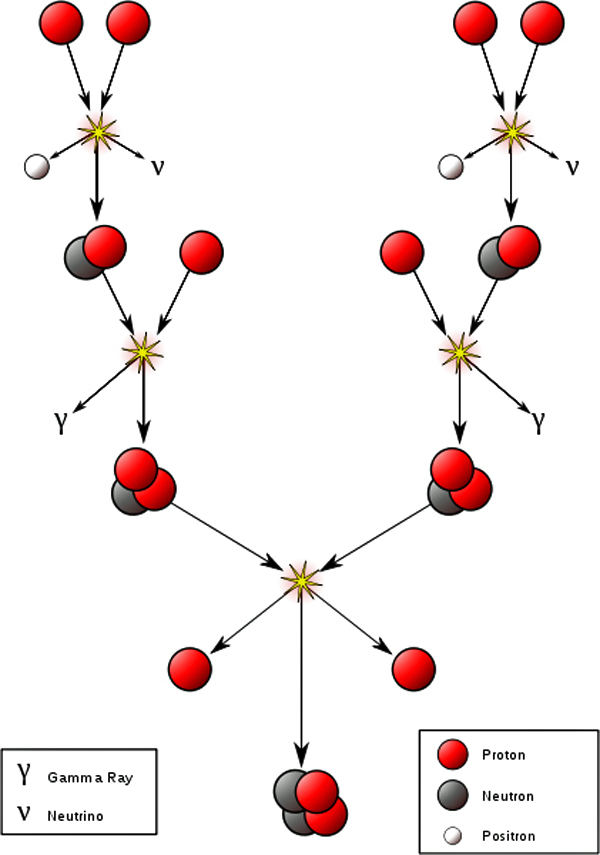
Sometimes the first two steps of proton-proton fusion, as shown in
crops at Woolaston Grange or Beggar’s Knoll, may continue onward to
the proton-proton chain reaction which powers our Sun,
or which powers man-made hydrogen bombs:
The crop
artists are certainly here and active this summer, because on June
7, 2010 at Stoney Littleton Longbarrow, they produced another of
their “future predictive” crop pictures, which seemed to predict the
unusual behavior of Comet C/2009 R1 McNaught one week before it
happened (see
StonyLittleton/comments.html). They may also have predicted on
June 23, 2010 at Savernake Forest an unprecedentedly powerful x-ray
burst from deep space (see
savernake).
Field
images are often helpfully supplemented by instructive field
contexts for truly paranormal crop pictures
Now in
addition to the field images themselves, the field contexts
of those two new crop pictures may provide more useful information.
Thus, it quickly seemed clear to both aerial photographers, Olivier
Morel or Julian Gibsone, that each new crop picture might have
“nuclear” connotations. Woolaston Grange was located on a bank of
the River Severn close to Oldbury nuclear power plant,
and essentially pointed toward it. Likewise, Beggar’s Knoll was
located not far from some unusual “radiative markings” in a field
below, and also pointed toward a large white chalk pit,
so as to suggest a large but finite region of explosion (see
Woolaston or
chalkpit):
“We can see at
Woolaston Grange the interaction between two wave patterns, where
energy is transmitted outward from both sources then passes through
the other source. Next there is a reaction between both sources as
they approach each other’s nucleus. This crop formation has been
located near Oldbury nuclear power station, which lies on the
opposite bank of the River Severn. Hopefully it is not some kind of
warning?”
“Radiation in the
landscape? Mysterious radiative markings can be seen in the
field below this wonderful new formation at Beggar’s Knoll. Could
there be a symbolic connection between the new crop picture and its
nearby field markings? This crop formation reintroduces a stylistic
theme which was present earlier in the season at Woolaston Grange. A
powerful statement!”
An objective
assessment of the data and its possible paranormal reality
So when all is said
and done, what do we have here? We seem to have been presented with
two more future-predictive crop pictures, which
ostensibly predict a nuclear fusion explosion somewhere in Earth in
the not too distant future, perhaps in the next one to five years.
The explosion may be located near a nuclear power plant (which works
by fission, not fusion), and it may cause a finite but substantial
area of destruction.
Could local humans
have made those two crop pictures with rope and boards? If so, then
they would have had to create a lot of very clever multi-layered
features at Woolaston Grange, as may be seen in aerial photographs
(see
Woolaston), or as were photographed on the ground by Ross
Holcombe (see
woolaston fieldreports):
“We visited the
Woolaston crop formation today. Some fascinating elements in the
lay, and a very palpable energy. There was a tracer arc hidden 6-8
inches under the surface lay, and in an opposite direction to it,
which completed the outside edge of the first ring around its
left-hand circle. Its right-hand circle did not show a similar
tracer arc, but rather showed laid-wheat filling in a completion of
the first ring. We also found a couple of spots where the underlying
wheat went with the direction of the flow initially, then turned
sideways by 90 or 180 degrees. A great formation in a very remote
spot!”
Likewise at Beggar’s
Knoll, they would have had to create many sharp perimeters and
graceful curves as described by Shawn Randall (see
chalkpit):
“I was just in the
Beggar’s Knoll formation today July 27, on the first day of its
reported appearance. A few of us dashed over to search for it as
soon as your notification came in. There was little sign of previous
visitors. Perhaps only one or two people had been there before, and
most of the formation had not been touched or walked upon. The lay
was quite flat to the ground, yet also fluffy to step on. Untouched
wheat lay spread before my eyes - a welcome sight - after many
visitors in other crop formations this year. I hardly wanted to step
on it!
The perimeters were
sharp and clean. Graceful curves in the lay of wheat were a lovely
feature with only one, or possibly two, swirled centers among them.
There were numerous segments of the design surrounded by undisturbed
standing wheat, with no tramline access. The formation is on a
sloping hill and incurs wind – possibly it had been rained upon –
yet still it was very smooth, even if a bit weathered. I also found
some bent stalks, even though the crop was mature and ready for
harvest. This formation is a beautiful example of ‘skilled clean
wheat lay’, that makes the experience of being among the first into
it an extra-special event on many levels!”
Thus an
objective assessment of those two crop pictures by two
different skilled observers, namely Ross Holcombe and Shawn Randall,
does not suggest that either picture might have been faked.
In addition to the
difficulties of field layout, any hypothetical human fakers would
have had to go through some college-level physics textbooks, find a
few figures describing nuclear fusion reactions, then draw them
carefully in two separate, faraway fields near a nuclear power
station and/or a white chalk pit, while paying off (or not being
observed by) the farmer in each case. Yet to what end? To somehow
“fool people” that we would be experiencing a nuclear explosion
soon? Or to show “nuclear fusion” crop pictures in an annual
calendar, for their exquisite appeal on a wall or coffee table?
Certainly a “human
faker hypothesis” would seem doubtful in these particular cases.
There may be of course other crop pictures from the well-trodden
fields around Avebury which tourists frequent, that could have been
produced by human hands (and also usually give a faked appearance on
the ground or by aerial photographs).
A possible
relation to current world events
Looking
at world events, one can scarcely fail to notice a possible relation
between these new crop pictures and recent events in the Middle
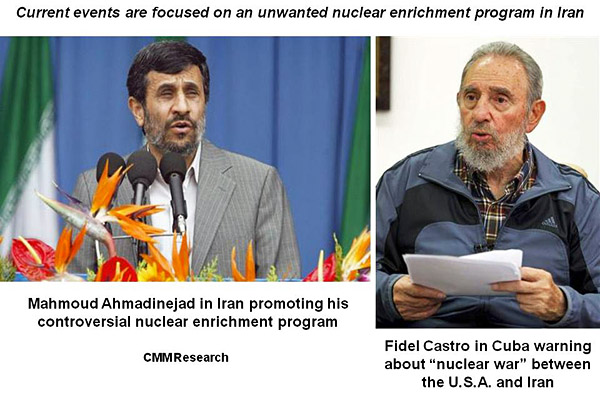
East. The colourful President of Iran,
Mahmoud Ahmadinejad, said recently that he expects the U.S.A. to
“launch a military strike on at least two countries in the Middle
East within the next three months”, say by October of 2010 (see
world_news-mideast). Meanwhile, the European Union has just
applied strong economic sanctions against Iranian oil and gas
industries, in an attempt to derail their nuclear development
program (see
EU-hits-Iran-with-tough-sanctions-against-oil-industry-over-nuclear-programmel).
An aging Fidel Castro has even emerged from seclusion in Cuba, to
warn the U.S.A. against a possible war with Iran, which he says
might “turn nuclear” (see
www.abc.net.au):
What might happen over the next six months, between now and the end
of 2010? Will the U.S.A. and/or Israel use tactical fusion
weapons against certain power plants in Iran,
which they believe are producing enriched isotopes of uranium,
needed for making a fission nuclear bomb? If so, that might explain
why the crop artists have shown us two new pictures at Woolaston
Grange or Beggar’s Knoll, which seem to illustrate the two earliest
stages of a proton-proton fusion reaction. One was cleverly located
near a British nuclear power plant, while the other was located near
a large white chalk pit, to suggest a finite but substantial region
of explosion. Might certain nuclear facilities in Iran be destined
to suffer a similar fate? Only the crop artists know for sure, while
the rest of us can just watch and wait.
Did they show us a third crop picture at Windmill Hill which also
predicts the future, on the same day as Beggar’s Knoll?
A third, well-documented crop picture appeared on July 27, 2010 at
Windmill Hill, on the same day as Beggar’s Knoll some distance away.
That third picture again seems to predict the future, by providing a
possible date for when the two “fusion events” shown at Woolaston
Grange or Beggar’s Knoll might take place. Yet as for most oracles,
its predictions seem fairly obscure!
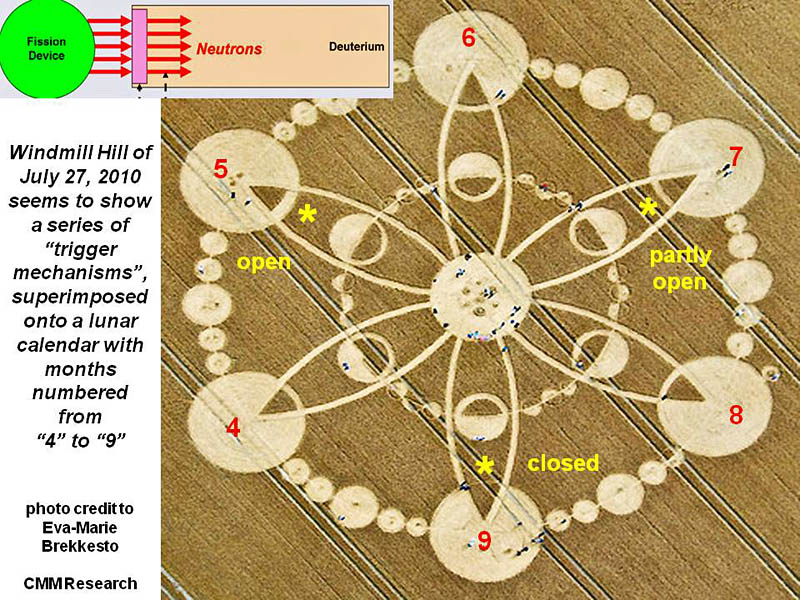
Windmill Hill shows what is essentially a six-month lunar calendar,
where the months have been numbered cleverly from “4” to “9” using
three nests of beaded crop at its very centre. Those three nests
show either 5, 7 or 9 beads inside, in order to uniquely number the
corresponding months outside as “5”, “7” or “9” (see
windmillhill comments or
windmillhill groundshots). The other three months “4”, “6” and
“8” may be numbered by simple inference.
Then along the outside it shows a completely different stylistic
motif: namely some kind of Its “trigger mechanism”, possibly
suggestive of the Teller-Ulam design for two-step nuclear fusion
(see
Teller Ulam_design). That trigger mechanism (which has been
labeled with a yellow asterisk) remains open during
lunar month “5”, partly open during lunar month “7”,
or closed by lunar month “9”:
So far, so good. Yet how can we read dates from their lunar calendar
in terms of our normal Julian-Gregorian calendar? If lunar month “5”
(open) matches July 27, 2010, when the crop picture appeared (on a
full Moon), then lunar month “9” (closed) would equal November 21,
2010 (as in the current Chinese lunar calendar).
Alternatively, if the start of their annual calendar with lunar
month “0” (not shown) matches July 27, 2010, when the crop picture
appeared, then lunar month “9” (closed) would equal April 18, 2011
(see
windmillhill).
Certain details along the outer edge of that crop picture actually
suggest a final lunar date of “8.25” rather than “9”. In which case,
its two possible “closed” dates would be either October 30, 2010 or
March 26, 2011. Again we can only wait and watch, not having the
prescient abilities of our crop-artist friends.
Why have they shown such difficult prospects for our future, and why
have we felt it necessary to discuss such crop pictures here?
These would have to count as some of the most distressing images
ever shown in crops, if our current interpretation of them is
correct. The only other comparable statement which they have made
would be “much pain but still time” at Crabwood in
2002. Of course that was eight years ago, so the “still time” period
may be running out.
Yet we strongly believe, based on many years of experience, that
those crop artists would only show us such distressing images, if
something could still be done about a bad situation in a
favourable way. It is for that reason that we have discussed them
here. By proper foreknowledge of any bad situation, its outcome can
always be ameliorated to some extent.
For example, some secretary to President Obama might be a “crop
circle enthusiast”, so that by reading this very article, a
potential nuclear attack on Iran might not be carried out.
Alternatively, if a nuclear episode is really destined to happen,
then by reading this article or others, and by studying new crop
pictures for the rest of 2010, certain people who might be affected
by that terrible event will instead escape safely.
In summary, this is certainly not a time to neglect what modern crop
pictures might be telling us. We should pay closer attention now
than ever. “The wise man walks with eyes in his head, while the
fool walks in darkness.”
CMM
Research
(serving the public since 2002, with never one cent taken for our
research efforts)