|
Castle hill Crop Circle
Axis mundi
mene, mene, tekel, ufarsin

 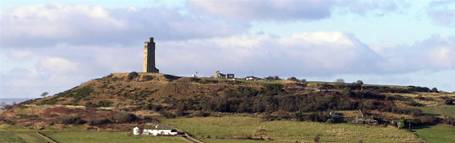
Castle hill CC at first seems a totally boring CC and usually it’s
the surrounding features that are the clue in this mystery.
Especially in this case considering it was 350km north of the all
the others. Firstly I’ve constructed what appears to be an omphalos,
or “navel” symbol, which was commonly used, in ancient times as a
metaphor for the “axis mundi” or “central pillar” of one’s cosmos.
This symbol is mirrored in the castle on Castle Hill on a large
“mound”. The castle itself may be a reference to the penis of
Osiris or masculine energy atop the “primordial hill”. This navel
symbol had many overlays and functions on many levels corresponding
also to the four worlds in Kabbalah, which came much later after
Egypt. Each world (from the top down) an aspect of the creators
name YHVH.
One can see the four levels of the “navel” below in the diagram.
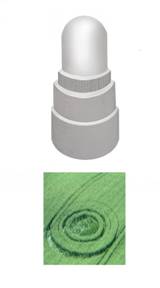
Castle hill CC in 3d (left) with a few other samples from history.

 
Ancient Egypt (far right) notice the mound underneath?


an Irish version (four sections)
The Delphi navel, (left) note the four main sections) similar to the
crop circle navel.
The shape of the navel stone was important in regards to the top
curve representing the curvature of the “heavens” with the four
aspects joining heaven and earth.
This shape has pretty much pervaded everything in architecture down
throughout history, the origin of the curve was repeated in Kabbalah.
Kabbalah also has 3 main pillars. Two outer, and one central pillar,
of which the design is repeated throughout history as either a Djed
pillar or later configurations of pillars and symbols of pillars.

Here’s an older version (right) from ancient Egypt incorporating the
central Djed pillar with double arms (outer two pillars), one set
holds up the heavens the other rules the earth with crook and
flail. Note the handle (Jedi light saber)
Note the curved “dome” at the top, underneath also “two arms” which
are entwined with an Ankh, symbol for immortality the twin arms
later becoming “two pillars” of Joachim and Boaz, the “four worlds”
(horizontal) just above the lower set of arms.

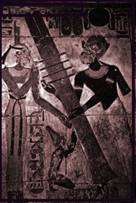
This Djed pillar is also a representation of Osiris, who is “meant”
to be the central pillar holding up “maat” or balance between heaven
and earth. Every king in Ancient Egypt
was a manifestation of “Osiris”.
(left) we can see the Djed pillar with
the two “feathers” on top which represent
light, these later became the basis behind
the Mosaic “tablets” note the shape of the
rounded tops (below).
One can see the four horizontal sections again in the pillar itself.
The two pillars originated also from Egypt and were depicted as
“feathers” on the headdress of Amun Ra (Amun means “hidden”)
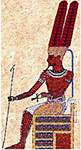
Feathers later became symbolized by the two pillars of
Joachim and Boaz
in Kabalistic literature and also in biblical lore the tablets of
Moses (thutmoses, thoth)

Charlton Heston (left as Moses) losing the plot in this illustration
here, note the “two” bolts of lightning… the tablet on the left,
same shape. Two tablets (center) and (right) the 3 pillars of
“light” (Kabbalah) in the church windows. (Far right) 3 pillars
Kabbalah (note the middle pillar also has 4 Sephiroth)
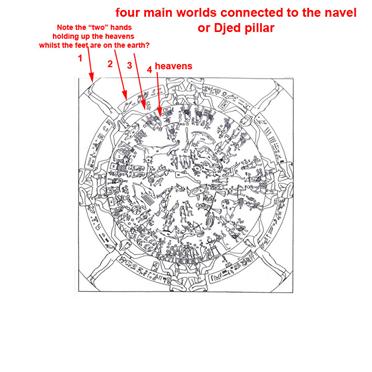
Below we have a zodiac of Denderah, note the four “worlds” held up
by two hands (2 pillars).
A little history on the thought behind the primordial mound and the
Djed pillar (phallus, navel, ad finitum) it was also considered a
phallus due to the masculine nature of the energy underpinning the
cosmological metaphysical process of reaching upward toward
the “heavens”.
In ancient Egyptian thought, the world (earth) was the considered
the feminine archetype of fertility and abundance. “Primordial
mounds”, were originally “pyramids”, later attributed to sacred
“mountains” that were placed on her “shoulders”
allowing for a connection between heaven and earth. This
“primordial mound” back then, may have be attributed to the
original “Cheops” Pyramid. This Pyramid may also have been
considered as “Osiris”. According to Peter Tompkins in his book
“secrets of the Great Pyramid”, the main Pyramid was constructed
during the constellation of Cancer over 70,000 years ago.
This “mound” was considered sacred and represented the source
of all knowledge and wisdom and was connected in an oblique way to
fertility, mainly as the higher rites were performed around the time
of the “flooding” of the Nile. All the myths were centered on this
fertility for the benefit of all. These “fertility rites”
later transferred to the Hebrew religion, the tabernacle itself a
representation of a female’s reproductive system, then took on the
continuation of the “sacred mound” albeit the mound changed to a
“tent”. Sadly the information regarding the sacred feminine (Shekinah)
was lost and a continuation of masculine deity worship
prevailed and every building in every major city on the planet ended
up a representation of a male lingam. Higher, higher, harder
harder!
We’ve all heard the myth about Isis piecing together the chopped up
Osiris, later she seats herself on the lingam of the repaired Osiris
to give birth to little Horus. Well maybe this castle is his last
“bit” for Isis to find? Hell the Castle is as hard as it’s going to
get! If one is inclined to change a B for P then this “B”rick Castle
may be a representation of a primed bulbous cavernosis atop the
primordial mound?
On to the CC and some more evidence. First some information on the
Castle Hill tower nearby the crop circle. This castle was built
approx 555BC. I thought the age of the building very significant in
this interpretation... Historically around the time this building
was built, the last king of Babylon was taking power…
Labashi-Marduk, Chaldean king of Babylon (556 BCE), and son
of Nergal-sharezer (Neriglissar). Labashi-Marduk succeeded his
father when still only a boy, after the latter's four-year reign.
Most likely due to his very young age, he was unfit to rule, and was
murdered in a conspiracy only nine months after his
inauguration. Nabonidus was consequently chosen as the new king
Nabonidus (Akkadian Nabu-nāid) was the last King of Babylon, who
reigned from 556 BC to 539 BC. His reign was characterized by his
lack of interest in the politics and religion of his kingdom.
Nabonidus in this Stella shows him praying to the moon, sun and
"Venus".

Note the curved shape again.
Nabonidus, whose relationship with the previous Chaldean Kings of
Babylon is “unclear”, came to the throne in 556 BC by
overthrowing the youthful king Labashi-Marduk. In 549 BC he
left Babylon to live in Arabia leaving his son Belshazzar behind to
rule the empire in his stead.
In 539 BC, according to the Hebrew Bible, while Belshazzar and the
nobles of the empire “were feasting and drinking from the
chalices” from the...
Hebrew Temple of Jerusalem,
a hand wrote an unknown Aramaic text on the wall:
mene,
mene, tekel, ufarsin … you know the rest…
The name is the Greek form of Babel, which is derived in turn from
the Semitic form Babilu, meaning "The Gate of God"
Babel is the name of a site where, according to the Bible
(Genesis, 11:1-9), an “unsuccessful” attempt was made to
erect a tower of enough height to reach “Heaven” - But in the Hebrew
language there is a similar word, "balal", which means
"Confusion"
John Scott
www.johnscottartist.com |