Another dire warning
that Western governments cannot afford to
ignore
|
Preliminary Note
I’ve been working for some time
on The Dragonfly formation, of June 03, because I discovered,
amongst other things, that it’s linked in a number of remarkable ways to
various other crop circles of the current season and my analysis should
soon be ready. However, after just a brief examination of the new
Wayland’s Smithy structure I had no doubt that it must be given priority
over my other work. …
Initial observations
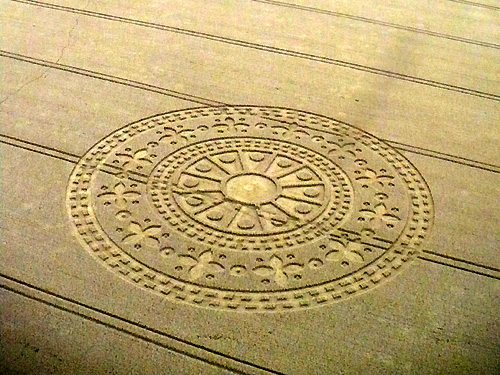
Firstly, I realised that it was
found on the day that represents the 8’th anniversary of the
enormous Milk Hill formation of 2001 i.e. August 12 [the 224th
day of the year], and I wondered if its builders had been inviting us to
recognise this clear relationship. This possibility was of particular
interest to me because I have long been convinced that the cited Milk
Hill marvel had been engrained with information pertaining to the 9/11
attacks on the United States [see
www.milkhill-revealed.com], which occurred 30 days after August 12,
and I was keen to ascertain whether the Wayland’s Smithy circle sheds
any light on this vexed subject.
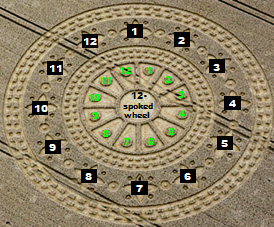
Secondly, I knew that, as Stuart
Dike pointed out, an explicit numerical link exists between the
described day the formation was found - August 12 - and its
geometry i.e. a 12-spoked wheel at its centre contains 12
discs and an outer band of standing crop contains 12 4-leafed
figures [plus circles], as illustrated in the following diagram - which
is based on an original photograph kindly provided by Stuart Dike -
where the cited 12 discs are numbered in green and the
12 leaf clusters, in white on black:-
But I was also drawn to the fact
that the formation contains two notable pairs of rings - one that forms
its outer sheath and a smaller one located inside the main structure -
and each of these embodies two concentric circles, comprising closely
packed, small blocks of standing crop.
Furthermore, when I counted [from
the formation’s centre] the quotas of these blocks, in order, I found
that the smaller ring’s circles have 52 & 56 and the
larger, 72 & 76, as shown in the following diagram:-
Note: for clarity, below, the two rings have been
isolated from the surrounding crop.
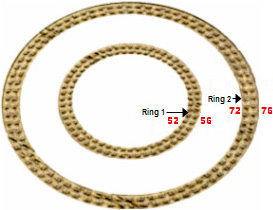
The quotas of small blocks in the formation’s two
rings [1 & 2]
And I noted that this arrangement is linked to
the number 4 in a set of explicit ways:-
1] the number of concentric circles is 4
2] the tallies of blocks in the 1st
ring, 52 & 56, differ by 4
3] the tallies of blocks in the 2nd
ring, 72 & 76, also differ by 4
4] the total tally of blocks, 256 [= 52+56+72+76],
can be expressed as 4x4x4x4 or 44
In other words, it appeared that the identified
sequences of blocks in the two rings had been carefully selected.
For the foregoing reasons, then, I decided that
the formation should be subjected to a more detailed examination with
urgency. …
My analysis and conclusions
Three signatures of authenticity
[A] Knowing that the
numbers 52 & 56 and 72 & 76 are part of the arithmetic series
52, 56, 60, 64, 68, 72, 76, where the common
difference is 4, I was curious as to why our attention had
been drawn to just those 4 entries, and I wondered if we were
being invited to express the relationship that exists between them in a
more novel way. …
If the first two numbers, 52
& 56, are represented as two columns of blocks then the final
two, 72 & 76, could be defined by placing two columns,
identical to the first, on a plinth that’s 20 blocks high, thus
[where the blocks are shown only symbolically]:-
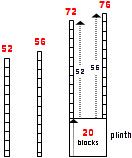
And when I’d produced this elementary figure I
soon realised that it’s pointing us to a profound relationship. …
If the plinth’s 20 blocks are
labelled sequentially - starting at 1 - these have a sum of
210 [= 1+...+20] and when this is added to 5256 & 7276,
which can be inferred from the juxtaposition of the formation’s quotas
of blocks - 52, 56 & 72,
76 - we obtain:-
12742
the geometric mean diameter, in kilometres, of
the WGS 84 ellipsoid
In other words, the ostensibly
curious sequences of blocks in the formation’s 2 rings … 52,
56 & 72, 76 … embody a definitive relationship with
an accurate earth model that is widely employed today: the ellipsoid
used for the popular WGS 84 map datum. I’d add that the cited
2 rings also exhibit a subtle link to the factor 20, which
forms a key part of the relationship: the objects embody the concepts
of 2 and ring [= 0].
Readers of earlier articles of
mine may recall that I consider such impressive allusions to the WGS
84 ellipsoid, within a formation, to be a pivotal mark of
authenticity.
[B] Having accepted that
the space between the formation’s 2 rings is linked to a 20,
in the indicated way, it was soon clear that that area has attributes
that enable us to produce another simple and elegant manifestation of
the cited geodetic number. …
The region between the rings is
occupied by 12 4-leafed figures of flattened crop and each of
these embraces 5 circles [4 small & 1 larger] that have areas of
standing crop at their centres, as shown in the typical arrangement
below, which is an adaptation of a photograph kindly provided by Chris
Bird:-
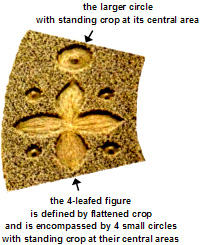
Clearly, then, the cited area
between the rings contains a total of 60 [= 12x5] isolated zones
of standing crop [just as the rings themselves have 256 blocks of
standing crop] - and 60 has a revealing relationship with the
20 that’s also associated with the region. If we express the latter
number as 10+10 [akin to sharing it between the two rings]
we can now produce the ‘simple and elegant manifestation of the cited
geodetic number’:-
Multiplying 60p [i.e. ‘the 60th
prime’ = 277]* by 10p+10p [= 23+23]
yields:-
12742
the geometric mean diameter, in kilometres, of
the WGS 84 ellipsoid
This elementary computation was
also described in an earlier article of mine that was published on this
site [ref. Eastfield (4) of 25-08-08] and I would remind readers that it
enables us to make sense of an ostensibly bizarre Biblical passage that
has baffled mankind for rather a long time: the creation myth of the
Book of Genesis.
And at this point I noted that
the 2 rings’ quota of blocks, 256 [= 52+56+72+76],
also exhibits a simple relationship to the 2 numbers that formed the
basis of the described calculation: 60 & 20 [which had to
be expressed as 10+10]. …
The product of the digits 2,
5 & 6 is … 60 … and when those digits are expressed
as the corresponding primes - 2p, 5p & 6p -
their sum is … 20 [= 2+7+11].
[C] I was now curious as
to whether the hidden but all important number 20 is linked in
any other meaningful way to the cited allotment of blocks in the
formation’s 2 rings - 256 [= 52+56+72+76] -
and I quickly obtained an unambiguous answer. …
Having noted that the expression
256 + 20p [= 67] yields … 323 … I discovered
that the latter number relates in a stunning way to the arithmetic
series I described earlier, in which 52 & 56 and 72
& 76 are, respectively, the first and last two entries:-
52p+56p
+ 60p+64p+68p + 72p+76p
= 323p i.e.
233+257
+ 277+307+331 + 353+379
= 2137
I’d established, then, that the
number 20 can be inferred from a relationship that exists between
the 7 entries of the arithmetic series - 52, 56,
60, 64, 68, 72, 76 - and the four
members of this sequence that are displayed in the formation’s rings -
52, 56, 72, 76 -
as shown below:-
52p+56p+60p+64p+68p+72p+76p
= 323p … and … 323 - [52+56+72+76]
= 20p
And given the key role of the
number 20 in the two described ways of generating the geodetic
number 12742, from the crop circle’s unique structure, it was
evident that the above clear relationships constitute another
signature of the formation’s authenticity.
Allusions to terrestrial time
Being thus convinced that the
Wayland’s Smithy edifice I was now examining was the work of the hyper
intelligent beings whose thought provoking constructions I’d borne
witness to elsewhere I was determined to find what else they were trying
to tell us! …
As the sequences of blocks in
each ring are placed in close proximity to one another it occurred to me
that the crop circle builders may also have been inviting us to consider
relationships that exist between the two sums - 108 [= 52+56] &
148 [= 72+76] - and this hypothesis immediately produced an
intriguing result. …
The expression 108p+148p
yielded 1440 [= 587+853], the quota of minutes in a day. And this
was of particular interest because I knew that the area enclosed by the
rings highlights 60, the quota of minutes in an hour and, seconds
in a minute.
This numerical relationship
between the 2 rings and the area they enclose also meant that the number
of hours in a day is being inferred i.e.:-
1440/60 = 24
Furthermore, these apparent
allusions to the numerical parameters that are employed in our
terrestrial definition of time became all the more pertinent when I
realised that the 12-spoked wheel-like structure, which occupies
the formation’s central area, could represent the face of an artefact we
use to display the time within any 24 hour period: a clock
[devoid of hands]. Not only is the wheel divided into the traditional
12 sectors but it is endowed with 12 circles of standing crop
- positioned perfectly - upon which the numbers 1 to 12
could be placed [as I did on my first diagram of this document].
The above information is summarised below:-
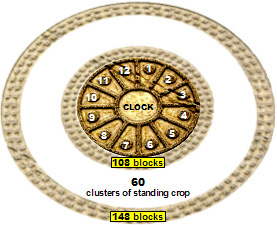
Links to time
60 = the number of minutes in an hour and,
seconds in a minute
108p+148p = 1440, the number of minutes in a
day
1440/60 = 24, the number of hours in a day
I was now presented with an
interesting possibility: were the builders of the formation drawing our
attention to these relationships and to their novel clock face so that
we’d also be able to identify, within their creation, a specific time
they were highlighting?
Before I seriously addressed this
question, however, I wanted to establish if the crop circle also
provides us with the means of identifying the day to which the cited
time presumably relates. …
Two days of the year come into focus
Having identified a meaningful
link between the individual block endowments of the formation’s 2
rings and the area enclosed by them i.e. [108p+148p]/60
= 24, a single day’s allotment of hours, I was curious as to
whether a similar relationship also exists between those block
endowments and the 12 areas of standing crop on the clock face
[which the inner ring encompasses]. … And with little effort I obtained
an answer I’d been expecting to find somewhere within the field
structure. …
I discovered that the summation
108p+148p [= 1440] exceeds 12p [= 31] by:-
224p [= 1409],
where 224 was the day the crop circle was found.
In other words, I’d uncovered a
simple and elegant allusion to the day of the year the formation was
first identified [expressed as a prime (as often occurs in formations)].
I considered this result to be of
special interest because it’s consistent with the other relationships I
described, involving the individual block endowments of the 2
rings [108 & 148]: in each of those 2 cases I’d
identified a defined characteristic of one day i.e. 1440
is its allotment of minutes and 24, its allotment of hours, and
I’d now found an apparent reference to one day of the year, which
happens to be what we believe was the edifice’s day of birth [but was
also the 8th anniversary of the Milk Hill giant].
These three complementary
relationships are juxtaposed below:-
The three relationships
108p+148p = 1440,
the number of minutes in one day
[108p+148p]/60
= 24, the number of hours in one day
[108p+148p] - 12p
= 224, the one day the formation was found
At this juncture I discovered
that the formation’s 2 rings also embody a more curious
relationship.…
I knew that the block quota in
the outer ring, 148, is 40 greater than that in the inner, 108,
and I suddenly realised that the 2 rings are also linked to this number
in another way that involves their endowments of blocks i.e. the 4
concentric circles within the rings consist of 52 & 56 and 72 & 76
sequences of blocks and these numbers’ 8 digits add up to: 40
[= 5+2+5+6 + 7+2+7+6].
Furthermore, just as I’d
recognised previously that the number 20 is closely associated
with the concept of 2 rings [because our glyph for zero,
0, can be classified as a ring] so it was now clear that
the 40 I’d identified is likewise closely related to the
concept of the rings’ 4 concentric circles i.e. a zero
can also be represented by a circle.
But having accepted that the
number 40 is linked to the formation’s rings in the cited ways, I
soon uncovered a relationship that sent shivers down my spine. …
I found that the summation 108p+148p
[= 1440] plus 40p [= 167] yields:-
254p [= 1607], and this
year’s 254th day will be … the 11th
of September, the 8th anniversary of the 9/11
attacks.
I was therefore confronted with
the possibility that, as anticipated when I first learned of the
formation, its builders were drawing our attention to that terrible
date!
I now wanted to establish whether
the formation’s apparent allusions to both the day of its discovery,
August 12, and September 11 can be shown to be related to events of 8
years ago - when Milk Hill’s monster appeared and the US outrages
occurred.
The impending 9/11 - and a specified time
I knew that 40, one of the
key elements of the relationship that had yielded the above 254th
prime, was closely associated with the number 8, which represents
the ranks of the 2 cited anniversaries i.e. it equals the sum of the
8 digits of 52 & 56 and 72 & 76. However, I concluded that if the
clever crop circle builders had really wanted to draw our attention to
this factor 8, in the described context, they would have had to
ensure that it has a central role not just in one such computation but
in the basic form of the whole edifice. And when I looked for it I
realised not only that it’s staring us all in the face but also that our
identification of it even answers another taxing question. …
The parts of the formation I’ve
been interested in during my examination of it are the small zones of
standing crop that are distributed throughout it; and the manifold
areas, which are of rectangular or circular form, straddle the
perimeters of concentric circles that could be drawn. And if we count
these circles we find that there are 8 of them, as depicted in
the Fig. below [where the tallies of the respective shapes are also
shown]:-
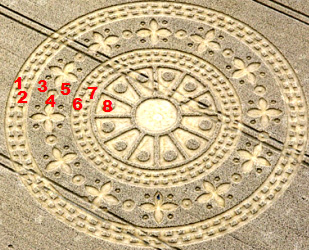
The 8 concentric circles
of standing-crop zones
1st
= 76; 2nd
= 72; 3rd
= 24; 4th
= 12; 5th
= 24; 6th
= 56; 7th
= 52; 8th
= 12
My recognition that the very
areas of the formation that have provided me with all my information -
the standing-crop zones - are emblazoned with the number 8 in
this way convinced me that the structure’s builders had indeed wanted to
draw our attention to the fact that their creation is being tied to the
events, of 8 years ago, that I described: the day that the giant
Milk Hill formation appeared and the day of the 9/11
attacks.
But before I outline persuasive
geographical evidence that supports this hypothesis we should take
cognizance of the fact that the 8th circle [counting
from the exterior] of the defined standing-crop zones is lodged within
the formation’s clock face. …
This relationship links the clock
- which we know is devoid of hands - firmly to the number 8, and
this raises the possibility that 8 o’clock is the time we were
seeking. But having formulated this theory I knew I’d be obliged to find
plausible answers to two fundamental questions it presents us with. …
1 Is it the morning or the
evening that’s being described?
2 Does the time pertain to
the impending 9/11, which the formation is highlighting?
Fortunately, I soon realised that
the crop circle’s ingenious architects ensured that this ostensible
conundrum can be resolved with extraordinary subtlety and simplicity. …
One of the formation’s most
prominent features, its 12 4-leafed clusters, has played no part
in my detailed analysis because it is comprised, uniquely, of only
flattened crop. But knowing that these 48 leaves, in common
with all the zones of standing crop, are disposed in a circular
arrangement, O, it was evident that they could serve as a covert
representation of the number 480, and this proved to be most
revealing. …
The leaf clusters are
encapsulated within a region that’s closely associated with a 60
i.e. it contains that number of small areas of standing crop. But 60
happens to be the quota of minutes in 1 hour - and if the cited
480, inferred from the same part of the formation, is considered
in this specific context it can be seen to represent … 8 hours.
What we are being told, then, in
this almost child-like manner, is that the 8 o’clock we were
speculating about is to be in the morning!
I would add that a notable
confirmation of this deduction emerged when I considered the fact that,
at the cited time, the clock’s 2 missing hands should be on the 8
& 12. … Not only do these numbers add up to 20, the factor
I’d earlier found to be hidden, but the sum of the 8th
and 12th primes is - 48 [= 17+31] - which
equals the quota of leaves that had yielded the crucially important
definition of 8 hours.
Knowing that, within the
formation, the described time is represented as 480 minutes I was
curious as to whether this 480 is linked in a meaningful way to
the 316 areas of standing crop that encompass the 12 on
the clock face [i.e. 316 = 148+60+108], and I quickly received an
unambiguous link to 9/11 [which we know falls on the
254th day]. I found that 316p [= 2087] exceeds
480 by … 254p [= 1607].
In other words, I’d uncovered
a definitive link between 8.00 am and September 11.
I then considered the fact that
the formation’s 2 rings fit within a circle that possesses by
definition 360 degrees. And when I added 360 to 1440, which
the rings are also closely linked to, yielding 1800, I found that
480p [= 3407] exceeds this by … 254p.
A pivotal geographical perspective
We know that my computation of
the first of the 2 above described manifestations of 254p
involved the 316 areas of standing crop that encompass the
12 on the clock face - but I didn’t stress that these 316 areas are
actually disposed on 7 concentric circles [although this would
have been easy to deduce] i.e. 316 = 76+72+24+12+24+56+52.
This key role of the number 7 interested me because, as explained
earlier, I knew that the block quotas of the 2 rings’ concentric circles
belong to a 7-entry arithmetic series - and this sequence
is an integral part of the formation’s overall numerical statement.
Furthermore, I couldn’t fail to
notice that when 316 is added to 7 we obtain … 323 … the
very number that I’d found closely tied to the described 7-entry
arithmetic series i.e. 52p+56p+60p+64p+68p+72p+76p
= 323p … and … 323 - [52+56+72+76]
= 20p.
It seemed possible, then, that
the cited link between the 7 concentric circles that are disposed
around the clock face, and the single 1 it encapsulates,
also embodies other relevant information. I therefore did a symbolic
sketch of the 7 circles and placed it alongside the clock face,
with the 1 circle within it, and focussed on the figure:-
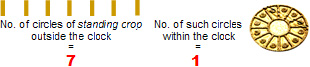
Recalling the key roles I’d
identified of the number 480, which had been inferred from the
unique ring of 4-leafed clusters of flattened crop, I now noticed
that this exceeds 71, which can be inferred from the above
arrangement, by a prime that was intimately associated with the Milk
Hill structure of 2001 … 409 … which was the quota of circles in
the main edifice. However, I had no idea, at first, as to whether this
relationship was merely the outcome of random chance.
But knowing that the 7 and
1 in the figure are so closely tied to the concept of
circle i.e. they represent numbers of circles of standing crop, I
wondered if 710, which can be inferred from this relationship
[again recognising that a circle can represent a 0], has a role
to play, and I soon found another link to the cited Milk Hill formation.
…
I discovered that 323p [=
2137], described above, exceeds 710 by 226p [= 1427] and I knew
that an angle of 226 hundredths of a degree [or 2.26°]
differs from the value of the meridian that passed through the
formation’s centre … 1.851° W … by .409° [see
www.milkhill-revealed.com], 409 being the structure’s
allotment of circles.
Indeed, I was also aware that the
cited .409 could actually be read directly from the field that
accommodated the formation: when viewed along a meridian from the
north the main edifice could be seen to be accompanied by a
minuscule circle on its left and by juxtaposing this point-like
structure with the 409 we could infer .409.
It now seemed possible, then,
that the architects of this Wayland’s Smithy formation had been inviting
us to find the above subtle allusions to the 2001 Milk Hill structure,
one of which appeared to include data relating to the latter’s
geographical longitude. This hypothesis remained a tentative one,
however, until I tried to determine if the above cited 226, which
embodied the cited link to Milk Hill’s meridian, also relates in a
meaningful way to 12, the one number that’s displayed explicitly
on the formation, and is, in particular, the quota of discs of standing
crop on the clock’s face. …
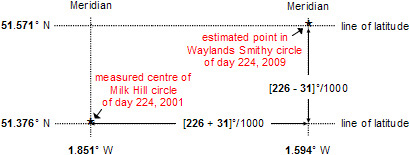
Having noted that the expression
226 + 12p [= 31] yields 257, I discovered that when
257 thousandths of a degree is taken from the cited Milk
Hill meridian, 1.851° W, we obtain … 1.594°
W … which appears to pass through the Wayland’s Smithy structure
[unfortunately its accurate coordinates were not measured, as far as I
am aware].
And any thoughts that this
outcome was merely a random event were dismissed when I found that the
value of the expression 226 - 12p is … 195. I
discovered that when 195 thousandths of a degree is added
to the line of latitude that passed through the centre of the Milk Hill
structure [see
www.milkhill-revealed.com], 51.376° N, we obtain …
51.571° N … which also appears to intersect the Wayland’s
Smithy circle.
These extraordinary relationships
are displayed on the diagram below:-
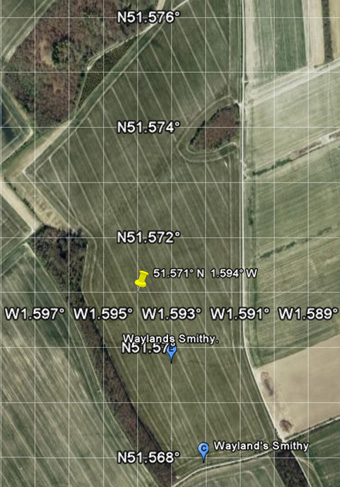
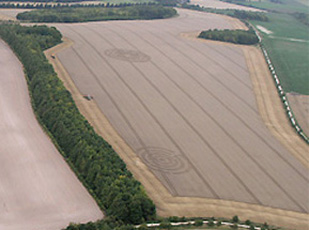
And the position of the cited
point in the field that the Wayland’s Smithy formation appeared in,
51.571° N 1.594° W, is shown on
the Google Earth map below, followed by an aerial picture [which is at a
low angle] kindly provided by John Montgomery:-
The significance of this curious
geographical relationship between 2 formations that appeared exactly
8 years apart can be understood, I believe, when we consider the
other links I’ve described between the cited Wayland’s Smithy and Milk
Hill edifices and the 8th anniversary of the date
September 11. In my simply constructed Milk Hill website I’ve tried to
demonstrate that that massive crop circle had been designed to embody
precisely defined data about the US attacks that occurred just 30 days
later. On that occasion, however, nothing was done about this
information because nobody was aware that it existed. Indeed few people,
including those in the dedicated crop circle fraternity, even had an
inkling that formations embody statements of that kind.
But today I have rushed this
abbreviated article to the Crop Circle Connector because it appears to
me that we are again being given a dire warning, one that’s been picked
up before the event and not after it. As explained above I
believe that the builders of the Wayland’s Smithy formation had made
efforts to tell us that more malevolence has been planned for September
11, at 8.00 am, to compound the carnage of 8 years ago.
Another indication that my
analysis is correct can be detected, I believe, when we take cognizance
of the fact that the number that defines [when combined with 12p] the
precise angular displacements between the Milk Hill & Wayland’s Smithy
points i.e. 226, differs from 480, which we found
highlighted in the latter formation, by the now familiar … 254.
Furthermore, we know that the number 480 was inferred from a circle of
4-leafed clusters of flattened crop within the structure and the
above aerial picture and Google map show trees to the North, South, East
and West of the circle.
It’s also the case that the
difference between the numbers that represent the days of the year
corresponding to August 12 and September 11 i.e. 224 & 254,
is, when both are expressed as the corresponding primes … 198
[= 1607 - 1409]. And when we add this to 254 we obtain a factor
that can be expressed as … 226+226 … which happens to be
the total angular displacement [expressed in °/1000] between the
Milk Hill and Wayland’s Smithy points [i.e. measured along a meridian
and line of latitude pair].
·
As stressed in previous articles, 1 must be counted
as the first prime number. A list of the first 700 primes [thus defined]
can be found on
www.milkhill-revealed.com.
© Neil Hudson Newman August 22, 2009 |