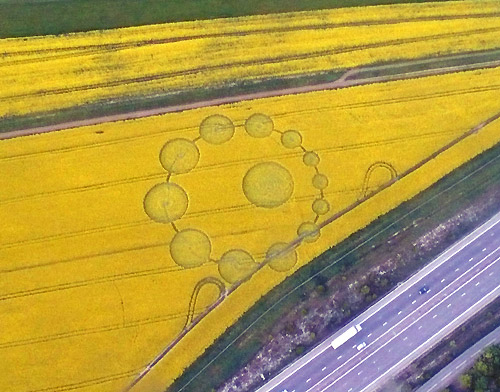
The field orientation of Peaks Down tells us two kinds of extra
astronomical information: the location of our Sun on July 7, and
the importance of an apogee full Moon on July 7
A
new crop picture at Peaks Down seems to show our “Earth” as its
large central circle, along with 12 surrounding circles of
varying size, which may represent the “12 full Moons” of any
lunar year. Those 12 full Moons were drawn according to an
elliptical orbit, so that the one closest to
Earth (perigee) could be assigned as January 11, 2009, while the
one furthest from Earth (apogee) could be assigned as July 7,
2009. Next, three full Moons which lie furthest from Earth were
drawn with the largest circles, meaning that they are trying to
tell us about upcoming dates of
June 7, July
7 or
August 6, 2009.
Now
the field orientation of Peaks Down tells us two kinds of extra
astronomical information: (a) where our Sun will be located on
July 7, and (b) the importance of an apogee full Moon on July 7.
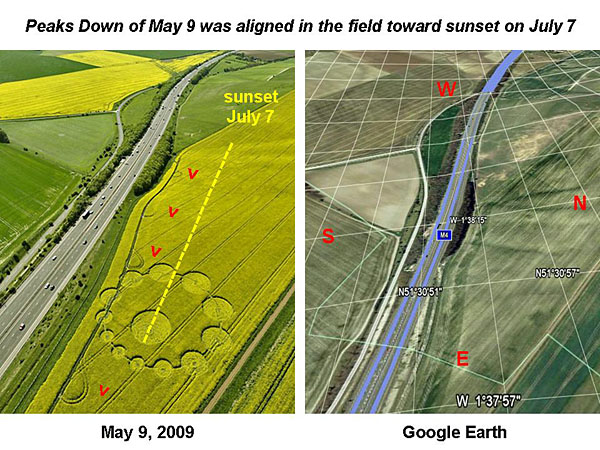
Looking first at the diagram below, one can see on the right
four cardinal directions of North, South, East or West where the
crop picture appeared:
Then
on the left, one can see how the neighbouring M4 motorway and
four small “teardrop” shapes are aligned slightly north of west
at 305o, which is close to the 308o of
sunset on July 7 at latitude 51o N. If those four
“teardrops” were meant to represent discrete emissions from our
Sun, then their choice of field location for this picture makes
a lot of sense!
In
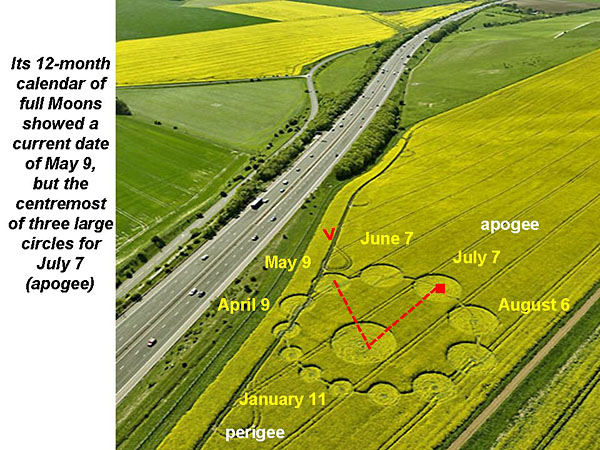
the next diagram, one can see their 12-month calendar of full
Moons, with perigee or apogee dates noted. A small “teardrop” on
the left indicates our current full Moon of May 9, while the
centremost of three large circles suggests another full Moon of
July 7, which also lines up with crop tramlines:
The
suggested date of “July 7” from Peaks Down on May 9 may be
relevant to another crop picture from Roundway on May 10, which
shows an upcoming flare / coronal mass ejection from our Sun.
Two earlier crop pictures from Rutland’s Farm on April 23, or
Morgan’s Hill on April 24, also seemed to show an upcoming flare
from our Sun, along with a time frame of two and one-half lunar
months until it might occur (April 24 to July 7). Earlier this
week, our Sun produced a small coronal mass ejection for the
first time since 2006: see
sohowww.nascom.nasa.gov.