The ancient Mayan
astronomy of Earth, Sun and the Pleiades
One year ago on May 8, 2008, a spectacular “yin yang” type
of crop picture appeared near Avebury Stone Avenue. It told
symbolically about the zenith location of our Sun at noon on
the same day, near latitude 17.5o N in the Mayan
heartland of La Venta or Palenque (see
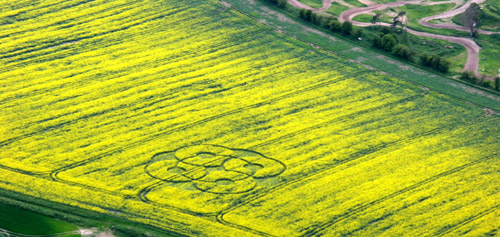
aveburystoneavenue2008). Now this year on May 3, 2009, a
conceptually related crop picture has appeared at East
Kennett Longbarrow. It tells symbolically about the zenith
location of our Sun at noon on the same day, near latitude
16o N a little further south:

Two characteristic symbols for “Sun” or “Earth” have been
laid on top of one another in this new crop picture to
suggest “zenith”. One of those symbols appeared recently in
crops at West Kennett Longbarrow on April 19, 2009 (see
westkennettlongbarrow2009), while the other appeared at
Knoll Down on July 28, 2008 (see
knolldown2008a).
Due to the relative simplicity of this new pattern, we
cannot be sure that it is paranormal in origin, and field
inspection by Charles Mallett did not yield any firm
conclusions (see
fieldreport). Nevertheless, we can still discuss its
symbolism in relation to other crop pictures that have
appeared before.
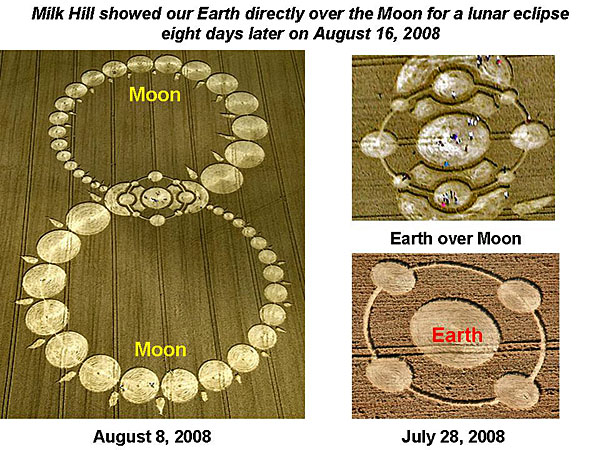
For example, its Celtic-cross symbol for “Earth” is
certainly not new! That four-lobed symbol has been appearing
regularly in crops since the early 1990’s (see
time2007f). Last year on August 8, it appeared at Milk
Hill to tell us about “Earth” laid directly over the Moon
during a lunar eclipse, eight days later on August 16, 2008
(see
080808):
A
few years earlier on August 9, 2005, it appeared at Marden
to tell us about the “Pleiades” laid directly over the
“Earth” on a yearly date of November 18 at midnight (see
marden2005a):

Such
an astronomical alignment was well known to the ancient
Mayans:
"According to accounts provided by Spanish explorers, the
Mayans held a ceremony once in every 52 years to mark the
end of their Venus calendar, which also coincided with
observation of the Pleiades directly overhead at midnight.
There is only one day of the year when one can observe that
star cluster directly overhead at midnight: namely November
18, when our Sun lies directly overhead at noon on the other
side of the Earth. The Mayans believed that, at some future
time, the apparent movement of our heavens from east to west
would cease at the time of an Earth-Pleiades conjunction,
following the completion of a 52-year Venus calendar"
(see
pleiades-venus-mayan-calendar).
Our current 52-year Venus calendar will end on March 28,
2013 (see
time2007c). Likewise, the Mayan Long Count calendar will
end on December 21-23, 2012, with an Earth-Pleiades
conjunction one month before on November 18, 2012. Could
those crop artists have had the Long Count calendar in mind,
when they made this series of crop pictures?
Very possibly! Thus the second part of Marden 2005 (see
marden2005b) and Roundway 2009 (see
roundway2009) both show symbols which suggest “18 months
of 20 days”, for any 360-day year from the Mayan Long Count
calendar:

In
summary, all of these pictures seem to illustrate themes
from ancient Mayan astronomy: (a) the zenial passage of our
Sun, (b) lunar eclipses, or (c) Earth-Pleiades conjunctions.
Some pictures also show symbols from (d) the Mayan Long
Count calendar. Who could be making such field images, and
why?
PS We would like to thank Lucy Pringle, Phillippe Ullens and
Steve Alexander for some of the photographs used here.