|
The Mesoamerican World Tree as
drawn in three English crop pictures from Etchilhampton 2008,
Avebury Down 2008 or Clatford 2009: an eclipse of our galactic
center in December of 2012?
"Every
major image from Mayan cosmic symbolism is probably a map of the
sky"---Linda
Schele
A new and
highly impressive crop picture from Clatford near Manton on May 4,
2009 has inspired a great deal of interest and speculation. For
example, there remains fairly mixed opinion about whether it is
paranormally real or a human-made fake? Also, nobody seems to have
even the faintest clue what it might mean!
In this
article, we will first review two other crop pictures from last year
at Etchilhampton or Avebury Down, in order to understand the general
kind of symbolism shown at Clatford; and then we will study Clatford
intensively with regard to its symbolism, paranormal reality and
field location. Our conclusion will be that Clatford is probably
paranormally real, or too complex to have been made by local fakers;
and that it was made to remind us of a rare eclipse between our Sun
and part of the galactic centre in December of 2012.
The Mayan World Tree: a symbol of
crossing between the Milky Way galaxy and the ecliptic path of our
Sun
All three
of the crop pictures to be studied here use a very general kind of
astronomical symbolism taken from ancient central America, namely
that of the Mayan (or Mesoamerican) World Tree:
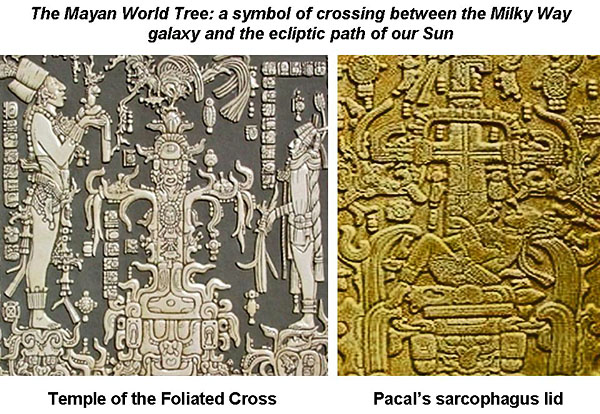
It shows
up most famously within a Temple of the Foliated Cross from
Palenque, or on the sarcophagus lid of Pacal the Great (600 AD). In
the latter case, we can see Lord Pacal resting on his back, looking
up at the night sky and that World Tree. He must have been a keen
astronomer for his day! But why did the Mayans (or Aztecs) call part
of their night sky a World Tree?
“The Mayans
called the diffuse, white path of our Milky Way through their night
sky a World Tree, because it appeared erect like a tall ceiba tree
in summer, when the constellation Sagittarius was located well above
the horizon. It was also called Wakah Chan meaning ‘six’ or ‘erect’
and ‘sky’. A certain location in Sagittarius near the centre of our
galaxy, where the World Tree meets the solar ecliptic, was given
even more attention by the Mayans. That solar ecliptic was often
represented as a bar crossing the major axis of their World Tree,
thereby creating an image similar to the Christian cross”
(see
palenquecross or
creation).
Two
cross-like crop pictures from the summer of 2008 at Etchilhampton
Hill or Avebury Down both showed a Mayan World Tree
Now that new
picture from Clatford on May 4, 2009 clearly shows a World Tree, but
it was not the first. Thus on August 15, 2008, the first Mayan World
Tree to appear in crops was found on top of Etchilhampton Hill (see
Etchilhampton2008):
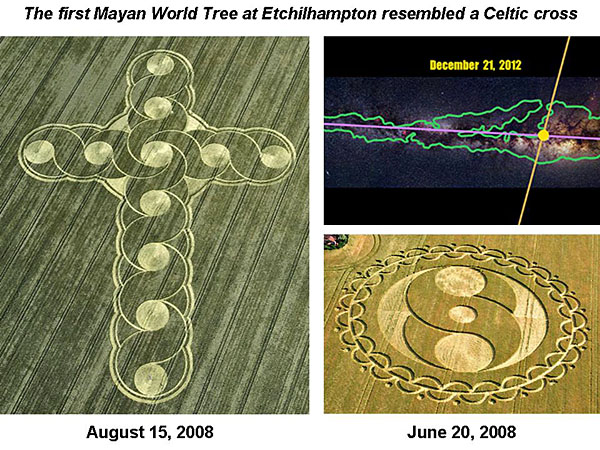
Many people at the
time believed it to be a Christian symbol, because it closely
resembles a Celtic cross. Yet it used a characteristic symbol
for “eclipse” taken from Furze Knoll on June 20, 2008, repeated ten
times, to make up its World Tree (see
furze2008). A large
round “Sun" also appears at its very centre, where the two arms of
that cross intersect (see above, upper left). So it more probably
was meant to tell us about a certain astronomical crossing between
the plane of our Milky Way and the solar ecliptic (see above, upper
right), than anything religious per se.
The next
Mayan World Tree appeared one month later on September 28, 2008 at
Avebury Down (see
aveburydown2008):
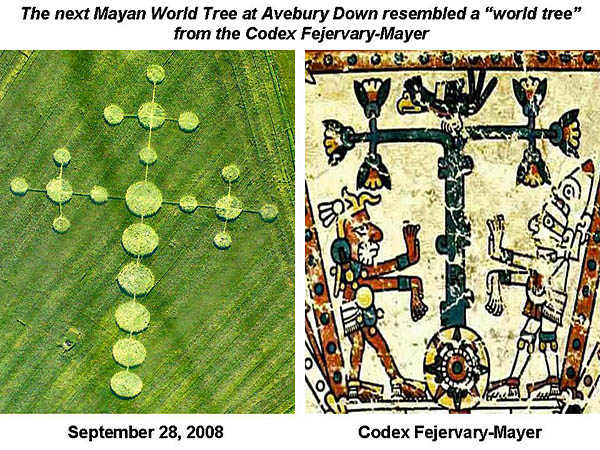
It used
long-forgotten symbols from ancient Mayan astronomy to portray its
World Tree, especially those from the Codex Fejervary-Mayer (see
Mayer
or
fejervary_mayer)
First it showed
six large
circles going up, consistent with a double meaning of “Wak” in the
phrase “Wakah Chan” as either “erect” or “six”. Then it showed three
branch-like protrusions on the left, right and above, although the
ancient Mayans would often draw a funny-looking bird on top!
The latest
Mayan World Tree at Clatford shows “two world trees” from the same
Codex
So far we have seen
only single World Trees. Yet the Mayans (or Aztecs) would often
include two or even four World Trees in the same drawing, in order
to represent cardinal directions in their sky of North-South, or
even North-South-East-West. Indeed, the latest World Tree at
Clatford seems to show “two world trees” from the same Codex:
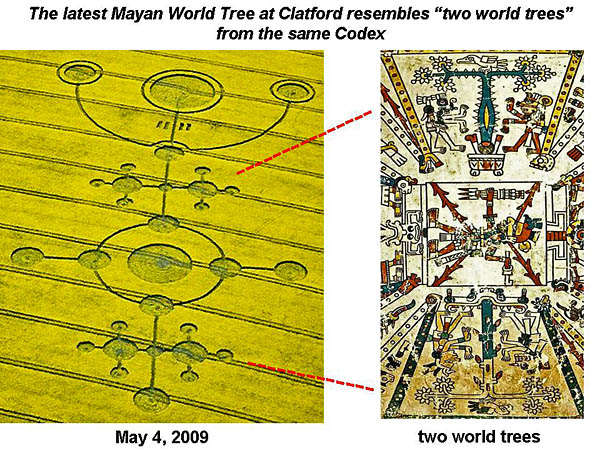
That means
they are trying to tell us about two cardinal directions in our
night sky, whether North or South along the plane of the Milky Way
galaxy (as seen from Earth). Those “two world trees” were drawn
slightly differently in another Mayan-Aztec codex:
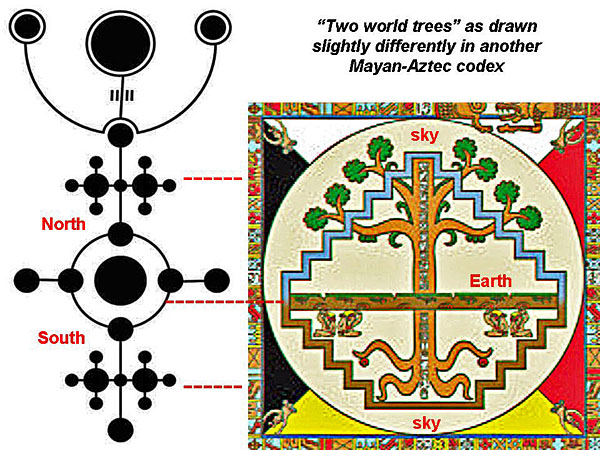
There we
can see two possible sky directions of North or South, along with a
flat horizontal bar to represent the surface of our Earth.
"The World Tree
represents a Mayan view of the sky. Just after sunset on August 13
of any year (the day when their Long Count calendar began in 3114
BC), the Milky Way runs overhead from south to north, almost
like a large tree. The southern or northern skies are located in
branches of those two trees”
(see
maya).
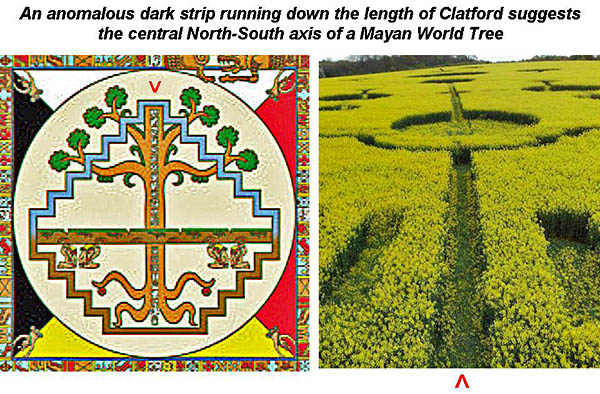
An anomalous dark
strip which runs down the centre of Clatford suggests the central
North-South axis of a Mayan World Tree
The Mayans would often
draw their World Tree with a distinct vertical stripe, in order to
represent the dark central axis of our Milky Way where most stars
are obscured by dust. An indeed, such a strange feature also appears
at Clatford:
Charles Mallet, one of
the leading field inspectors of crop circles, wondered what it might
mean:
“Most
notably, a certain kind of damage shows up as dark strips that run
down the centres of narrow avenues in the formation. All of that
damage looked systematic and intentional, and did not convey the
appearance of standard hoaxing.”
Andrew Pyrka
likewise commented: “A certain perfection is visible throughout
the formation, with swirls and twists everywhere. Yet a central
construction line is also quite clear, where plants show a strong
parting left or right as if something came through the centre”
(see
fieldreports)
A slight curvature of
Clatford down its long axis matches that of our Milky Way galaxy
pretty closely
While preparing this
article, I was contacted by Linda Howe following her interview with
Charles Mallet (see
www.earthfiles.com), because both of them were wondering what
the slight curvature of Clatford down its long axis might mean?
I knew already that
“two world trees” as shown there were meant to symbolize two
cardinal directions in our night sky as either “North” and “South”,
but remained uncertain which was which! After receiving that
important clue from Linda and Charles, it all became clear:
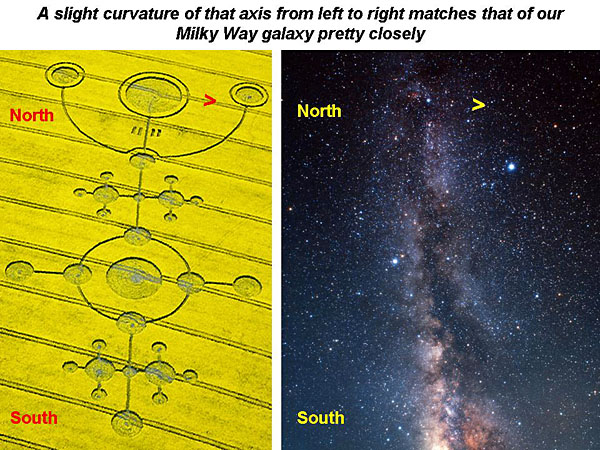
Just line up the
long axis of Clatford with a good photograph of our Milky Way
galaxy, and you have the answer! A constellation Cygnus can be seen
at the northern end of our Milky Way (above right).
Two long curved lines in the upper
part of Clatford suggest a crossing between the Milky Way and the
curved ecliptic path of our Sun
The very
reason why those ancient Mayans called the Milky Way a “World Tree”
was because it crossed halfway along its length, with the curved
ecliptic path of our Sun. Such a feature shows up quite clearly in
the upper part of Clatford (below left), as well as in the Codex
Fejervary-Mayer (below right):
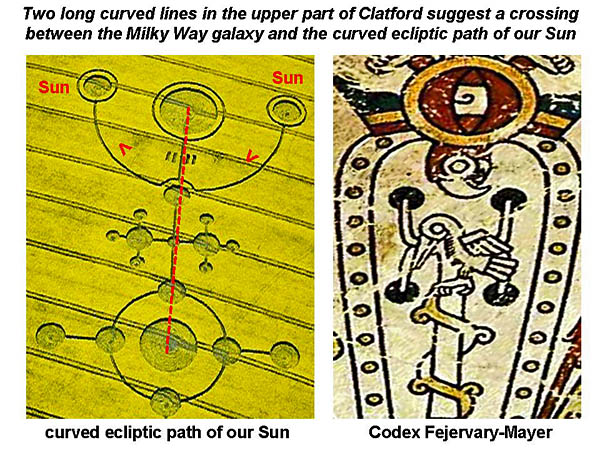
On the
right, our solar ecliptic (near the “bird”) has been drawn as going
in two possible directions as either “up” or “down”. Those two
directions correspond to our Sun’s path through the sky as seen
either above or below the equator, say in central America versus
South America. A two-ended “pointer” from that Codex (top right near
the “parrot”) also appears commonly in modern crop pictures, where
it is used to indicate direction: say at Serpent Mound in 2003 or
South Field in 2008.
When viewed from northern
latitudes, the curved ecliptic path of our Sun always leans toward
the South
The solar
ecliptic can of course be viewed in two possible directions, whether
“up” in the northern hemisphere or “down” in the southern
hemisphere. Yet when viewed from northern latitudes, the curved
ecliptic path of our Sun always leans toward the South:
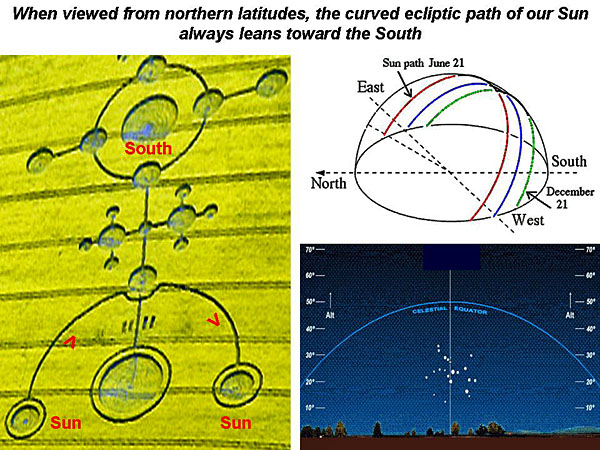
In fact, we can use
such astronomical knowledge to confirm that we have assigned our
North-South axis correctly at Clatford, and indeed we have! For example in England,
the Sun rises in the east, goes south by noon, then sets in the
west. Alternatively in Australia, the Sun rises in the east, goes
north by noon, then sets in the west.
The curved
double-ball symbol shown there for “solar ecliptic” was very
important to the ancient Mayans. They called it a "double headed
serpent", and their kings often wore a "serpent bar of authority" to
symbolize the same thing (see
mayastudies).
The uppermost part of
Clatford along its central axis shows a crop symbol from the early
1990’s which means “eclipse”
Now we can understand most of the symbolic elements shown at
Clatford, in terms of ancient Mayan astronomy and their World Tree,
but what is the picture trying to tell us as a whole?
Well, at the very top of Clatford along its central axis, just above
its two curved lines for “solar ecliptic”, one can see a classic
“solar eclipse” symbol from many crop pictures in the early 1990’s
(see
time2007f):

But what kind of
eclipse? That symbol could refer in principle either to an ordinary
eclipse of our Sun on July 22, 2009, or else to a rare eclipse of
our galactic centre on December 21, 2012 (at the end of the Mayan
Long Count calendar):
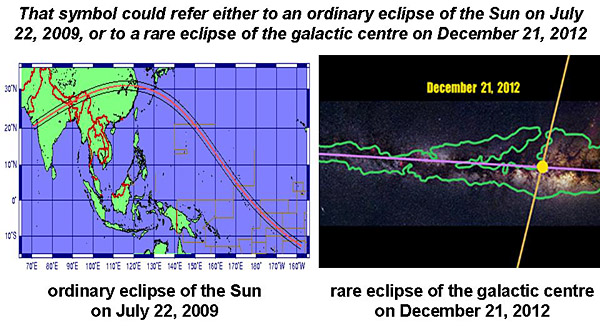
Last summer in 2008,
most of their pictures dealt with ordinary eclipses of the Sun or
Moon (see
080808). How
can we know which kind of eclipse they are talking about this time?
Field orientation at Clatford: why
does its North-South axis point southeast rather than south?
While
pondering this question, one interesting clue came from the local
field orientation at Clatford, which was toward the southeast rather
than south:
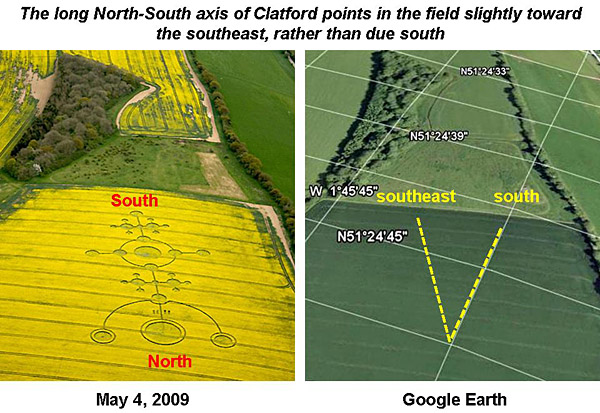
Why would
they deliberately misalign their crop picture away from where it
should be? When choosing field location, they seemed to be very
careful, and focussed on a big clump of trees nearby that point
precisely north or south. Those trees even seem to resemble a
photograph of our Milky Way as shown above!
The southern end of our Milky Way
points southwest in summer on August 13, but southeast in winter on
December 21
In order to address
the question of field orientation, and its possible relation to the
earlier question of “which eclipse?”, I prepared a series of maps of
our night sky relevant to central America near Teotihuacan for just
after sunset local time (see
controls).
Using those
maps, I soon found that the southern end our Milky Way points
southwest in summer on August 13, but southeast in winter on
December 21:
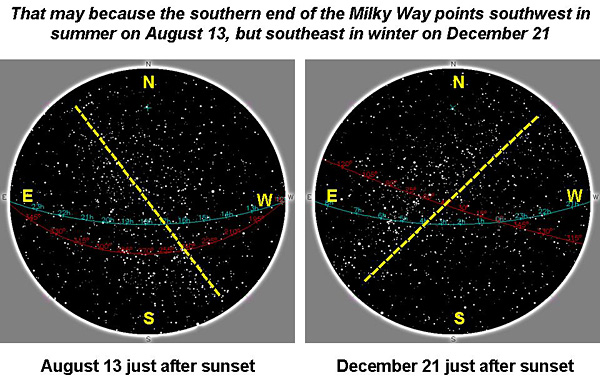
Thus,
their “eclipse” symbol as shown at Clatford was meant to tell us
about a general eclipse of the galactic centre by our Sun on
December 21 of any year, when it passes through the constellation
Sagittarius; or perhaps even a rare eclipse of the galactic centre
(in some particular part) on December 21, 2012, when the Mayan Long
Count calendar ends.
In
summary, Clatford of May 4, 2009 showed us the ancient symbols for a
Mayan World Tree, apparently in relation to an upcoming eclipse of
our galactic centre by the Sun on December 21, 2012.
The CMM Research Team
P.S. We would like
to thank Charles Mallett, Steve Alexander, Lucy Pringle, Tammi
Paxman, Olivier Morel and Andreas Muller for some of the photographs
used here.
Appendix.
First page of the Codex Fejervary-Mayer
For the reader’s
convenience, we have provided below a complete view of the first
page from Codex Fejervary-Mayer, which shows eight “world trees” in
total. Four of those represent North-South-East-West, while another
four in the corners represent
Northeast-Northwest-Southeast-Southwest. The little man in the
centre is their “god of fire”
:

|