|
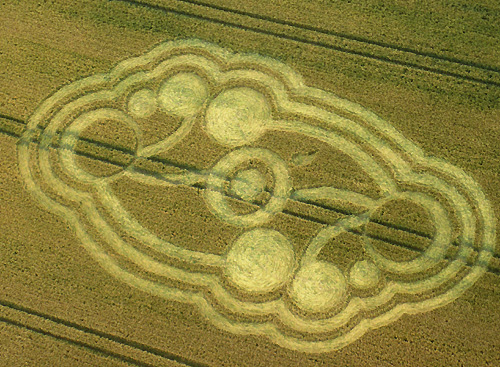
A "small teardrop" was drawn next to our "Sun" at
Liddington Castle on July 19, 2009, in order to predict a minor
geomagnetic storm and aurora three days later, at the time of a
solar eclipse on July 22, 2009
Twice already this summer, and many times in the past, our
mysterious crop artist friends seem to have predicted the future, by
showing a detailed and reliable foreknowledge of unexpected
astronomical events, days or even years before they were scheduled
to happen.
Well-known examples from the past might include: (a) prediction of
the G-spot scar on Jupiter in 1994 due to an impact by Comet
Shoemaker-Levy (see time2007i
or scorpious_hour), (b)
prediction of an outburst by Comet Schwassman-Wachmann 3 in 1995
(see time2007a),
(c) prediction of an outburst by Comet Holmes in 2007 (see time2007g
or
time2007h), (d)
prediction for decoding of the Antikythera device in 2006 (see
time2007u or /time2007w),
or (e) prediction of minor solar storms in 2003 or 2004 (see newfarm
or westkennettavenue).
So far this summer, they have predicted correctly: (i) a giant
sunspot on July 6-8, 2009, by means of two "sunspot" crop pictures
at Avebury Avenue on June 17 or Waden Hill on July 1 (see
westkennettavenue or
wadenhill2), and
(ii) a minor solar flare on June 14, 2009, by means of a "flare"
crop picture at Tawsmead Copse on June 13 (see southfield).
Their “flare” picture at Tawsmead Copse included two crescent-like
symbols, in order to represent upcoming lunar or solar eclipses on
July 7 or July 22 respectively. The larger of those two
crescents was then divided into 39 small parts, as if to say "39
days between June 13 and July 22”. Was something going to happen on
July 22, apart from the expected solar eclipse?
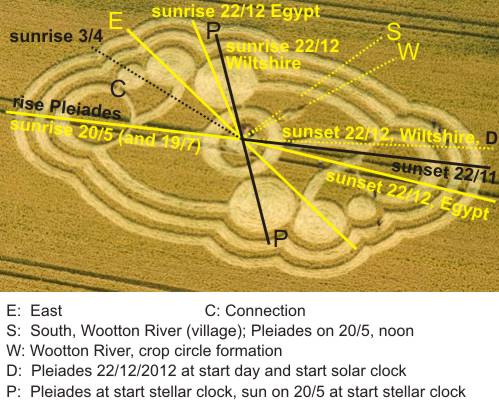
It was thus of considerable interest to see a strikingly clear "map"
of that July 22 solar eclipse drawn in crops at Liddington Castle in
southern England on July 19 (see
badbury). Not
only did their new Liddington picture show the path of eclipse
totality across Earth's surface, but it also showed a "small
teardrop" shape (white asterisk or arrow) next to an "eclipsed
Sun":
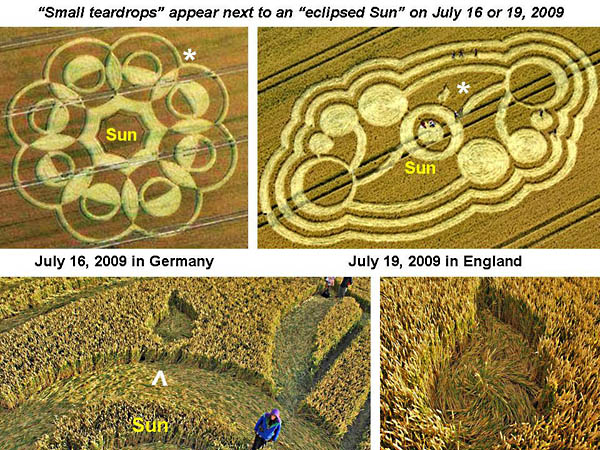
A
fairly similar Sun-teardrop picture had appeared in Germany, three
days earlier on July 16.
Was something going to emitted from our Sun during the brief,
five-hour duration of that eclipse: say a flare, coronal mass
ejection or increased solar wind?
Studying events carefully on July 22, we next found that nothing
dramatic happened to our Sun during the eclipse, but rather
to planet Earth itself. Thus, we learned on the next day that a
minor geomagnetic storm had impacted Earth on July 22 from
0300 to 0900 UT, matching closely the time of eclipse from 0000 to
0500 UT. Apparently it was due to an unexpected increase in the
solar wind from a coronal hole, rather than from a flare or
coronal mass ejection per se. That geomagnetic storm caused
bright auroras all across northern Canada for the first time
in over a year, because our Sun has been so quiet lately:
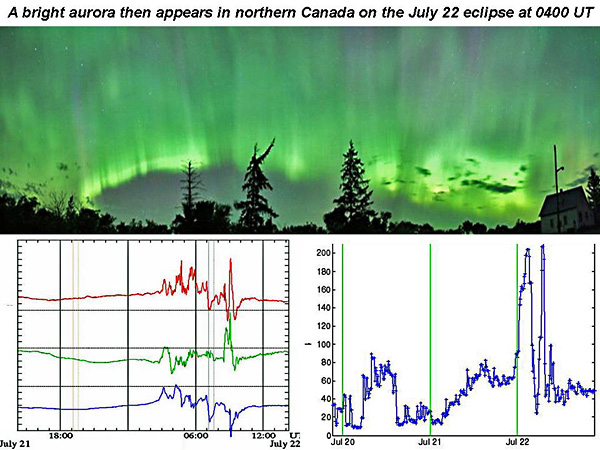
"In the pits of our deepest solar minimum for
over a century, skywatchers had almost forgotten what the northern
lights look like. But they appeared once again last night over
Saskatchewan, Canada. The auroral display was sparked by a solar
wind stream which hit Earth's magnetic field late on July 21.
The ensuing geomagnetic storm registered 6 on a scale of geomagnetic
activities from 0 to 9" (see spaceweather.com
or
http://space.rice.edu/ISTP/wind.html).
"Geomagnetic activity is expected to remain at
minor storm levels during the next 24 hours, then return to quiet.
The Earth is now within a solar wind stream with speeds up
to 500 km/second. Minor storms were observed at a planetary level
early on July 22, with Kp indices of 5 between 0300 and 0900 UT"
(see
http://prop.hfradio.org).
"It has been a long while since the aurora
borealis put on a display like we had this morning! What was
forecast to be a weak solar wind stream from a coronal hole
turned out to be quite strong" (see http://blog.boomerphoto.com/2009/07/22/july-22).
These images from the NOAA POES satellite show greatly increased
auroral activities over both of our north and south poles on July
22, peaking around 0400 UT during the solar eclipse (see
www.swpc.noaa.gov/pmap):
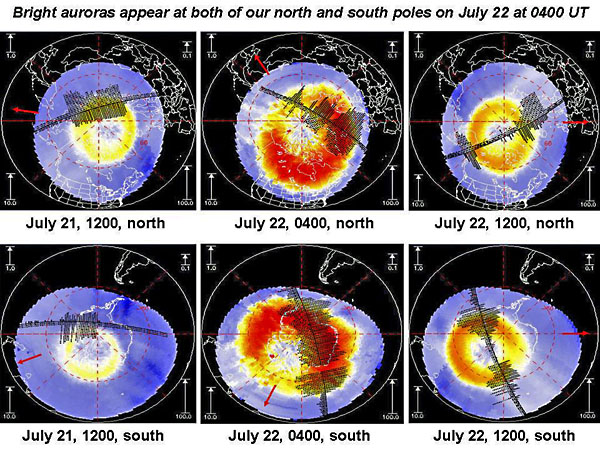
A
crop picture at Milk Hill on June 2, 2009 predicted bright auroras
within our polar regions on a date close to the lunar eclipse of
July 7, and showed eight "small teardrop" shapes (see
milkhill).
That minor geomagnetic storm on July 22, 2009 might therefore count
as (iii) the third unexpected astronomical event which
those crop artists have predicted correctly this summer. As time
goes on, we are learning to read their field-drawn symbols more and
more accurately.
One further point needs to be made here: namely, that the overall
psychology of those crop artists seems to be quite different from
our own. As space-time travellers, they seem to be almost obsessed
with tiny details of solar system astronomy: say a giant sunspot, a
minor solar flare, or a minor geomagnetic storm. Yet none
of those events would interest a typical Earth human in the
slightest! One might be tempted to laugh at them for studying minor
astronomical events so closely, but then some humans on Earth will
fill an entire football stadium, just to watch the acquisition of a
new or talented player by their local club.
The "Quetzalcoatl" crop picture which appeared near Silbury
Hill on July 5, 2009 also seems to make two new future
predictions, of when "large teardrop" shapes (perhaps coronal mass
ejections) will be emitted by our Sun, during the autumn of 2009. A
detailed analysis of binary codes within that picture will be
presented shortly.
The CMM Research Group
P.S. We would like to
thank Olivier Morel, Andrew Pyrka, Lutz Fiedler and Tenho Tuomi for
some of the field images used here. |