|
Because it is made up of such fundamental archetypal symbols, the
beautiful mandala-like formation at Wayland Smithy, nr Ashbury,
Oxfordshire, July 27th incites my need to investigate
further. It did not require too much research before the ingenious and
elegant communication revealed itself. This formation is a reworking, a
reconfiguration of the traditional relationship between the circle,
representing ‘Heaven’, and the square, representing ‘Earth’. Or perhaps
it is the latest development in that relationship. Taking a look at the
actual formation and its implicit relationships, and then looking at the
various traditional meanings given to the basic symbols: the square,
circle, and the number four, we can derive a very powerfully gentle
message of joy, dynamism, creativity and hope.
The
Wayland Smithy formation could have been an emblem carved on an old
church wall or entrance way. It has a somewhat familiar feeling about
it, and seems quite simple in basic form yet upon examination, there is
much to deliberate. This crop circle is made up of many circles, of
many different sizes. The circles relate in size gradually to each
other, forming lines that make up the sides of three squares, arranged
so that the smallest square in the middle is enclosed by a bigger one
and that one is enclosed by the largest one. The centre of each side of
each square is the largest circle in that side. The circles forming the
rest of the side gradually diminish in diameter, giving the square a
more rounded look. This pattern of large centre and smaller sides seems
to be a development of the image of the three circles we see in the All
Cannings, June 30 formation. The three squares are divided into
quarters by a cross of circles whose arms extend by one larger circle
outside the perimeter of the square. The horizontal and vertical lines
of this cross are also made of circles of graduated sizes, with a larger
circle on the perimeter and gradually smaller circles moving into the
centre towards the smallest central circle. This graduated nature of
the lines making up the design give it a lovely sense of softness and
movement as well as the typical solid sense of the square.
|
 |
The
‘squareness’ of this formation is its predominant feature. In many
ancient cultures, Chinese, Indian and Mesopotamian being a few, the
square is the symbol of Earth. It is also representative of God
manifest in Creation, stability, balance, wholeness, order, and the
basis for inner life. It is emblematic of the four corners of the
Earth, the four directions.
The
Earth Sign, a square divided into four smaller squares by a cross, is a
universally acknowledged symbol of Created Earth with the central point
defined by the cross around which the world was created. “The basic
earth sign comes from China, where the ‘four-square’ earth also
represented law and order, given to humanity by the Earth Mother after
originating with Tao, Mother of All Things, and passing through heaven”
(Perry in Walker, 51).
In
this formation we see a series of three squares, a small central one,
middle one and the larger square defining the outside perimeter. This
aspect of the design brings the ‘Morris Square’, also known as the Mill,
to mind. As such it is a board for a game, but it probably came from
the ancient Celtic symbol called the ‘Triple Enclosure’ which delineated
“the center of the world with the four quarters, four cardinal
directions, four elements, four winds, four rivers of paradise, and so
on emanating from the holy Mill or Cauldron at the center” (Huxley in
Walker, 57).
So
far, the square symbolism has given us a lot to think about. The
imagery of the circle and square combined carries a predominant meaning
of the ‘marriage of Heaven and Earth’, the union of spiritual and
material, etc. Usually we see this image as a large square enclosing a
large circle, or a square building supporting a huge dome; a sort of one
to one relationship. The circle appears in this Wayland Smithy formation
241 times, as Stuart Dyke noted. There is a marked difference in the
relationship between the circle and square shapes in this case. Rather
than existing ‘above’ the square, the circle forms actually make the
square and are contained within it. They also arrange themselves in
undulating lines made up of large and gradually smaller circles,
suggesting movement and change. So we have stability in the square
form, yet an amazing picture of dynamic, energetic activity in the
circles that define it. The square with a circle in the middle is
symbolic of the Anima Mundi according to Hermetic philosophy. The
circle has long been the symbol for ‘Heaven’, the idea, and the
uncreated. It also symbolizes the cosmos.
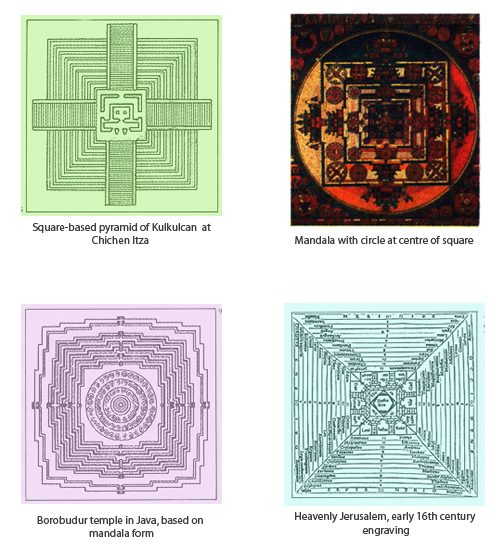
The
eastern mandala is essentially a square formation, with an entrance on
each of the four sides, and usually a circle at its centre. Some
examples of the square as traditional symbol compare favourably with the
Wayland Smithy crop formation. Even the four circles outside the square
form could be seen as ‘entrances’ such as those found in many temples of
the east.
|
|
Does
this new combination of circle/square relationship herald a new way of
life here on Earth? Does this picture hint at the realization of a
spiritualized matter? Does it represent the movement of spirit within?
It does have a sense of completeness, wholeness, perhaps holiness. Are
we coming into a new ‘One’? The idea that the addition of the feminine
element to the Trinity gives us completeness or the totality of the One,
was expressed by the symbolic figure in alchemy, Marie la Prophétesse:
“Du un sort le deux, du deux sort le trois, et du trois naït l’un comme
quatrième” (Encyclopédie, 565). [From one comes two, from two comes
three, and from three is born the one as four.]
The
number four is implicit in the square, and there is such an amazing
universal, pragmatic and scientific foundation for the importance of
four to human life. A very few examples of the significance of four in
our lives are: four elements basic to structure of all living organisms:
oxygen, nitrogen, hydrogen, carbon; four raw materials making up the
‘primordial soup’: water, carbon dioxide, methane, ammonia; four
nucleotides making up the quaternary code of our DNA: adenine, thymine,
cytosine, guanine; four directions for orientation in space. The four
cardinal points are a “phylogenetically ancient navigational principle”
used by bees for example. (Stevens, 116 – 123). In ancient religion the
four elements were key to creation: “ ‘The square signified that Rhea,
the mother of the gods, the source of time, made herself manifest
through changes in the four elements represented by Aphrodite (Water,
source of life), Hestia (Fire), Demeter (Earth) and Hera (Air).’ The
square symbolized the synthesis of the elements” (Penguin, 915). Four
is the number of stages in alchemy, the number of degrees in initiation
in the Algonquin medicine men’s lodge, the number of successive
creations in the Mayan tradition, and so on. What is crucial in all
this is that the ‘Four’ contribute to the totality of the ‘One’. Four
and the square represent that old adage: One in All and All in One, as
does this beautiful crop circle offered to us for contemplation and
enjoyment.
|
 |
A
contrasting image of the relationship of spirit to matter can be seen in
an ancient Celtic artifact found in a Viking grave. In this figure we
see the square body and its interior of chequer-boards and mason
squares. The head is essentially made of rounded lines and surfaces. He
represents the “individual who is spiritualized without becoming
disincarnate” (Champeaux in Penguin, 912). When this image is compared
to the Wayland Smithy formation, we see that some kind of progress has
been made in the relationship between matter (the body and the square)
and spirit (the head and circles). Instead of there being a definite
split between the two as in the spiritually aspiring Celtic figure,
there is a real union in which both the circle aspect and the square
aspect are one.
The
Wayland Smithy circles seem to be dancing into one great mandala
representation of the Earth. This formation could be named The Square
Dance of the Circles!
Michelle Jennings
Sources:
Chevalier, J. &
Alain Gheerbrant. The Penguin Dictionary of Symbols. Penguin
books. London. 1996.
Cooper, J.C.
An Illustrated Encyclopaedia of Traditional Symbols. Thames and
Hudson. London. 1978.
Encyclopédie
des Symboles. Françoise Périgaut, trad. de l’allemand. Le Livre de
Poche. 1996.
Julien, Nadia.
The Mammoth Dictionary of Symbols. Robinson Publishing.
London. 1996.
MacCana, P.
Celtic Mythology. Newnes Books. London. 1983.
Stevens,
Anthony. Ariadne’s Clue: A Guide to the Symbols of Humankind.
Princeton University Press. Princeton. 1998.
Walker,
Barbara. The Woman’s Dictionary of Symbols & Sacred Objects.
Castle Books. Edison, NJ. 1988. |