|
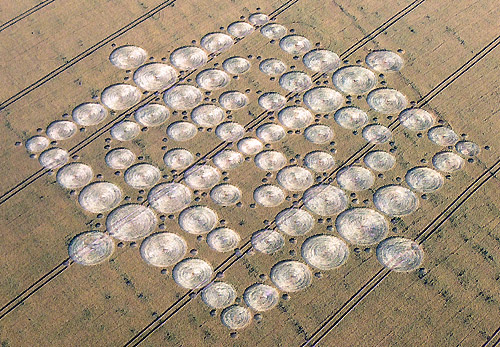
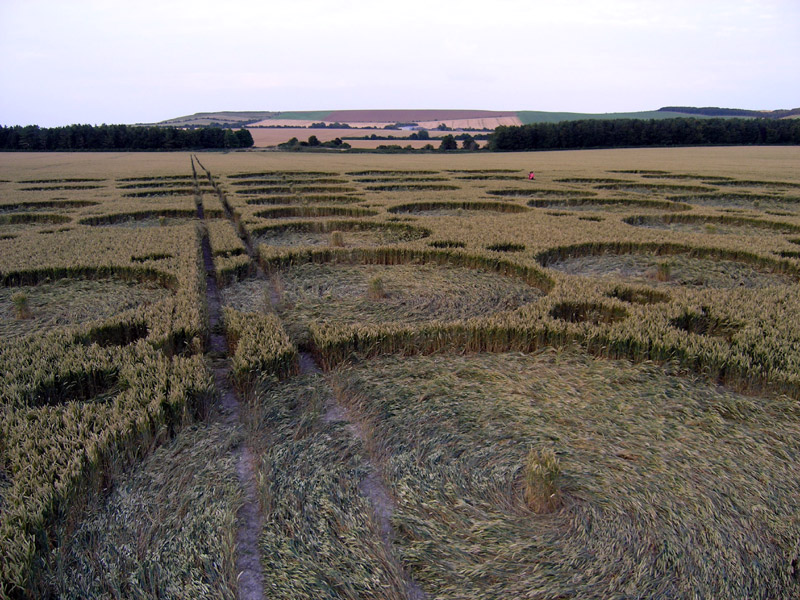
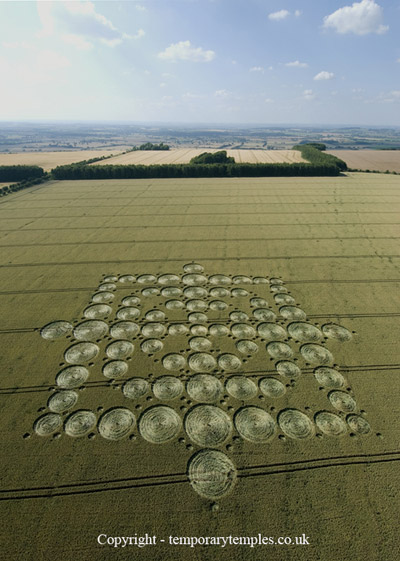
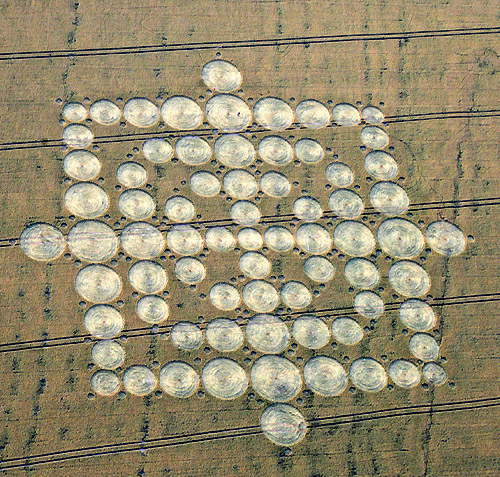
Wayland Smithy, Nr Ashbury, Oxfordshire.Reported
27th July.
A short prime number based analysis, in the style of Neil Hudson
Newman [http://www.milkhill-revealed.com/].
This
analysis takes the number 1 as the first prime number. This is
not accepted practice in modern mathematics, but it was accepted
practice until the 19th century, and a large body of
mathematics is still valid despite regarding 1 and the first
prime number. [HERE]
A list
of prime numbers can be accessed in PDF format from NHN’s
website [HERE].
The formation.
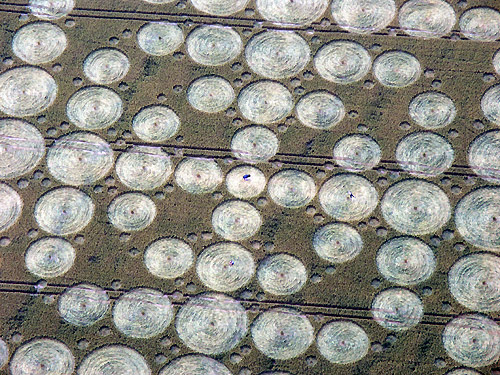
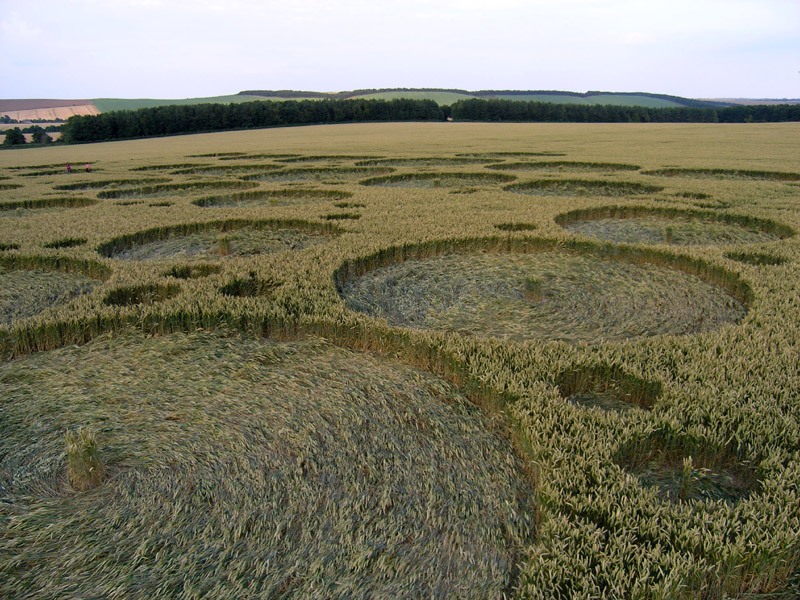
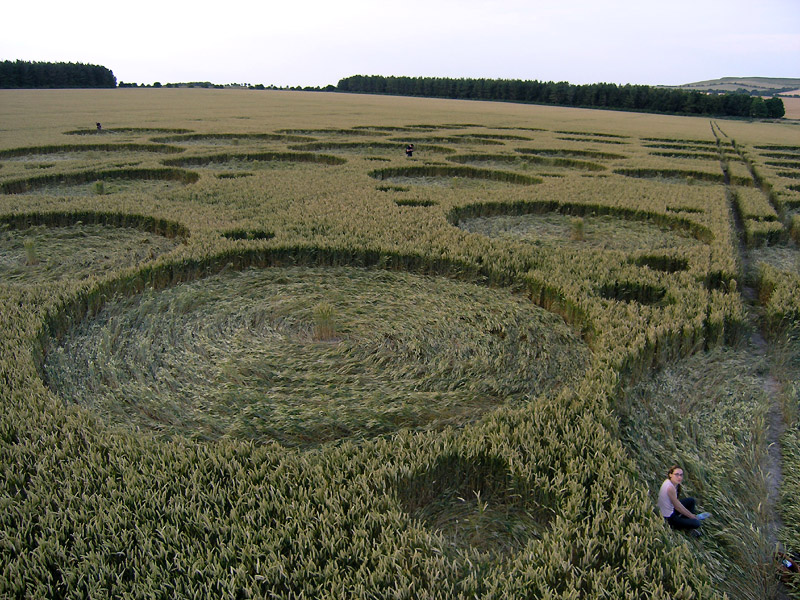
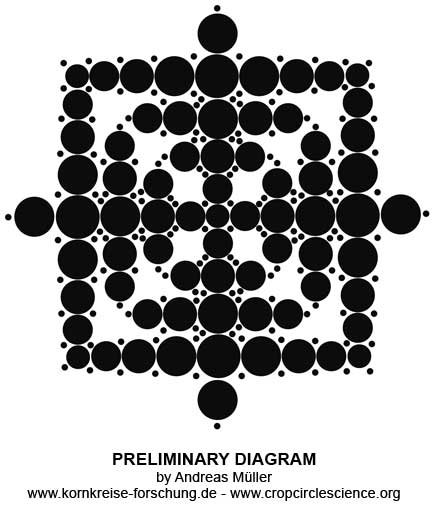
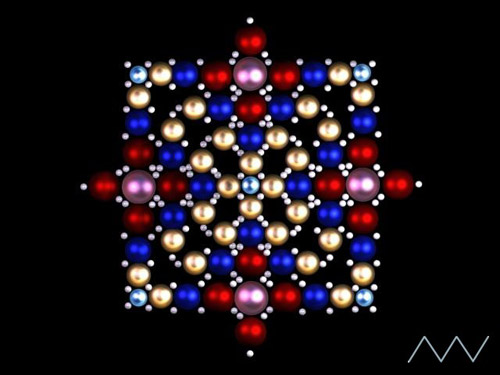
The formation consists of large and small circles. The large
circles have 5 different sizes, and the small circles (sometimes
called grapeshot or satellites – I’ll use grapeshot here) appear
to be all the same size.
Total circles = 241 = 54th prime number (54p for
short)
Total main = 73 = 22p
Total grapeshot = 168
One of the first steps of the analysis is to find relations
between these numbers. Immediately it can be seen that 241 and
73 are primes. What about 168? Well, it can be expressed as 73 +
(73 + 22), which establishes a relation to the other numbers.
241 can therefore be expressed as 73 + 73 +73 + 22.
Incidentally, 73 can be expressed as 22 + 22 + 22 + 7 (.
54 can also be connected in these ways: 54+54+73-13 = 168 and
54+73+73-32 = 168, but I’m sure that you’ll agree that these
relations are a little less tight…
My next step is to establish if this formation has a simple
relation to the number of day it was created/discovered. It was
discovered on the 27/07/08, which, due to the leap year, is day
209. (I’ll cover an interesting relation to the number 208 in
the appendix, in case it does happen to have been discovered a
day earlier). In order to do this I’ll first need to take a
closer look at structure of the formation…
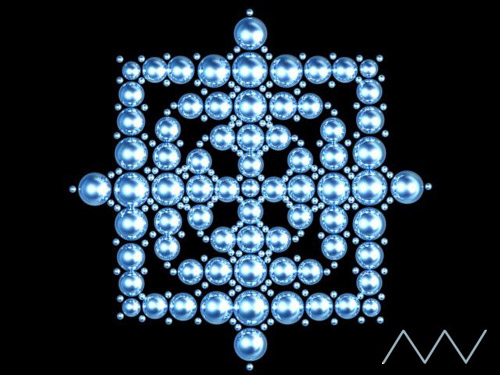
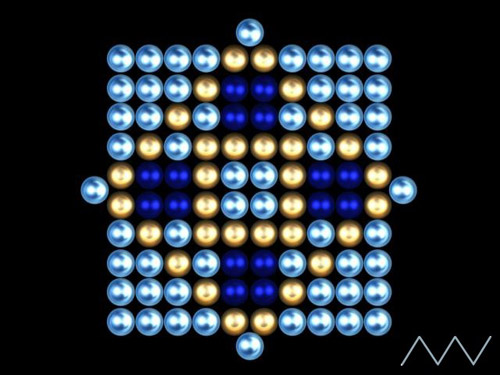
From a ‘basic’ perspective, the formation consists of 1 ‘cross’
placed over 3 shapes (not all perfect squares or circles but a
continuity is implied by the grape shots). From this I can
determine that 4 and 13 are what I call the base numbers (bn) of
the formation. This means that these numbers will be reoccurring
features in the formation. I can determine this because 1+3=4
and 1 and 3 infer 13. Also, turned in the right, the cross forms
the Roman numeral ‘X’, which of course stands for 10, which
added to the 3 shapes can give 13.
Using a technique used by NHN - adding together a number of
primes set by the base number - I can easily make the number
209.
Sum of first 4 primes: 1+2+3+5 = 11
Sum of first 13 primes: 1+2+3+5+7+11+13+17+19+23+29+31+37 = 198
198+11 = 209 - the day of the year on which the formation
appeared.
Now let us pull apart the shapes themselves.
The cross has 21 (or 20 excluding the centre circle) main
circles and 40 grapeshot circles. Either 60 or 61 in total.
The shapes are as follows:
Outer - 32 main and 64 grapeshot. 96 in total.
Middle - 20 main and 40 grapeshot. 60 in total.
Inner - 12 main and 24 grapeshot. 36 in total
Now, 241-32 (number of main circles in outer square) = 209,
therefore demonstrating another simple numerical method of
reaching the day of discovery.
It is interesting to note that this leaves the inner shapes,
which, as they total 20 and 12, infer 2012. This, as we all know
(what you haven’t heard?), is the year of the end of the Mayan
long-count calendar, which is fast becoming the biggest doomsday
meme ever! Given the wealth of Mayan interpretations that this
formation (and countless others) has already had, I find this
worthy to note. (Also, the sum of the inner and middle = 36+60 =
96, the total of the outer square. The two inner shapes are also
more similar in shape than they are to the outer square.)
Another reading of this is to take the four internal circles
(not including the centre circle) away from the 12 leaving us
with 8. This gives us the day of the year 209 from 241-32 and
the year through 20 and 12-4. Am I stretching here?
Here are the other relationships I have found, some not
particularly interesting but others do add support to previous
statements…
- Each of the 4 (bn) segments made by
the cross have 13 (bn) main circles, and excluding the
grapeshot circles linked to the cross, 32 grapeshot circles.
(Does this imply 32 as a base?)
- Each shape is surround by twice as
many grapeshot circles as there is main.
- Excluding the centre circle the cross
has 20 main circles and 40 grapeshot (see previous point).
40/10 (implied by the roman numeral X) = 4 (bn)
- Each arm has 5 main circles (5 = 4p).
4(bn).
- The branches coming off the arms have
3, 5, and 9 main circles respectively. 359 (inferred) is the
73rd prime number, (and the number of main circles) and 73
is the 22nd prime number.
- The prime factors of 209 are 11 and
19. 11p = 29 and 19p = 61. 61-29 = 32! So I guess 32
probably is a base…
- The core (take away the outer square
and the 4 ends of the cross) has 37 main circles. 37 = 13p.
13(bn).
It should therefore be apparent that this formation not only has
a admirable fourfold symmetry, it also has a wonderful
consistency built into its structure, through its base numbers
of 4, 13, and 32, two simple methods of calculating the day of
discovery and the double factor between main and grapeshot
circles, etc. This is all made possible by the importance of
primes as a method for the calculations in much the same way as
the Milk Hill formation of 2001. Is this coincidence?
In Neil Hudson Newman’s analysis (which was after 9/11), he
showed (conclusively, I feel) that the day of discovery + one of
his base numbers (in this case, 29) equalled the date 11/09/01.
Following this, I have come up with these date speculations
(In British format!):
209+4 = 213 = 31/07/08
209+13 = 222 = 09/08/08
209+4+13 = 209+17 = 226 = 13/08/08
209+32 = 241 = 28/08/08
209+17+32 = 209+49 = 258 = 14/09/08
Shall any of these dates prove to be ‘major’ in the same way as
9/11? . . . I would not like to speculate on this.
In NHN’s analysis of the Milk Hill formation he also went as far
as to decipher coordinates that aligned with the 3 attacks (the
1st a supposed attempt on the Capitol building in
Washington). However, I do not find his method as convincing in
this area of his analysis. In other words, I’m no mathematician,
and got lost in his figures…! On that note, I would appreciate
if you would check my numerical calculations here, as even one
mistake could be costly… (to whom?)
Conclusion
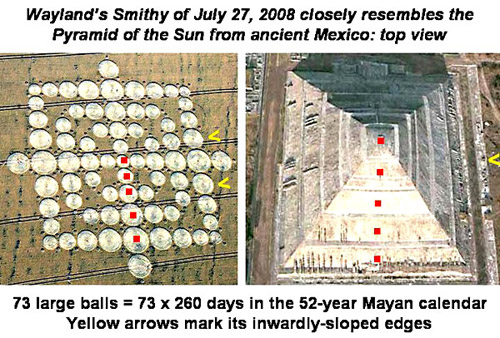
Having read the initial interpretations on Crop Circle
Connector, I have come to the conclusion that this
formation likely has a distinct and important Mayan
interpretation. Many of the numbers relate to Mayan measures of
time, and the shape of the formation itself has also been
likened to Mayan symbols and pyramids.
I would implore anyone with knowledge in this field to take my
findings and to try and relate them to the Maya and their
mythology and mathematics. Perhaps it will help to shed some
light on the coming few years, perhaps even the next few days or
weeks. Whatever the case, I am sure you would agree that this
formation is very special indeed, and its internal numerical
structure proves that if anyone of this earth planned and
executed it, they sure went to a lot of trouble!
Thank you for reading,
Chris Thomson, 29th July 2008.
Thank you to:
http://www.milkhill-revealed.com/
Appendix: The ‘208’ possibility…
I
originally calculated the date of discovery as day 208, because
I didn’t take into account that 2008 is a leap year. I typed in
208 on Google to see what it came up with and I found out that
it was a ‘tetranacci number’. [HERE].
This is
a sequence that starts with four predetermined numbers 0, 0, 0,
1 and the next number is always the sum of the previous four.
208 is the 13th tetranacci number, thereby establishing a
relationship between two base numbers important to the
formation, 4 and 13, and the day of its (wrongly calculated)
creation/discovery, day 208. 208 also happens to be 2X2X2X2X13
or 24 X13.
But of
course, the sum of the 4th and 13th
tetranacci numbers is 209! So I think this date is most likely
correct.
|