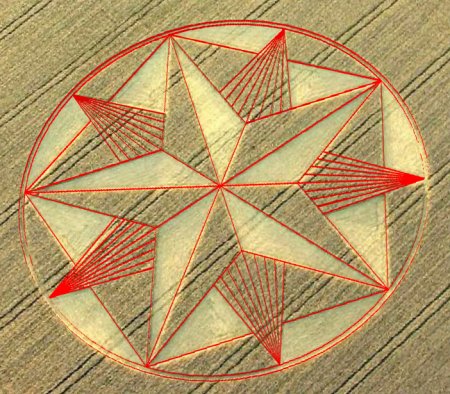
2008 Etchilhampton Hill (3) formation





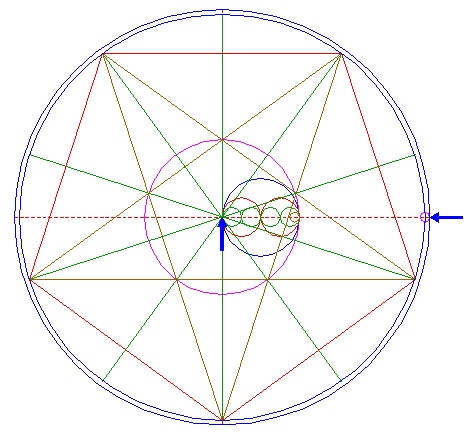
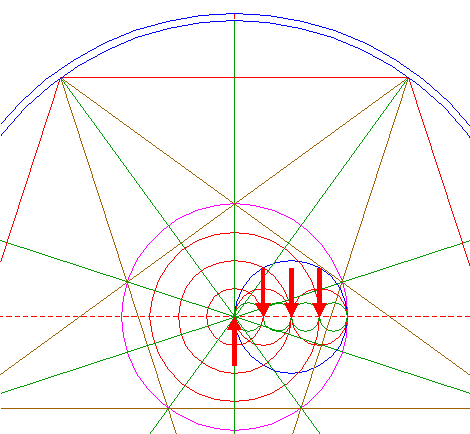

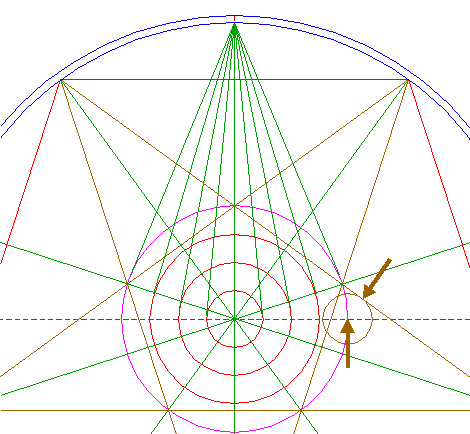
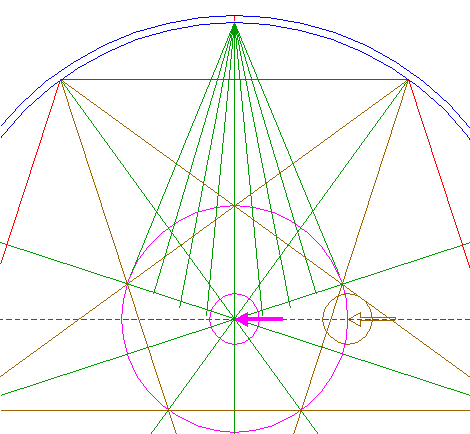
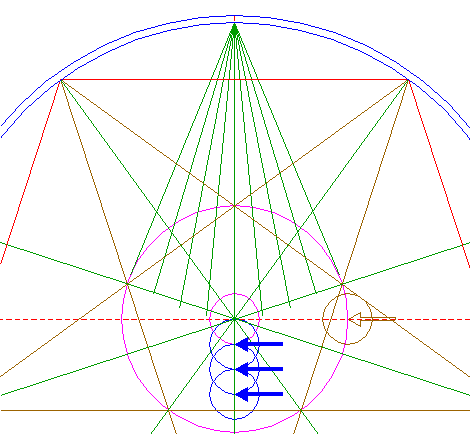
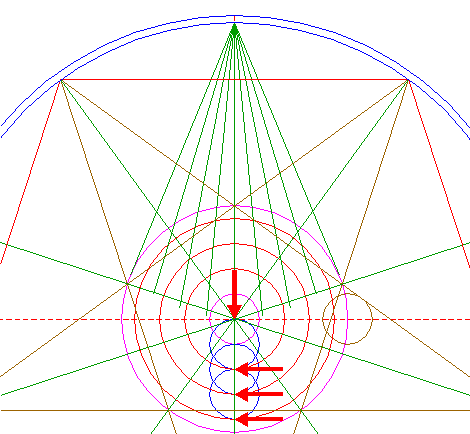
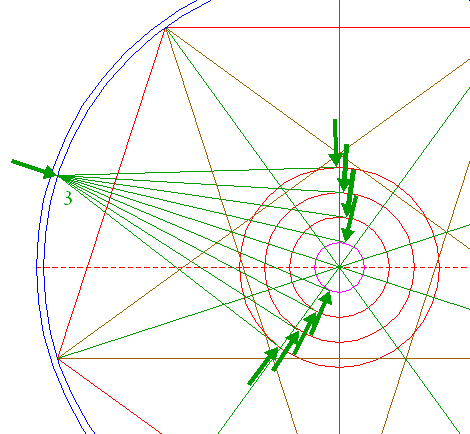
(For clarity, some of the results of previous steps are removed temporarily).
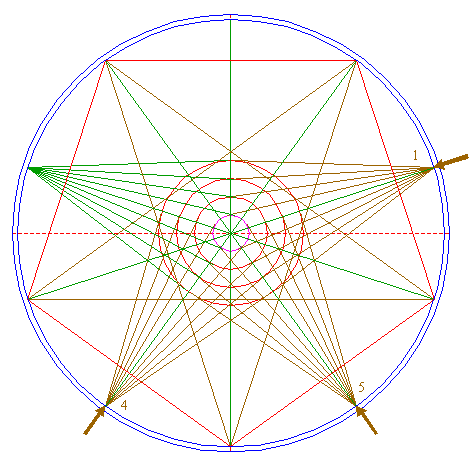




|
Reconstruction of the 2008 Etchilhampton Hill (3) formation | ||
| 1. |
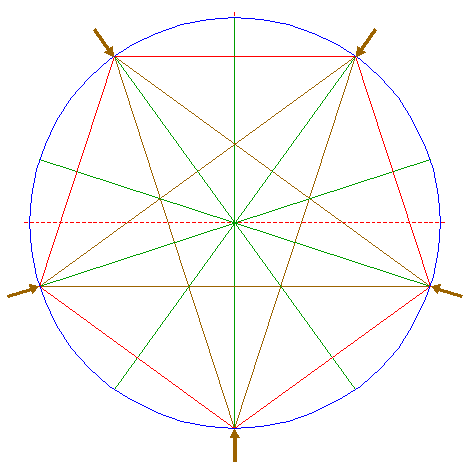
| Draw a circle. Draw and extend the horizontal and vertical centerlines. |
| 2. |
| Construct the inscribed pentagon (regular 5-sided polygon) of circle 1, pointing down. |
| 3. |
| Draw the five rays of pentagon 2, from the center of circle 1 to its angular points. Extend each ray in the opposite direction up to circle 1, and number the end-points of these lines, counterclockwise, from 1 for the righthand one just above the horizontal centerline to 5, as shown. |
| 4. |
| Create the inscribed pentagram (regular 5-pointed star) of circle 1, by drawing the five diagonals of pentagon 2. |
| 5. |
| Construct the circumscribed circle of the pentagon enclosed by pentagram 4. |
| 6. |
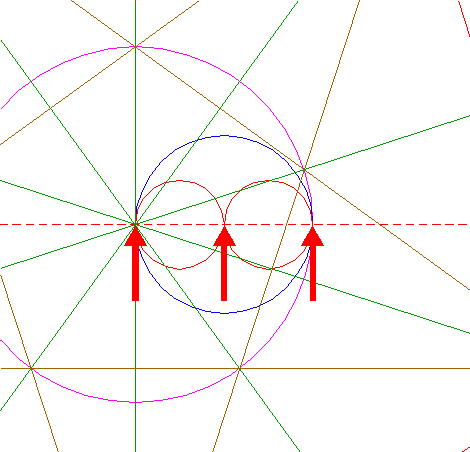
| Construct a "two-points" circle, defined by the end-points of a centerline (diameter), between the center of circle 1 and the righthand intersection of circle 5 and the horizontal centerline. |
| 7. |
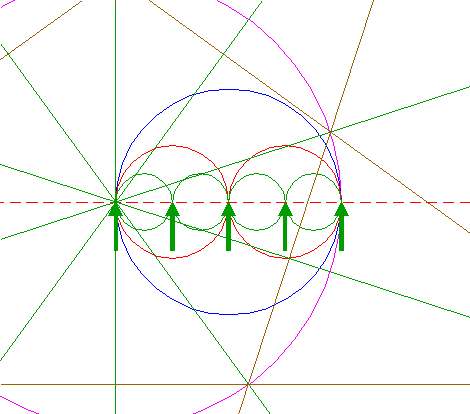
| Construct two "two-points" circles, between the center of circle 6 and its lefthand and righthand intersections with the horizontal centerline. |
| 8. |
| Construct four "two-points" circles, by repeating step 7 for each of circles 7. |
| 9. |
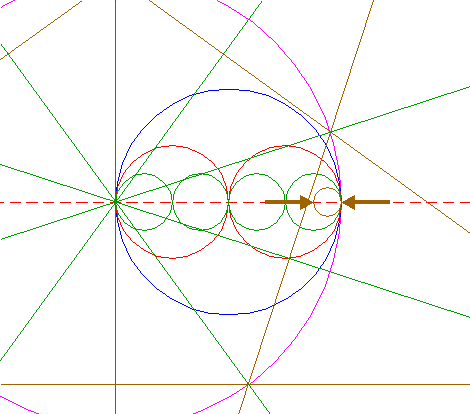
| Construct a "two-points" circle, between the center of the rightmost circle 8 and its righthand intersection with the horizontal centerline. |
| 10. |
| Copy circle 9 to the righthand intersection of circle 1 and the horizontal centerline. |
| 11. |
| Construct a circle concentric to circle 1, tangent to circle 10 at the righthand side. |
| 12. |
| Construct three circles concentric to circle 1, passing through the mutual intersections (tangent points) of circles 8. |
| 13. |
| Draw eight lines, all from the end-point of rays 3 nr. 2, tangent at both sides to circles 5 and 12. |
| 14. |
| Construct a circle centered at the righthand intersection of circle 5 and the horizontal centerline, tangent to the diagonal of pentagon 2 connecting the upper lefthand and lower righthand angular points. |
| 15. |
| Copy circle 14 to the center of circle 1. |
| 16. |
| Copy circle 14 three times, the first to the lower intersection of circle 15 and the vertical centerline, the others to the corresponding intersection of their preceeding ones. |
| 17. |
| Construct three circles concentric to circle 1, tangent to circles 16 at the lower sides. |
| 18. |
| Draw eight lines, all from the end-point of rays 3 nr. 3, tangent at both sides to circles 15 and 17. (For clarity, some of the results of previous steps are removed temporarily). |
| 19. |
| Repeat step 18 for rays 3 nrs. 1, 4 and 5. |
| 20. |
| Circles 1 and 11, pentagon 2, lines 3, 13, 18 and 19, and pentagram 4, are used for the final reconstruction. |
| 21. |
| Remove all parts not visible in the formation itself. |
| 22. |
| Colouring all areas corresponding to standing... |
| 23. |
| ...or to flattened plants, will finish the reconstruction of the 2008 Etchilhampton Hill (3) formation. |
| 24. |
| The final result, matched with the aerial image. |
| Copyright © 2008, Zef Damen, The Netherlands |