What!!! On Earth??? By
Michelle Jennings
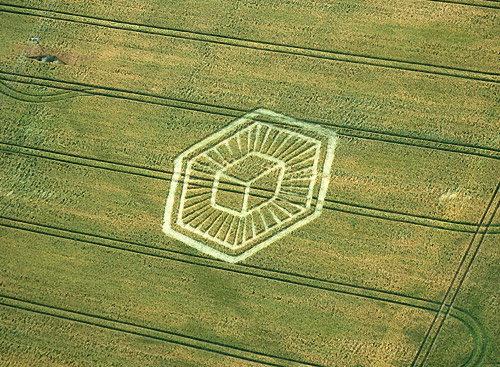
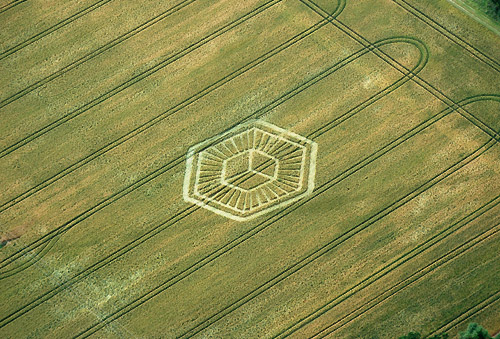
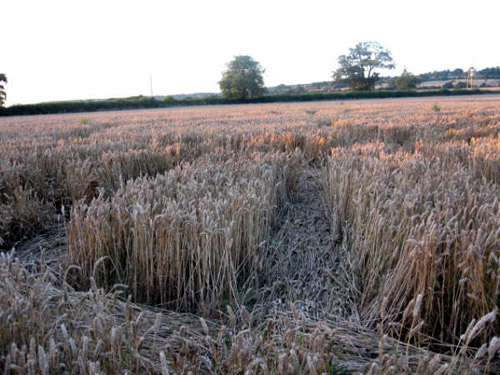
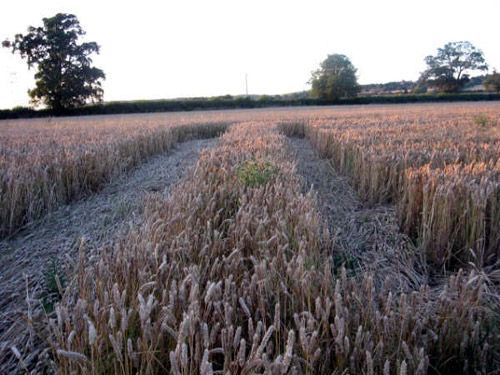
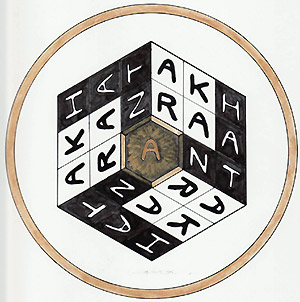
The Toot Balden crop circle, reported July 7, 2007 conveys to
us another fascinating message in such a succinct, yet
multi-faceted way. My main area of knowledge is symbolism and
traditional mythology, so hopefully it will complement the
mathematical and scientific information that has been coming in
regarding the crop circles this year.
Hexagram is contained by, and to some extent, defines the
hexagon. Symbolically, the hexagram stands for the yin/yang, the
union of male and female, and the sacred marriage. It
represents primordial energy and the Source of all Creation, the
Great Androgyne. In Jungian terms, it represents the union of
opposites, i.e.of the personal, temporal world of the ego with
the non-personal timeless world of the non-ego. Ultimately, this
union is the fulfilment and goal of all religions. (Penguin
Dictionary of Symbols) At Uxmal, Yucatan, it is a symbol of the
sun shedding its rays on earth the fertilization of earth. The
hexagon itself symbolizes a dying, or surrender to a greater
force in preparation for new life, something like what happens
to bees over the winter in the hexagonal cells of the honeycomb
in order to re-emerge in springtime.
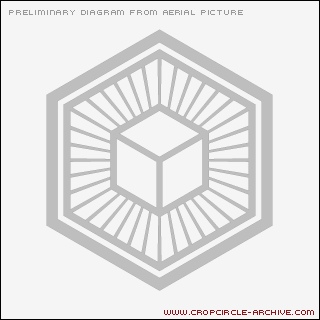
The cube, which in this formation is represented by the interior
hexagon with the y lines to indicate the 3D cube, is a symbol
of earth and its four corners corresponding to the sunrise,
sunset, midday, midnight and to the solstices and the
equinoxes. It also brings forth the concept of solidification,
stability, (therefore truth and the base for the throne of the
goddess, e.g. Cybele, Rhea). In Chinese tradition it is
representative of the earth deity. In Mayan tradition, the Tree
of Life grows from the Centre of a Cube. It symbolizes the
material universe and the New Jerusalem.
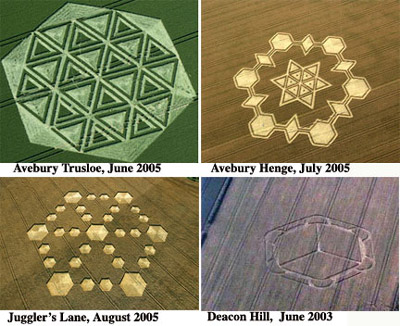
Previous crop circles that feature the hexagon, as the main
characteristic of the lay, with some indication of the cube,
are: the
Juggler's Lane formation of August 2005;
Avebury Henge
July 2005;
Avebury Trusloe June 2005;
Deacon Hill, June 2003.
In an article I wrote about the Juggler's Lane formation, I
noted that the whole design was suggestive of the iron crystal
formation of the Earth's core (Ideas and Associations Regarding
Juggler's Lane, near Cherhill, Wiltshire, August 21, 2005). The
Avebury Henge formation was considered by some to be referring
to the water crystal and Dr. Emoto's theory (The Love and
Gratitude Formation).
The point I am getting at here, is that these particular types
of formations are referring directly to Earth and the material
dimension: earth, water, fire, air. These four elements are
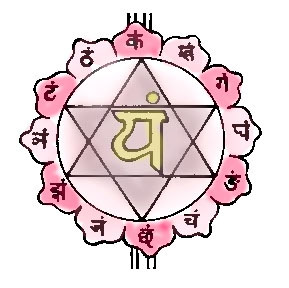
associated with the first four chakras, with the fourth, the
Anahata (meaning: a sound not made by striking, i.e. Om) chakra
the heart chakra being represented by a twelve-petalled pink
lotus whose centre is a smoky coloured hexagram. This chakra is
the centre where material and spiritual energies meet, join, and
interact. It is the balance, and therefore a stabilizing force,
as is suggested by the cube form in the centre of the Toot
Balden crop circle.
Anahata
The rays in this formation seem to be coming from the cube
centre. Light seems to be coming from the inside in this
formation. Is there some new way in which our own earth and
matter will manifest? Will the long-perpetuated association of
matter with darkness and evil become a perception of the
past? And will we be shown another side of matter that has
until these times had to be hidden? Some 2006 references to
quantum changes and space-time perception seem to support these
ideas.
It seems that the Toot Balden crop circle supports a message
that is bringing us to a new understanding of ourselves, of our
material world and of the Earth itself in relation to an
ever-evolving universe.
References:
Chevalier, Jean & A. Gheerbrant. Penguin Dictionary of
Symbols.
Penguin Books. London. 1982.
Cooper, J.C. An Illustrated Encyclopaedia of Traditional
Symbols.
Thames & Hudson. London. 1978.
De Vries, Ad. Dictionary of Symbols & Imagery. Holland
Publishing
Co. Amsterdam. 1974.
Julien, Nadia. Mammoth Dictionary of Symbols. robinson
Publishing.
London. 1996.
Walker, Barbara G. The Woman?s Dictionary of Symbols &
Sacred Objects. Castle Books. Edison, NJ. 1988.
Michelle Jennings |