|
It cannot be denied that this particular
crop circle is quite extraordinary in terms of its shape and large
area of downed crop. Nonetheless, I do not consider this lack of
similarity to previous years’ circular beauty in crop formations to be
a criterion by which we should dismiss the relevance of this formation
as an opening statement for this season’s crop formations in Britain
in particular. Although it seems rather clumsy and boxlike, it has its
own internal mathematical harmony that has vast, universal and
activating connotations.
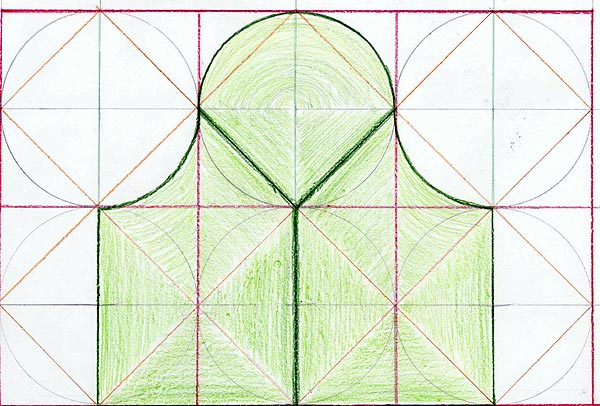
The underlying geometry, it seems to me (an amateur beginner at
reconstruction of formations) is a large rectangle containing six
‘squared circles’. The diameter or the central upper circle provides
the dome shape in the centre of the formation, and the lower southwest
and lower southeast quarters of the upper circles on each side of the
central one provide the beautifully curved upper sides of the
formation. The lower perpendicular sides of the formation descend from
the vertical axes of the two upper circles to meet the tramlines at
90* angles, forming a rectangle containing two squares delineated by
the central perpendicular extending from the vertical axis of the
central upper circle and supporting two ‘wave peaks’ which are defined
by the arms of the central ‘Y’ formation.
The arms of the ‘Y’ are defined by the points of contact of the two
upper outside circles with the central upper circle joined to the
intersection of the central vertical with the perimeter of the central
circle. The ‘leg’ of the ‘Y’ is defined by the extension of the
vertical axis of the upper central circle to the tramline. The arms of
the ‘Y’ extend invisibly as boundaries for triangles within the
squares below.
Symbolically, we must consider the circle, the square, the rectangle,
the triangle, the ‘Y’, and the tramline all in relationship to one
another to get any sort of meaning from this formation. The circle,
square and triangle could be considered the most basic, almost
ontological symbols, for all of humankind. The rectangle, ‘Y’ and the
tramlines belong more to the active human participation in the
understanding and establishment of relationship between the World and
its Creator.
The basic theme (to my view) here is ‘We’ve got a big part to play in
this!’ as different from many former formation themes like ‘There is
Presence and Beauty which is guiding, overseeing and protecting you!’
When trying to understand a message from the unconscious or in
symbolic form, I usually like to start with the most familiar,
concrete and mundane thoughts, relationships and feelings. One very
interesting and perhaps mundane observation I note in this formation
is that it looks somewhat like an old mantelpiece clock, at least the
top part of it does. Is it time for some action?
Also, the base for the whole formation is a man-made, really
pragmatic tramline. Tramlines have been used as reference points and
lines before, I know, but this is definitely a crucial and important
part of this formation. The contemporary activity and work of humans
in their daily lives are implicated in this fact. After checking out
these more worldly and practical approaches to the significance of
this design, we can move on to a
historical/religious/symbolic/spiritual/mathematical understanding.
The square is universally considered a symbol for earth, matter,
stability, limitation, and order in the universe. The four corners of
the Earth and the four directions are extensions of this idea. The
rectangle is a development of the square, representing home, the
female form. When it has the proportions of 1 to .618034, then it
represents the ‘Golden Mean’, the base for the measurement of curves
of seashells and galaxies, natural phenomena, and basic proportions
for many architectural works (one being the Parthenon), and other
daily objects such as windows and playing cards. The rectangle is also
named the rectangle of the ‘Divine Section’ and it is found in many
artistic and architectural works throughout the ages. The rectangular
proportion containing this formation is an approximate to the golden
mean
proportion. So we have some representation in this geometry, of the
Earth and its characteristic growth and stability.
The circle is a universal symbol for Heaven, the spiritual. The
circle bisected horizontally is a symbol for the division of the
waters above from the waters below, between heavens and the
firmament. The diameter is also a symbol for the Mother Goddess---Dia
(goddess) Meter (Mother). The circle in this formation is omnipresent
as ‘squared’ circles and circles which circumscribe squares. The
central circle that provides the dome in the manifest design is
squared by a square in the grid of six squares in the great rectangle,
as are the circles represented by the two lower quarters. The arms of
the ‘Y’ form a right angle to each other, thus describing one half of
a square that is circumscribed by the central circle in the formation.
If we just consider the relationship of these simple shapes to one
another and then take into mind the symbolic meaning of these shapes,
we could come to a conclusion that the formation is some kind of
representation of the interaction of Heaven and Earth, Spirit and
Matter, –what is named by some ‘the Marriage of Heaven and Earth’. It
is a representation of matter imbued with spirit and spirit existing
in matter.
Then we see a great ‘Y’! According to Pythagoras, the ‘Y’ represents
‘man’ or humanity, the central ‘leg’ being the foot of innocence of
the child and the arms being the ability of the adult human to choose
between good or evil. ‘Y’ also represents the crossways, the diverging
paths, and three in one. It also represents the Androgyne who, having
experienced enlightenment after dissolution and death, becomes the
Hermaphrodite, now whole, unified, centred, the ‘petra genetrix’, the
‘Philosopher’s Stone’. The ‘Y’ is also a symbol for the Egyptian god
Seth who was the brother of Osiris and the opponent of Horus. He
represents: the constant battle between good and evil, war, chaos, and
destruction. Although he is mainly seen as a negative force, probably
in the First Kingdom he was considered more positively and was
associated with Min the god of fertility. The death of Set resulted in
the flooding of fields with his blood, thus replenishing the soil for
new planting, just as the Nile floods its banks each year. Whatever
the nuances, is seems that the symbolism of ‘Y’ as Set and man could
be profoundly significant in the context of this formation since the
idea of conflict between good and evil, and the element of free will,
of choice is implied. Another important implication here is the idea
that there is a goal of redemption or salvation, i.e. the becoming
‘whole’ or overcoming destruction brought on by the conflict of
opposites.
The triangles that are seen in the downed crop form an ‘Earth
Diamond’ or ‘Eye of Fire’ within the squares of the lower
rectangle. This is said to be the sign of the Virgin Earth–Mother
Earth at the beginning of creation. The Goddess with the ‘eye of fire’
was a Nordic Goddess whose fiery eye always saw the truth and mortal
faults could not be hidden from her. So implicit in the presence of
the triangles is the notion that perhaps we are approaching a
beginning of a new way of life on Earth, a new creation–one in which
the truth is revealed so that deceit and treachery cannot dominate or
rule.
The top wavy line, defining the top boundary of the formation is
similar to the sign Leo of the western zodiac, but resembles more
closely the Runic symbol for Midsummer (Pennick, runic time circle
130). I do not know if this is significant at all, but it is possibly
a part of the interpretation.
If these formations have to do with our lives here on the Earth and
some kind of major change to come, as has been predicted by so many in
so many ways, then this particular type of formation is perhaps giving
us a clue as to how humanity is to participate in the huge
transformation. Our Earth is a receptacle for the Divine. Our labour
and thought are critical to the transformation process, which will
render the union of the spiritual and material apparent in this
existence. This is for all; there is no exclusivity in terms of faith
or no faith. The symbols used for this message are essentially
universal, understood by cultures all over the world and innate to
mathematical understanding of the universe. It is Humanity’s will, our
choice to begin to know and accept ourselves as partners in the divine
process of creation that will determine the success of our inclusion
in the equation for progress of conscious life on this planet.
The dramatic change in type of formation is an indicator that there
is now a dramatic shift in how the action is to be carried out, i.e.
with our participation as co-creators of our own destiny.
Sources:
Cirlot, J.E. A Dictionary of Symbols. Routeledge & Kegan Paul. London.
1978.
Cooper, J.C. An Illustrated Encyclopaedia of Traditional Symbols.
Thames and Hudson. London. 1978.
De Vries, Ad. Dictionary of Symbols and Imagery. North-Holland
Publishing Co. Amsterdam. 1981.
Pennick, Nigel. Rune Magic: the History and Practice of Ancient
Runic
Traditions. Aquarian Press. London. 1992.
Walker, Barbara. The Woman’s Dictionary of Symbols & Sacred
Objects. Castle Books. Edison. 1988.
|