Images CCC Copyright 2005
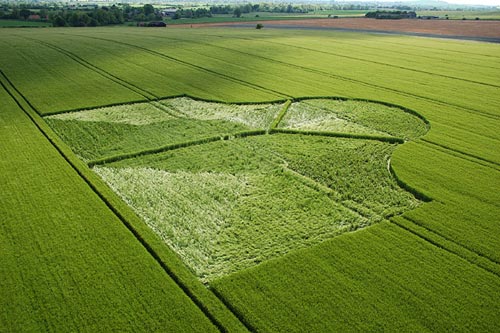
Image Steve Alexander Copyright 2005
|
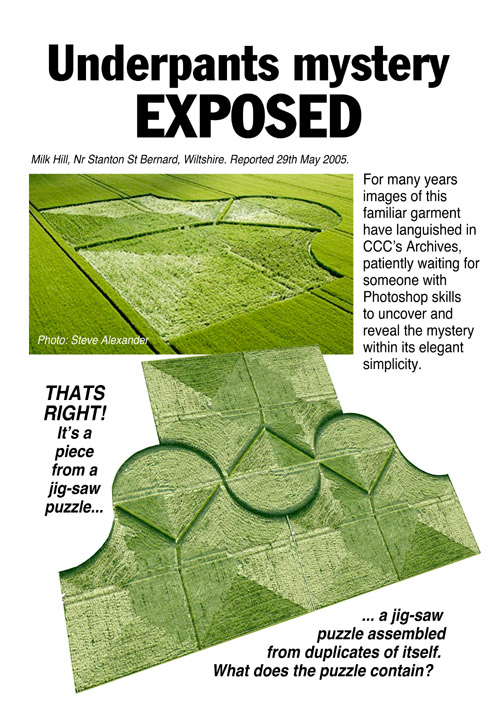
MILK HILL REPORT.
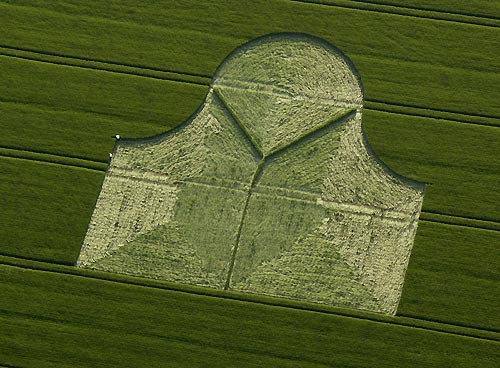
Probably the most unusual and perplexing
design to have appeared so early on in a crop circle season. Many of us
normal expect to witness the conventional forms of circles or some kind
of formation based around circular geometry. However this design
certainly wasn't devoid of these characteristics, but its shape
raised a number of eyebrows and caution towards its origin.
The Crop Circle Connector has to be
honest, and confess that we felt very unsure about this event
initially, and indeed this feeling hasn't entirely debated. What was
really fascinating and very confusing at the same time, was its floor
construction. It was the quality of the floor pattern that stood out from
our entire experience of this design.
On the ground there were plenty of
features that have become hallmarks towards events that have
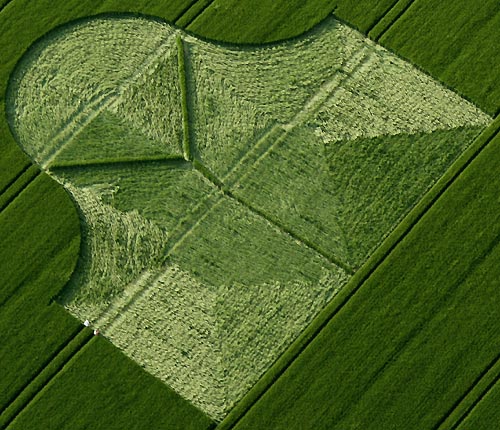
pleased us down through the years. The three sections of crop, created
this 'Y' shape in the middle, which when viewed from the air looked quite
irregular. However it was the two lower sections that impressed us the
most, as they were flattened in four quarters, and created with some
quality. The geometry involved within this portion of crop, is referred
to as the Golden Section, and has been widely used in Architecture
throughout the centuries.
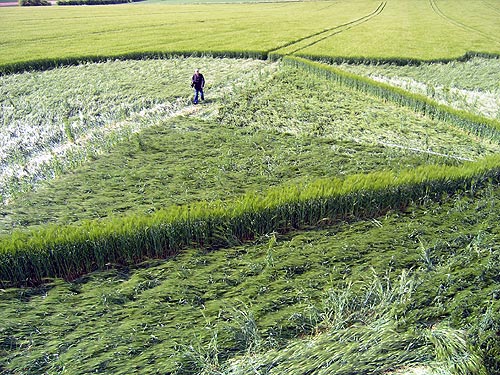
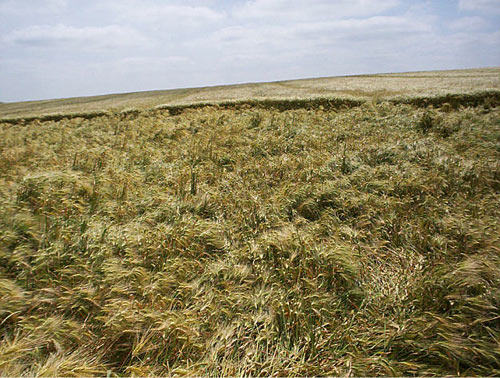
The recovery of the crop at this stage in
the season, meant that walking on the crop itself had to be done
with some care. The Barley was still quite immature, as your feet tended
to disappear if you walk within the plants, and it was very lightly
flattened. Around the perimeter and standing crop of the 'Y' shape
was a one foot wide pathway. This made negotiating each portion of the
formation easier, as it was quite a relief to minimize walking on
the larger areas of the Barley.
From the aerial photographs the four
directional flows can be fully appreciated, which ultimately
creates this three dimensional effects, using the light and shape
technique. This was the clever part to the whole design.
Running across the lower half of the
formation, was one tramline, which contained a curtain of crop, which
when viewed closely showed no signs of being flattened. This particular
effect has been witnessed several times in the past, and is possibly due
to the lower pressure being applied to the crop at this point. This is
why some plants remained unaffected and in some cases completely
untouched. However this natural division within the formation was the
marker for the direction of crop in the lower sections. The upper two
directional lays were on the other side of the rut of the tramline, which
demonstrates that the tramlines were very important towards the
construction of the event.
Certainly a design that has been on
everyone's lips at this stage in the season. Its unusual nature has
provided many representations, but perhaps this was its intention, to
make us all wonder over its interpretation.
Report
Stuart Dike |
AN ARTICLE BY M GLICKMAN
We are like teenagers who, when offered an exquisite but unusual meal,
moan to mummy and daddy that they want a McDonalds or a Kentucky Fried
Chicken.
It is my opinion that the 30th May formation at Stanton St Bernard,
though original and unfamiliar, will prove to be one of the most
important and articulate crop circles of the year.
The crop circle phenomenon is delivering a curriculum which is
designed, at every step, to stretch us far beyond our comfort-zone. Our
ill-considered responses to Stanton St. Bernard show just how
desperately we are in need of the wisdom on offer in the fields.
It was characterised as “a blot on the landscape” and likened to
“underpants”. These comments add little to our understanding of
anything but the sadness of their authors’ spirits and imagination.
Let me deal with blatant errors.
First, the crop was barley, not “young wheat” as suggested.
Third, the lay, derided by many, was as light as any formation we have
seen and in many areas seemed hardly moved down at all. However the
aerial shots show just how careful and artful the segmental
floor-patterning was.
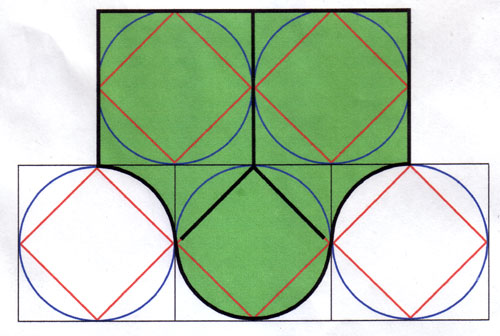
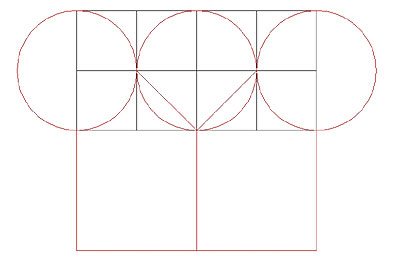
It was clear immediately that Stanton St. Bernard bore a subtle and
specific geometry. The diagram is idealised and not to scale. It shows
the basis of the construction and order.
A row of three squares, shown in thin black lines is placed above a row
of two identical squares. The two rows are staggered so that they are
centered in relation to each other. A circle, shown in blue, is placed
in each of the five squares, and a smaller square, oriented diagonally,
is placed within each circle. The larger, containing, square holds the
circle at the centre of each of its sides while the smaller, contained,
square touches the circle with its corners.
Diagram
Michael Glickman Copyright 2005
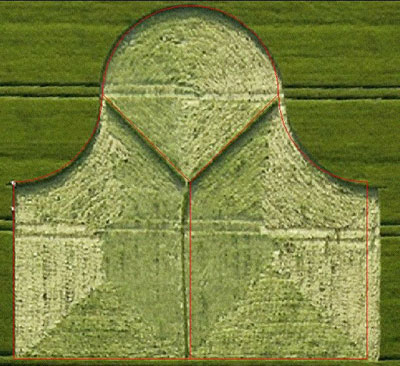
Once this diagram is set up, the order of the formation is clear,
though the meaning remains - for the moment at least - a mystery. The
three thin standing walls of crop forming a “Y” conform precisely to
the diagram, as does the sine curve made of a semicircle and two
quadrant shoulders.
The sine curve defines the circumference of a single circle (one half
plus two quarters) while the rectangle below it is made of two sides
and a double-length for the base. These might equate to the four sides
of a square. Once again, the circle to square relationship is
highlighted.
It was surveyed by Dan Vidler of ukcropcircles and his measurements
emphasise the disparity between idealised diagram and field reality. We
might have expected the base-line of the two squares of the lower row
to be cut exactly in half, but in fact the base of the western square
was 96 feet while the eastern was 108 feet. The numerically sharp-eyed
will immediately note the 8 to 9 ratio here. What might this suggest?
The importance of this remarkable event will, I suspect, continue to
reveal itself through the season as others work seriously on it. It is
a glowing augury of things to come.
We are being offered strange and enigmatic gifts and perhaps the
uniqueness of this formation indicates its importance. We learn nothing
if we look only through the superficial lens of precedent and
convention.
|
Images Nick Nicholson
/ The Crop Circle Connector
Copyright 2005
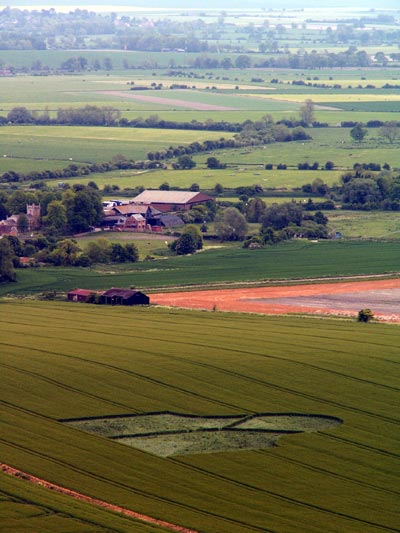
On Monday I visited the formation on the ground
and it was embarrassingly obvious that the crop was indeed
Barley. Also I have to add that there was no observable damage to
the crop, i.e. plank scrapes and the stems were not crushed to the
ground and were recovering fast. There was however a pathway
around the edge of the rectangle. It was a blot on my personal
landscape, do please remember that this is a personal opinion and
nothing more.
Nick Nicholson
|
Click on thumbnails to enlarge
Digital Images CCC Copyright 2005
Diagram
Alex (for x-cosmos) Copyright 2005
|
The May 29th Milk
Hill crop circle
Click on
thumbnail to enlarge
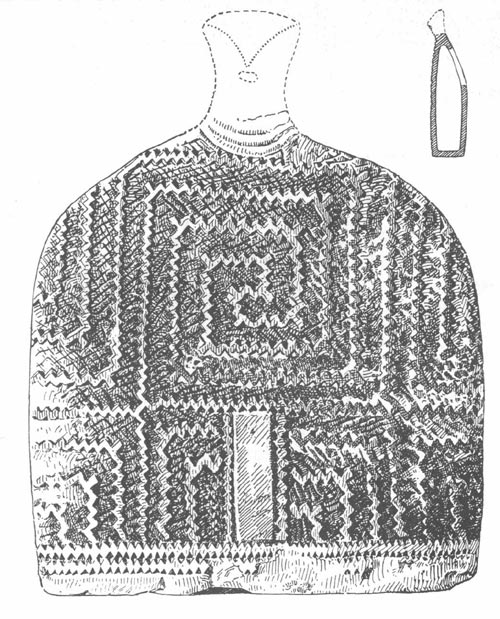
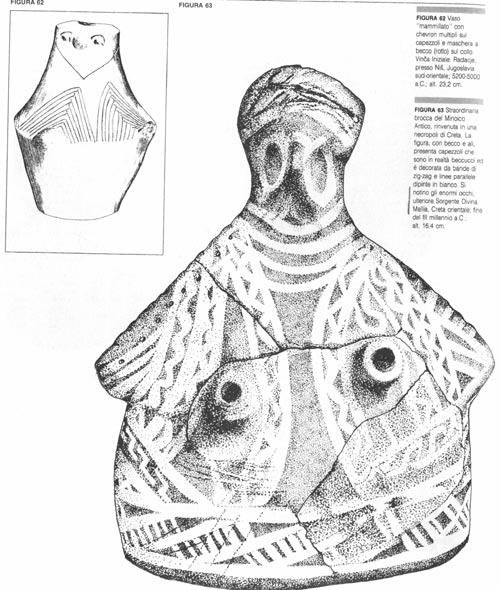
While looking at
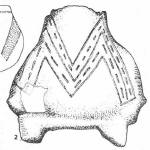
their imposing figure of the May 29th Milk Hill pictogram, a whole series
of prehistoric statues found all over Europe by the great archaeologist
Marija Gimbutas, and reproduced in her book "The Language of the Goddess"
(see illustrations below), comes to mind. The statues have in common a
beaked bird head, breasts, and a hint at wing like shoulders and,
according to Gimbutas, represent the Bird mother-goddess, the most
ancient of a series of symbols representing the Earth Mother goddess.
In the words of
Marija Gimbutas:
"The Bird Goddess was
the source and dispenser of live-giving humidity --- and symbolized as a
water bird, she united the sky with the earth, and her earthly home was
the mirror of a divine plane of existence. Her appearance, like that of
the migrating birds, announced the springtime return of life in all of
Europe" (next to her we find the "4 swallows" pictogram).
"The V" or Chevron
stenographic sign representing the pubic triangle, symbol of the creator
and protector of life, would become the specific symbol of the Bird
Goddess for thousands of years. The converging lines in the "V" often
continue down the centre of her body as an ornament with a symbolic
meaning. Many of these statues are faceless and extremely abstract, with
only the sign of the "V", the sign of the Goddess. The breasts were often
formed by V's and inverted V's or enclosed within this symbol and these
V's, parallel lines (water symbol) and X's symbolize the Bird Goddess,
divine source of nourishment - both milk and water (appeared below Milk
Hill). Her body represents the source of life incarnate, therefore
parallel lines on the statues represent both streams, and rivers as well
as her wings and other parts of her body."
"She is the source of
the Vital Water which imbues with energy, heals the ill, restores youth
to the aged, restores eyesight, puts dismembered bodies back together and
brings them to life".
Marjorie Tomkins
|
Regarding the
funny looking
pictographic crop formation:
by Michelle Jennings
Click on images to enlarge
Images Michael Murray Copyright 2005
|
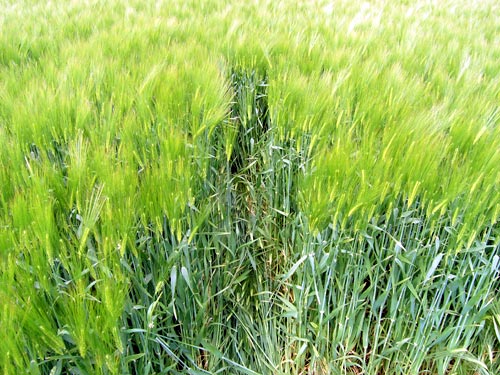
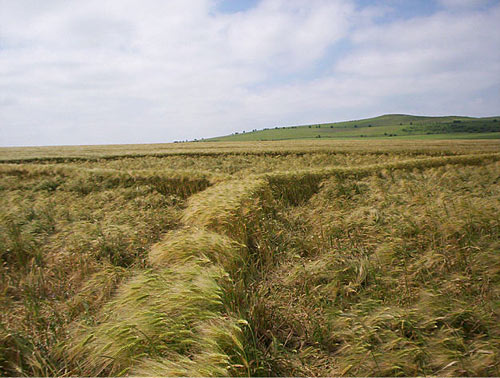
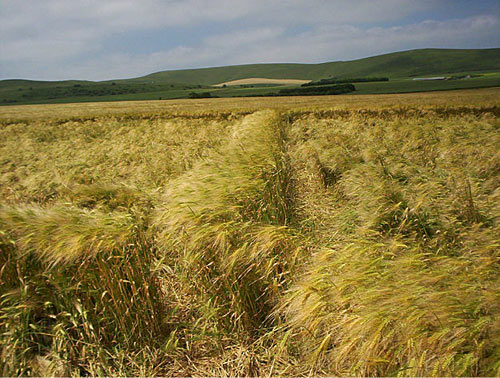
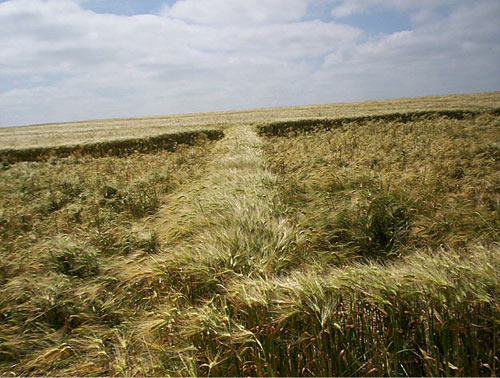
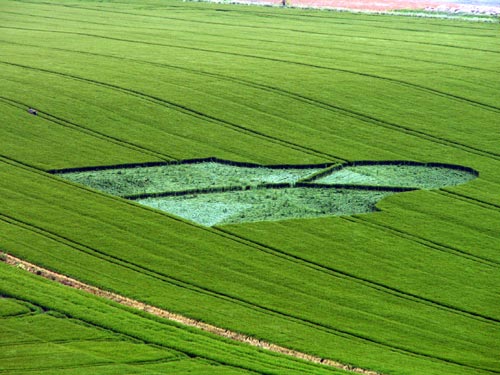
I went to see this formation 3 weeks after it was
reported, the barley has started to stand up again and makes the ground
lay impossible to make out. The Y figure can still be seen clearly. I took
the pictures from where the arms join.
Michael Murray |

Discuss this Crop Circle on the Forum
|