|
Code: SUSSEX 2004/03
Location: NEWMARKET HILL, WOODINGDEAN, EAST SUSSEX
First reported: 15th June 2004
Crop: Wheat
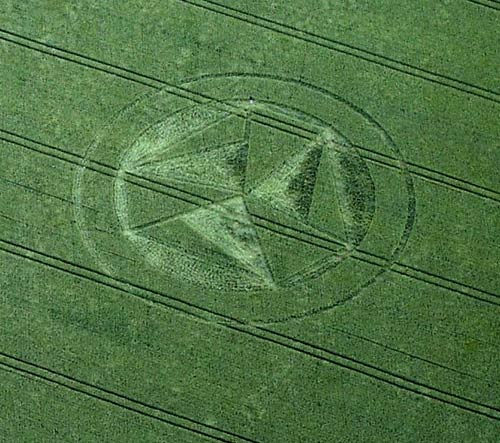
Design: Ringed circle with standing triangular components
Dimensions: 200ft total diameter
Surveyed by: ALLAN BROWN and ANDY THOMAS, 15th June 2004
REPORT: This formation sits in the same field as
two spectacular patterns we had in rape in 2003. It is clearly visible
on the left as you drive from Falmer towards Woodingdean.
The design, contained within a 200ft diameter
clockwise ring, is oddly un-Sussex like, basically made up of a series
of triangles arranged within a ringed circle. The pattern is built up
around a nine-fold division of the circle. The three primary triangles
that meet in the centre of the formation are the proportions of sliced
pizza you'd get if you divided it up into nine equally-sized
wedges. The spaces between these three primary slices are cut into two
unequally-sized triangles, the flattened triangle, in each instance,
being the larger of the two. The 3.5ft pathways cut in from the sides
of the three primary nine fold wedges (72ft x 49ft) make the obliquely
cut triangles (69ft x 83ft x 27.5ft) slightly smaller than their
idealised size.
Underlying guide paths criss-cross the formation,
often in the opposite direction to the subsequent in-filled lay, and
are noticeably more compressed and flat to the ground than the overall
lay, which is rather messy. In both the guide lines and the larger
flattened areas, we found lots of creasing, kinking, splitting and
breakage on the stems. These overt signs of damage in a relatively
fresh, untrampled formation have previously been indicative of a manual
causative agency, as they have been notably present in known man-made
designs. The centre of the formation is pretty
flat and scruffy, and several of the junctions are haphazardly
constructed.
Clearly a modicum of planning has gone into the
design and implementation of this pattern, and it looks nice from a
distance. But the levels of damage inflicted to the crop are a world
away from the finesse, subtlety and mastery that we continue to witness
in a significant percentage of Sussex formations each year.
Report by ALLAN BROWN & ANDY THOMAS, 15th June 2004
Southern Circular Research
|