|
Code: SUSSEX 2004/06
Location: STEEP DOWN HILL, NR SOMPTING, WEST SUSSEX
First reported: 11 JULY 2004
Crop: Wheat
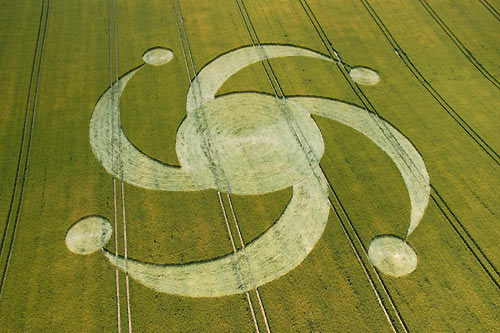
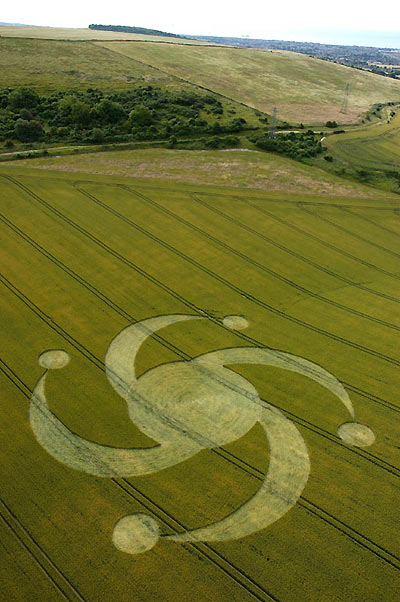
Design: Four-armed 'spinner'
Dimensions: 298ft total diameter
Surveyed by: Allan Brown, Andy Thomas & Jordan Thomas
REPORT: This new arrival lies about half a mile
south-east of the famous Iron Age hillfort Cissbury Ring, on Bostal
Road, which runs from Sompting to Steyning.
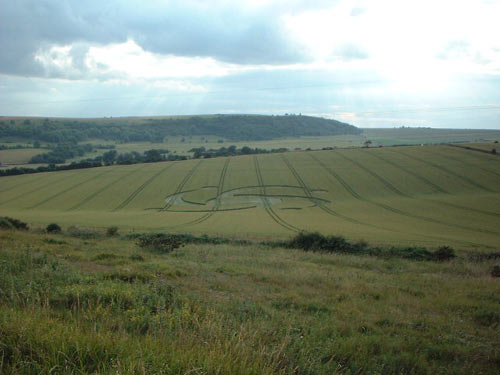
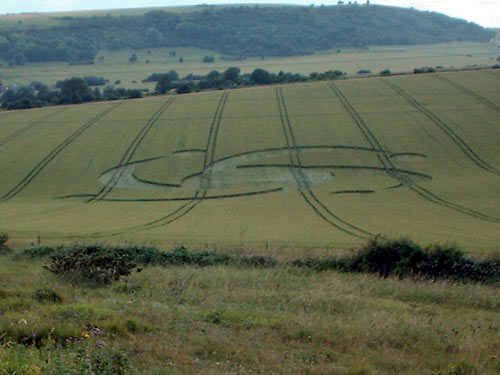
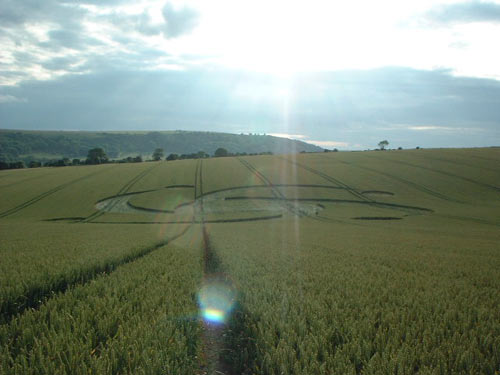
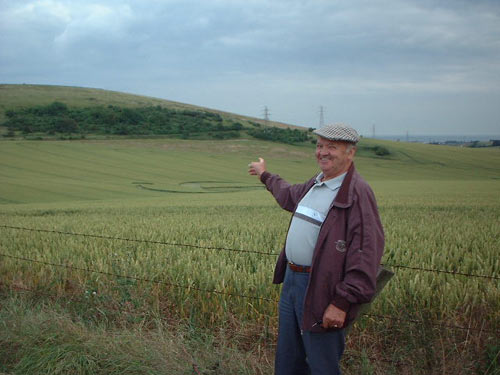
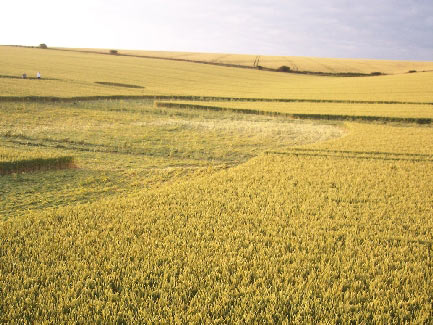
The formation is pretty difficult to find, as it is
nestled in the hollow of the field and cannot be seen from the road at
any point. It is only when walking along the footpath towards Steep
Down Hill that it comes into view, although an excellent view of it is
afforded if you stand upon Steep Down Hill looking back across to
Cissbury Ring.
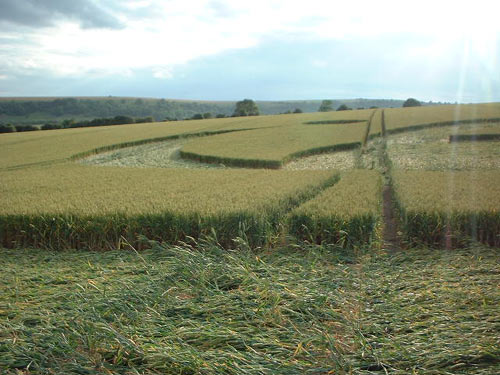
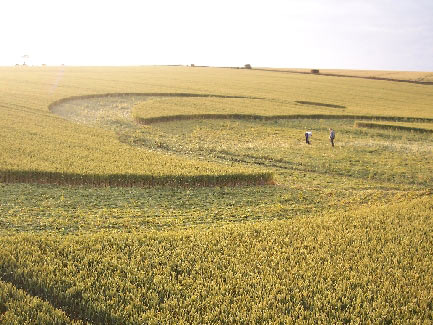
The formation is in wheat and at first glance looks
much more like a traditional Sussex-style design than many of those we
have received recently, and appears to reference the two-armed Sompting
Spinner design of 2002, but this time there are four long tapering arms
leading to 33ft clockwise circles. The main central circle is 126ft,
and anticlockwise.
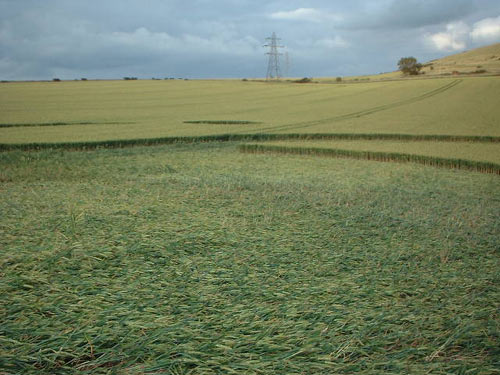
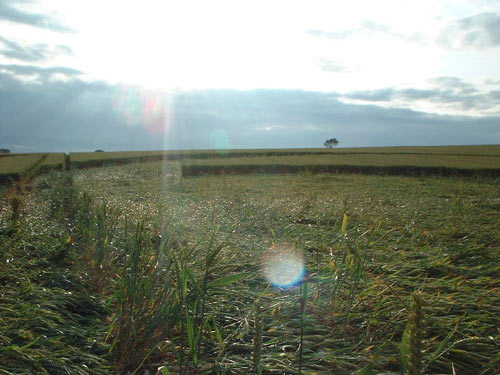
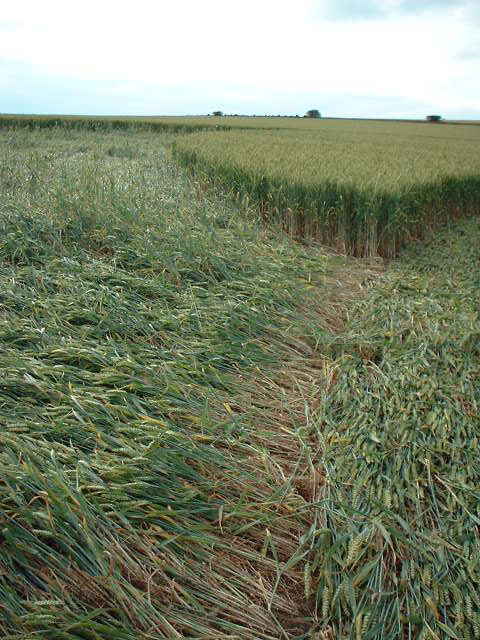
From the edge of the field the formation looks
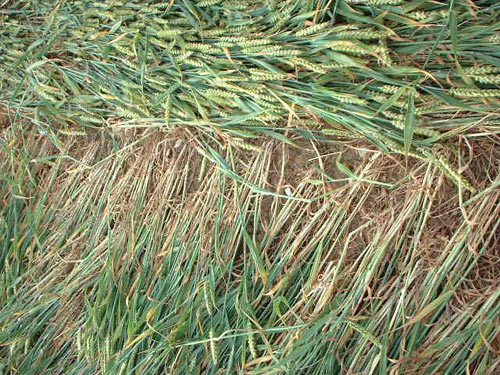
pretty neat. Inside, however, the crop has been heavily crushed to the
ground and is very noticeably kinked with obvious white crease marks on
the downed stems (a feature that we have found in every known man-made
formation that we've visited). Last year, only one Sussex formation
overtly displayed these marks - this year it has been worryingly rife.
As far as the geometry goes, this is a very simple
but smart design. It would be perfectly suited to easy construction,
as once the basic orthogonal axes have been established, all the
necessary marker points from which the various arcs are constructed
could be quickly and easily located.
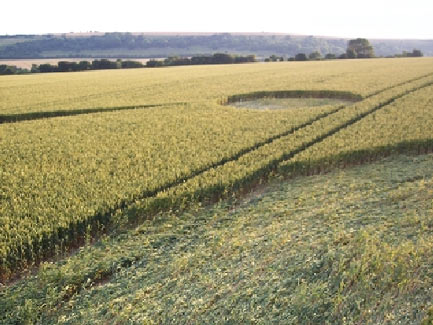
The lay is fairly neat over the formation as a
whole, although it becomes noticeably haphazard and disjointed as it
curves in towards the crescent tips of the arms, where they meet the
small satellite circles. Having worked out the geometry whilst still
inside the formation, we were able to go and check out the spots where
someone would have needed to stand in order for a planker to plank out
his path. At these spots the crop is very damaged, broken and flat to
the ground, and in one instance there is a place which could indicate
where someone has stood too close to the edge of the main circle and
left a slight scallop in what should have been standing crop. In a
number of these points, there is dried mud visible on the crop.
There is quite a volume of flattened crop in this
design, and little attention has been afforded to minor details such as
leaving standing or nested centres. It is a difficult thing to convey
verbally, but compared to the 2002 Sompting Spinner, the experience of
being in this formation couldn't be more different. The original
Spinner was pristine inside, with a fluid, energetic lay and somehow
much more poetically-positioned in the landscape. It was an original
idea with an awesome heptagonal-based geometry, as extracted by
researcher Martin Keitel. It's worth noting that in the 2002
formation, we personally spoke to a couple of local children, a brother
and his sister who, unprompted by us, relayed a story of how they had
seen a light hovering over the field during the night of its
appearance. It was so bright, it had scared them to the point where
they slept in the same bed with the covers pulled up over their heads.
As an aside, several members of Southern Circular
Research recently gathered on top of Cissbury Ring for a meditation to
mark the tenth anniversary of an experiment they had carried out there
in 1994 with psychic Paul Bura. Though this meditation was not common
knowledge, it's just interesting to note that this new formation is the
first to appear within sight of Cissbury Ring for nine years, a curious
synchronicity, whatever or whoever made it.
ALLAN BROWN & ANDY THOMAS
Southern Circular Research
|