|
CROP CIRCLES IN 2000 |
|
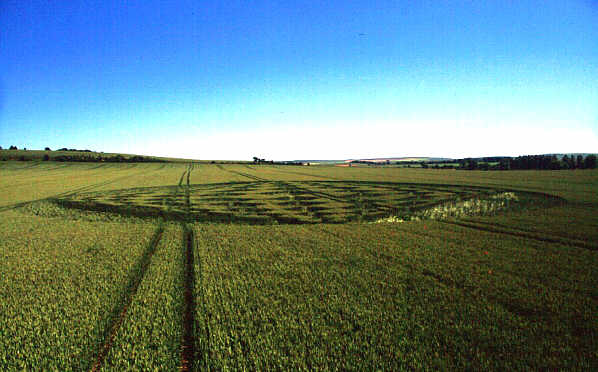
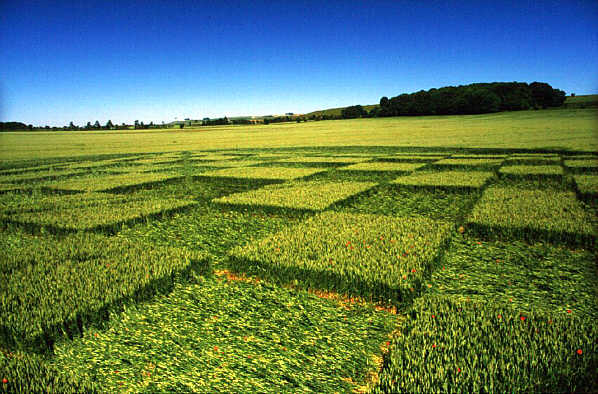
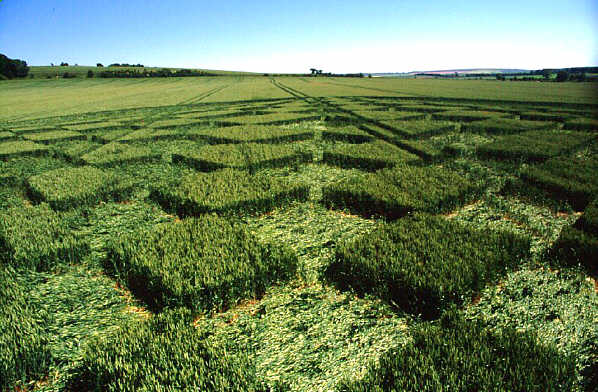
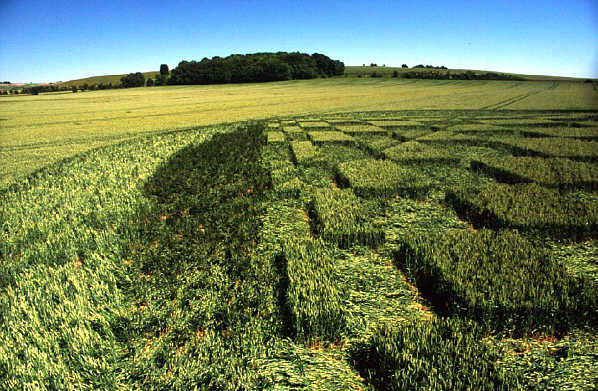
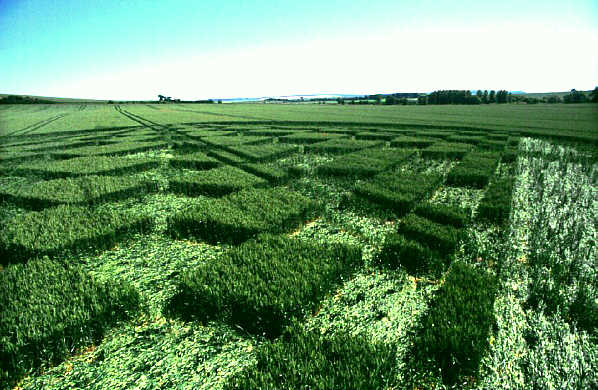
Windmill Hill, nr Avebury, Wiltshire. Reported 18th June.
GPS Reference SU08027134
Updated Wednesday 28th June 2000

Digital Image Francine Blake (Wiltshire Crop Circle Study Group) Copyright 2000
 |
Saturday and Sunday 15th/16th July 2000 |
 |
 |
 |
 |
 |
 |
Images Stuart Dike Copyright 2000
FIELD REPORT

 Image
Steve
Alexander Copyright 2000
Image
Steve
Alexander Copyright 2000
 A formation @ Windmill Hill nr Avebury, Reported 18/6/00
(Wheat)
A formation @ Windmill Hill nr Avebury, Reported 18/6/00
(Wheat)
by Charles Mallett (Signs Of The Times C & F Phenomenon Research)

Painting by Hungarian artist Victor Vasarely.
(Credit to Peter Sorensen for his 1960s Op Art suggestion)
Vega-Nor is an excellent example of Op art, a movement that developed in the 1960s. Op artists, interested in the scientific properties of color and line, studied
how the eye’s retina processes information and how that information is translated in the brain. They found that through the manipulation of color and line, our
perception can be fooled. Thus the name Op art, which refers to optics and optical illusions.
Vega-Nor creates the optical illusion of a sphere on a flat surface. The illusion is successful due to the ways in which Vasarely used color, shape, and line. Warm
colors such as orange and yellow tend to advance in space, and were chosen to surround the central squares, thus making them seem to pop out. The largest and
least distorted shapes are in the center as well. Shapes become progressively thinner and smaller as they get farther away from the center, which makes them seem to
recede into space. The lines also reinforce the illusion. The center horizontal and vertical lines are straight, even though they may not at first appear to be so, while the
others curve at carefully calculated angles. The small squares in each corner are the same size and painted with straight lines, creating a convincing background for the
illusionistic sphere.
There is more to Vasarely’s art than the science of colors and optics, however. He was also very interested in a democratic form of art that everyone could
understand, not just those with certain types of educational backgrounds and experiences. Op Art serves that goal well. There is no story to tell, history to know, or
symbolism essential to the work’s comprehension. Vasarely was also inspired by nature, and it is here that meaning beyond the optical illusion can be found if
desired. He said: "VEGA is a distant star well-known by everyone….This composition expresses the extension, the expansion of the Universe: the extreme of the
great infinities of Nature.
Article sent to us by Nicola Latham Source Albrightknox Art Gallery
|
by GRAHAM TUCKER This latest article from Graham Tucker, explains the relationship which is now apparent within the formations we see today with regard to their size, layout, and overall design. The formation at Windmill Hill was a example of how the Circlemakers want us to experience them, from an aerial viewpoint. |