|
GRIDLOCKED by GRAHAM TUCKER
|
|
Updated Monday 4th December 2000
Before the ‘99 eclipse, an unusual formation arrived at Escrick Park Estate, West Yorkshire. Although I never realised it at the time, this baffling creation that landed in barley, bang on the solstice, was later to reveal quite a relationship to the eclipse.
When I first viewed the aerial shot on the net, it struck me immediately that confronting me here was a digital timer displaying 80 (figure 1). This was a number I puzzled over … What could it mean? Well, the Circlemakers had left us a big clue that was literally staring me in the face. The two isolated circles were obviously ‘buttons’ and buttons alter things. So I altered what was before me, by simply turning the image around to reveal 08!
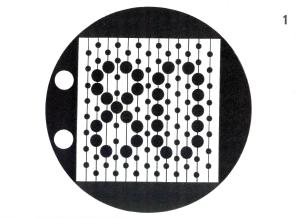
Within the design, this particular number is made up of 31 larger circles, and that was enough to convince me that August being the 8th month, consisting of 31 days, was part of the message here. Excluding the two ‘buttons’, we have 110 circles in all and like the number 80 previously, this means nothing until it's flipped round in order to reveal 011 - the day, and time of the eclipse!
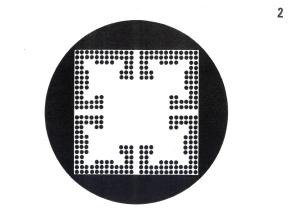
It was this formation that was to reveal something else to me though … as you can see from the drawing (figure 1) the Circlemakers provided vertical pathways in order that the inner circles could be visited. It doesn't take too much imagination to realise that if you were to draw horizontal lines through the circles, a grid would emerge. Looking at the ‘99 formations there are at least a half dozen or so that feature grids, and what's more, as far as drawing them is concerned, a grid has to be in place in order to reproduce an accurate design (figure 2 - Windmill Hill ‘99 - ‘a Temple floor plan’).
I first became aware of grids when one landed back in ‘97! During early August of that year at Etchilhampton, an astonishing square grid appeared consisting of 26 x 30 rectangles, that when viewed from the air looked like a big silicon chip! Also during that year, lattice grids were found employed in those fascinating fractals that appeared. A beautiful example of this being the fractal Star of David constructed from Pythagorean geometry found below Milk Hill.
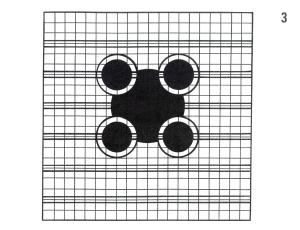
It's become quite obvious to me, that there is a strong possibility here that the Circlemakers are actually working from grids! For if you can imagine an intelligence viewing the field from above say, through a semi-transparent grid-screen containing an intended design, wouldn't this allow for precise positioning of the formation prior to placing it in the field? (figure 3 - Headbourne Worthy ‘97 - ‘Grid-locked’!)
Although this might sound a little imaginative, I believe that all crop formations could be designed upon a grid- even the simple ones, for this would explain why the Circlemakers have often employed tramlines as an integral part of the underlining geometry. Many of the early pictograms, as well as the simple circle groupings that are as common today as ever, feature this.
The height, at which the ‘intelligence’ hovers above the crop in relationship to the grid, could be that which determines how many tramlines the formation would have to rely upon for easy access. If this is the case, then obviously the actual size of the formation is pre-determined by this.
Headbourne Worthy and the like, that appear to sit on perfect grids (figure 3), are usually the exception rather than the rule. Look for where the middle tramline slices through most formations, and nine times out of ten it doesn't pass straight through the middle, but to one side. For those of you that have ever wondered why this is, one thing's for certain - it's deliberate! For the Circlemakers, being the attention-seeking performers that they are, beautiful centre swirls and nests wouldn't benefit from balding tramlines running through them. Mindful of this, the grid they employ takes account, and allows us to view centre pieces from the side.
Where the other tramlines slice through the formation is also carefully pre-planned, for clearly they're placed within their designs in order to minimize tramplers wading through the standing crop. Such is their intent that you are able, via tramlines and inner pathways, to visit each and every part of the design.
Are the Circlemakers employing grids in other ways? Interestingly, I've also discovered that they have expressed an awareness in certain patterns of number sequence that are to be found in ancient mathematical grids, known as ‘magic squares’. These squares encode numbers in such a way, that when unlocked reveal many types of geometric patterns such as ancient temple plans etc. The most commonly known squares are the seven that have traditional planetary associations linked to the Seven Wonders of the Ancient World.
As an example, we shall concern ourselves here with the simplest and smallest of the squares, known as the ‘Saturn Square’, that's linked to Solomon's Temple (figure 4).
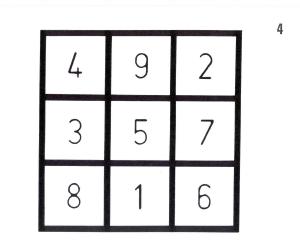
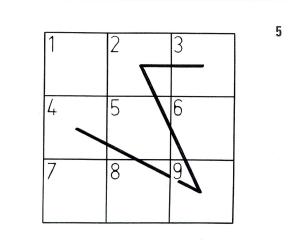
This square consists of 9 numbers seemingly placed at random throughout. In order to unravel a geometric pattern we need to draw a grid ourselves, that's numbered in horizontal sequence 1 to 9. Working horizontally across the ‘magic square’, line by line, (4, 9, 2, 3 etc), we then find the square that corresponds in number in our grid. By drawing a line from the centre of that square to the next indicated, we slowly find a pattern emerging (figure 5).
You can also work vertically (4, 3, 8, 9 etc) or as I was to discover, around the perimeter, (4, 3, 8, 1 etc) of the square. By working around the perimeter of this particular square, I found a pattern emerging that looked familiar. Looking back at some ‘98 formations, I found it! The ‘magic square’ had revealed the design of the final Wiltshire formation of ‘98, that came down in Avebury, apart that is, from two middle shapes that were apparently missing (figure 6). I found though, that simply by drawing two crossed lines in the centre, immediately completes this beautiful design. I also noted that the surrounding circle's perimeter touched each corner of my drawn grid, in proportion to the overall design.
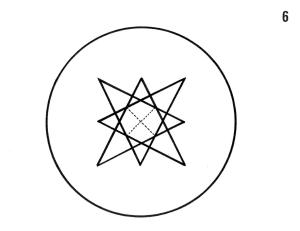
With this formation the Circlemakers are not only acknowledging ‘magic squares’, but through them they're seemingly linking yet again to our ancient past.
Because of the sheer complexity of some of today's formations, unless you've viewed an aerial shot previously, it's often quite difficult to try and work out what exactly is going on when you're wandering round them. For instance, take a look at figure 2 (the Temple floor plan) - I honestly had no idea what this one was about when I first visited it! The Circlemakers followed up the 'Temple floor plan' the following season with the actual floor tiles! (figure 7) This stunning formation, which arrived in June 2000, only revealed its 3-dimensional qualities when viewed from the air.
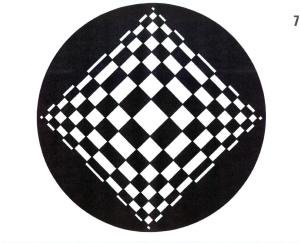
So it would appear that unlike simple-shaped formations, they are meant to be viewed from above. They are quite obviously, being presented to us now at a moment in time when air access via microlights and private planes etc has never been easier. This is also at a time when digital photography allows for an image of a fresh formation to be viewed and sent worldwide in next to no time.
The intent behind the complex multi-directional floor lays, only becomes apparent when viewed from above. I'm pretty sure that the often subtle pattern of light and shade that's created by the direction of the lay could also be held within the grid, for it's the choice of lay direction that determines a formation's shimmering holographic qualities. Check out any of Peter Sorensen's videos and you'll see what I mean, for when Peter circles around some of these formations on sunlit days, their shape-shifting three-dimensional qualities, simply leap out at you!
G TUCKER
Ó 2000End-note
Illustrated examples of magic squares appear in John Michell's excellent book 'The New View over Atlantis' published by Thames & Hudson.
|
|