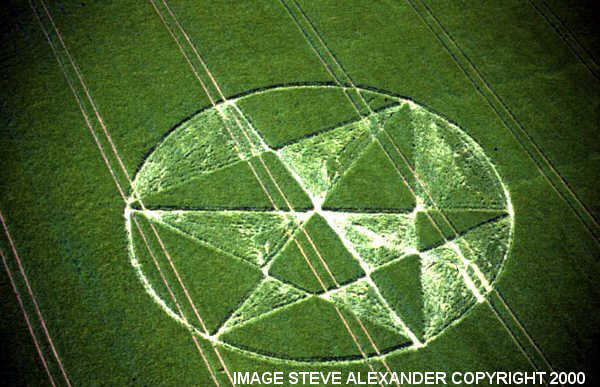
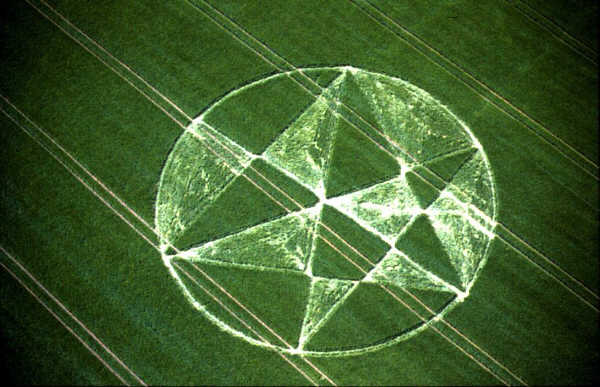
The East Field Star (with unusual perspective)
© Steve Alexander 2000
CROP CIRCLES IN THE YEAR 2000 - Steve Alexander & Karen Douglas share some of their recent crop circle experiences in this unique and beautifully illustrated series, exclusive to the Crop Circle Connector
THE EAST FIELD PERSPECTIVE
By Steve Alexander & Karen Douglas
May 2000
The East Field Star (with unusual perspective) © Steve Alexander 2000
| The English Weather
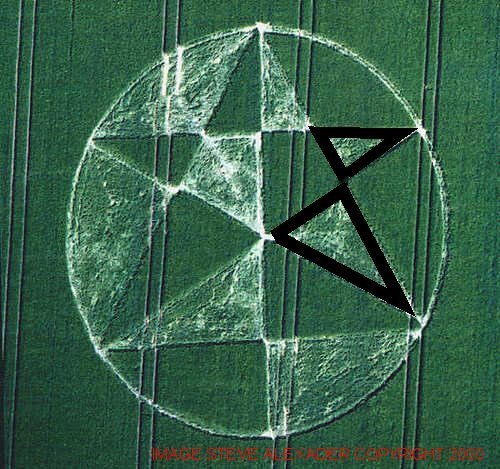
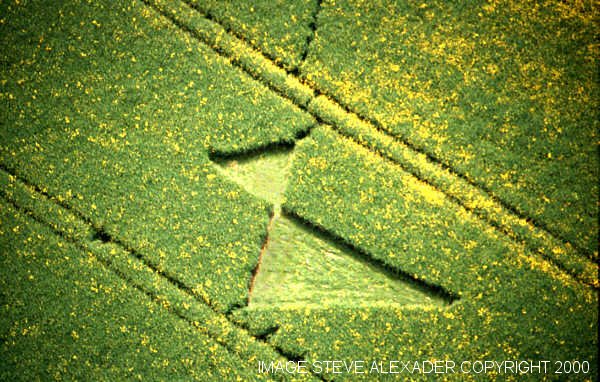
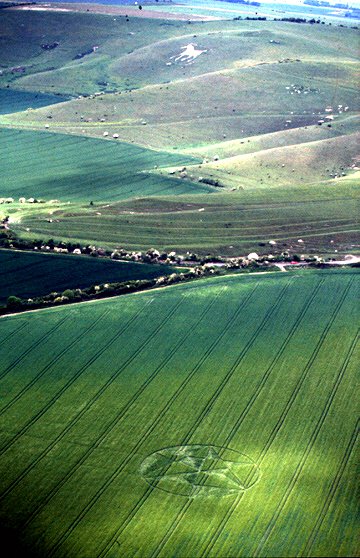
Throughout the summer months we do battle with the weather. Perhaps it’s more like a dervish dance in which we are swept along, waiting for some calm in which we can become disentangled for a while. So it was for the first part of the week in which this wonderful formation appeared. We drove to Alton Barnes on Sunday 21st of May, we had heard the excited whispers of a new formation in the East Field and after waiting agonisingly for confirmation we were off. However, on arrival it was cloudy, dull, overcast and threatening rain. We waited patiently for the sun to come out, we parked the car and watched the skies. It poured. The heavens opened and let loose a torrent of water flood from the dark clouds. We left East Field and sought solace in a cup of tea and some friendly chat with a friend, we waited. And we waited some more, however by the end of the day the sun was setting and there was not a chance of a meter reading from the camera. However, we were determined to experience the formation. Donning weather-proof jackets and wellington boots we made our way into the formation. The Beauty of East Field Even though the light was dim and fading, this formation was a joy. Standing here we had a compelling view of Adam’s grave longbarrow and the thick dark clouds appearing from beyond its summit. The formation gently rose before us on a slope in the field even though it was barely 24 hours old the barley was beginning to recover. Barley in May We were very much aware that this formation would begin to loose its crispness of image very quickly, perhaps within 1 – 2 days. We also knew we would be battling time as well as the weather in order to record the formation with any integrity. Barley in May is still growing and maturing. It wouldn’t be until late June before this plant is fully-grown and begins to dry out and turn golden. It would be mid July before harvesting would be in progress. These plants were very green, some had not yet developed their seed heads and their growth rate would be vigorous and relentless. This rate of growth would have a direct effect on the recovery rate of the plants flattened inside the formation, with the amount of rain and sunny spells phototropism (where the plants try to recover and grow towards the light) would be in full swing within hours. It would be Wednesday before the conditions were good enough to fly, and then only just. We just managed to catch a window of sun before yet more rain settled in over the area. We had been in Alton Barnes on Sunday, Monday and Wednesday monitoring the weather, by the time we drove home (some 1½ hours drive) we were very tired. A Different and Difficult Perspective We got our developed pictures on Thursday morning and thought long and hard about this image. This shape had to photographed from just the right angle for the magic of the shape to become clear. The perspective in the design of the star had made photography difficult. The angle at which the light fell upon this formation (giving the best light and shadow) was at direct odds with the obvious orientation of this formation. This was an interesting development, if the circlemakers were indeed going to add perspective to their formations during 2000, it was going to be a difficult and challenging year. With most circular formations a correct orientation is not implied, giving freedom to the photographer to shot his image at whichever angle the light falls best. If a formation does have an implied orientation this makes life hard and sometimes impossible for the photographer, especially if the implied orientation is at an angle where there is no good light. Anyone who flies around the formations knows that there is a certain angle at which the formation really stands out and the light and contrast are at their best. However there is also an opposite point at which the formation can almost be seen to disappear, if this were to coincide with an implied orientation for the formation, photographing a good image of the circle could be very, very, difficult indeed, if not impossible. Curious Relationships Looking further at the formation we noticed a curious relationship between the Furze Hill triangles and the new East Field star. The triangles can be seen to fit into the star – see illustration below. One, it seems, heralding the shape of things which would later develop.
More...
Steve Alexander & Karen Douglas
Have you seen the A pictorial tour of crop circles and their landscapes By Steve Alexander & Karen Douglas? |