More
astronomical images from Hoeven in the Netherlands on May 20,
2011
Five
new field diagrams have now appeared in the Netherlands during
April or May of 2011. All have appeared in grass rather than
standing crops. The first three showed apparently: (a) an
astronomical outburst of some kind when five bright planets line
up in Earth’s sky during June of 2011 (see
Bosschenhoofd2011a), consistent with an earlier and more
complex crop picture at Milk Hill in England during June of 2009
(see
time2011b), (b) a schematic picture of some “glowing comet
with a tail”, moving past the Moon and five bright planets in
Earth’s sky on April 31, 2011 (see
Hoeven2011a), and (c) a schematic picture of the same
“comet” with a long and pronounced “tail”, crossing Earth orbit
on May 19, 2011 (see
hoeven2011b).
Looking at those images, one of the researchers, Nancy Talbott,
asked whether they might portray comet C/2010 X1 (Elenin)
which is of some popular interest? In fact, the first three
field images seem not to show comet Elenin, but instead comet
C/2011 C1 (McNaught), which is still quite dim at
magnitude 9 or 10 after passing perihelion on April 17, 2011
(see
www.aerith.net). Quite remarkably, a fourth field diagram
(d) then appeared on May 12, which did show the astronomy of
comet Elenin. That was as if to say: “Here is the astronomy of
comet Elenin. You can see it is not the same as what we showed
you before” (see
Oudenbosch2011).
Now
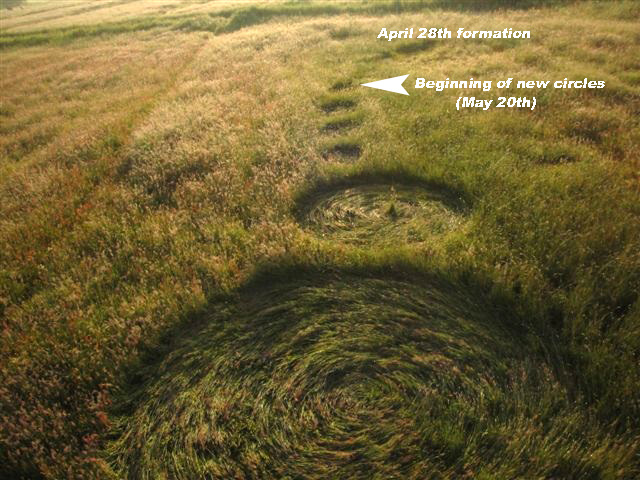
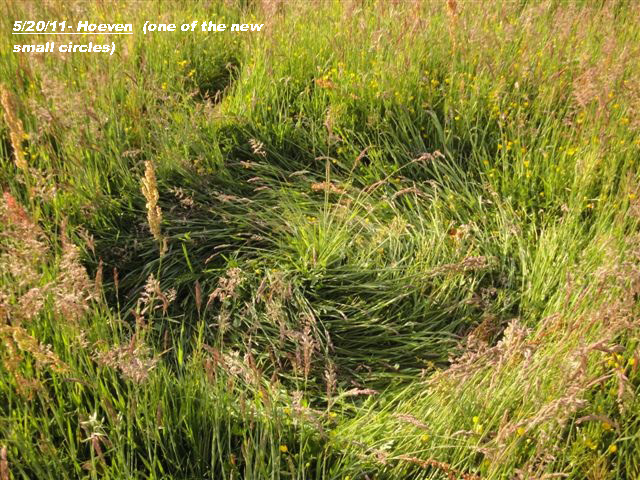
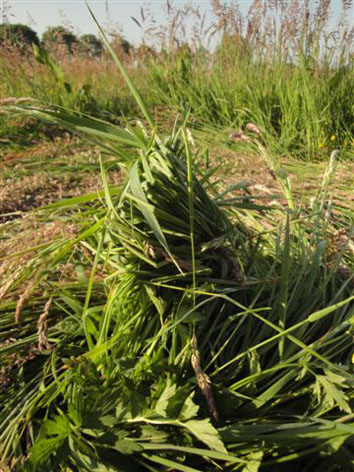
on May 20, 2011, a fifth set of diagrams (e) has appeared at
Hoeven, in another part of the same field which showed a
“glowing comet with a tail” on April 29 (see
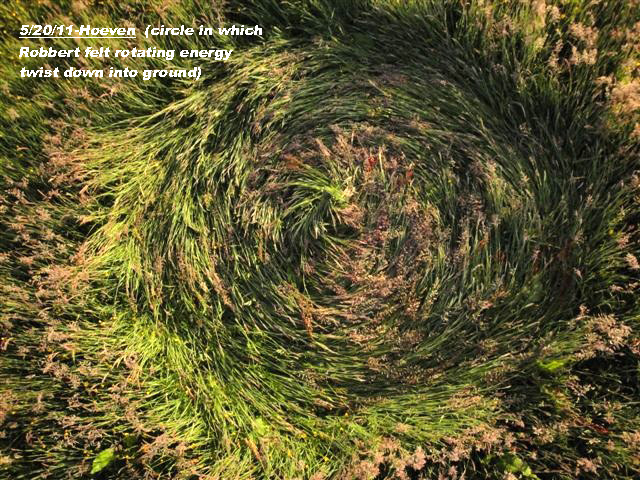
Hoeven2011a). This fifth set of diagrams is again
astronomical in nature. One circle shows a “comet with a short
curved tail”. A set of five enclosed circles seems to describe
the Pleiades star cluster M45. Another circle supposedly shows
“fast rotating energy turning on itself”. That is what the crop
artists showed us at Garsington in July of 2005, to predict a
spectacular outburst by fast-spinning comet 17P Holmes, more
than two years later (see the last slide of
time2007g).
A
summary of astronomical interpretations for both previous and
current field diagrams at Hoeven is provided below:

The
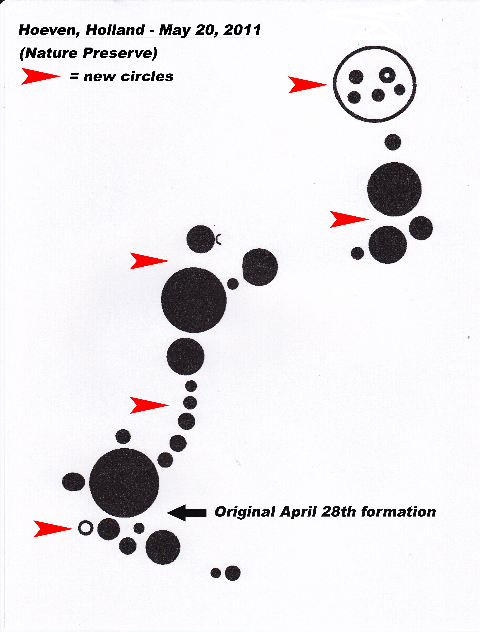
original field diagram from April 29 of our “Moon and five
planets” is shown at lower right. There we can see a “glowing
comet with a short tail”, heading in Earth’s sky toward that
astronomical grouping a few days later on April 31. We call it
an “glowing comet”, because Robbert and other eyewitnesses saw
that particular circle “glowing” at night, and then on the
subsequent night it “grew a tail”. Now in the new field diagram
of May 20, we can see one extra open circle, which
tells where that comet has moved in Earth’s sky to a new
location on May 30, somewhat closer to the Moon-planet grouping
than before.
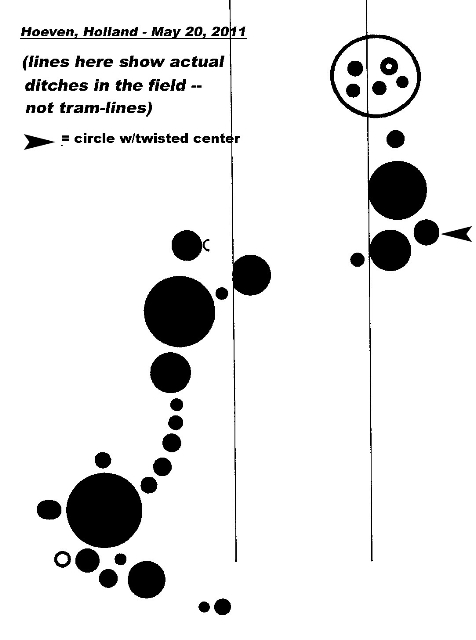
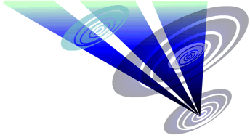
This
new astronomical arrangement is shown with more detail in the
central diagram above. There we can see a “comet with a
short tail” located next to the Moon and three bright
planets in Earth’s sky on May 30, 2011. Using a
computer-generated sky map (see below), we were able to figure
out that those “three planets” are probably Jupiter, Mars and
Venus, drawn in size according to their relative magnitudes
(where Jupiter and Venus are bright, whereas Mars is dim). The
assigned date of May 30 lies almost exactly one lunar month past
that of April 31, for the earlier field diagram shown at lower
right.
We
can see even more details of that new astronomical arrangement
in a field diagram which has been shown at upper left above.
There we can see on the far left an enclosed set of five
circles, which may be deduced from a sky map (see below) to
represent the Pleiades star cluster M45. It will lie directly in
line with Mercury, the Moon and two other planets (Venus or
Mars) on May 31, 2011. Once again, each planet has been drawn in
size according to its relative magnitude (where Venus is bright,
Mercury is medium-bright, or Mars dim). Five bright stars from
M45 have been drawn according to their approximate locations in
Earth’s sky, but strangely enough the depiction is not precise.
A final circle from in this new field diagram seems to show a
“spinning comet”, located slightly to one side of the
Moon as in the central diagram.
Now
let us compare both of those new field diagrams from Hoeven on
May 20 with actual sky maps for the assigned dates. In the sky
map shown below, we can see Earth’s sky on May 30, 2011 in
Sydney, at an hourly time of 2100 UT just before sunrise:
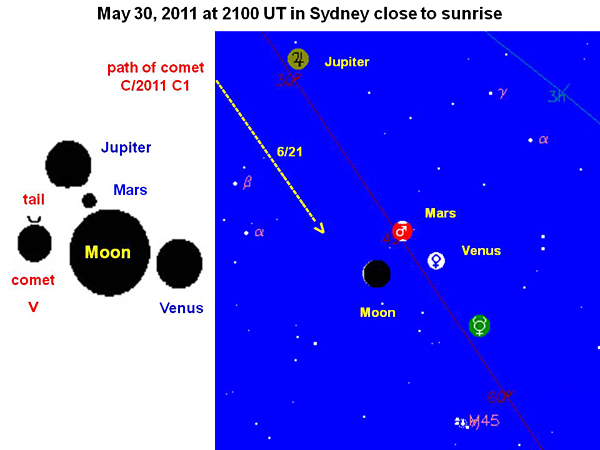
The
Moon and three bright planets Jupiter, Mars or Venus seem to be
located correctly for a date of May 30, 2011 in good accordance
with the field picture. Jupiter has been drawn much closer to
Mars in the field than it will really be located in Earth’s sky,
but that is just a stylistic device, used commonly in
astronomical crop pictures to reduce their overall size. The
“comet with a short tail” will lie slightly to the left of the
Moon on May 30. That agrees fairly well with the expected sky
path of comet C/2011 C1 (yellow dashed line), although we cannot
be certain.
Another sky map from the Netherlands on May 31, 2011, at an
hourly time of 0500 UT just before sunrise is shown below:
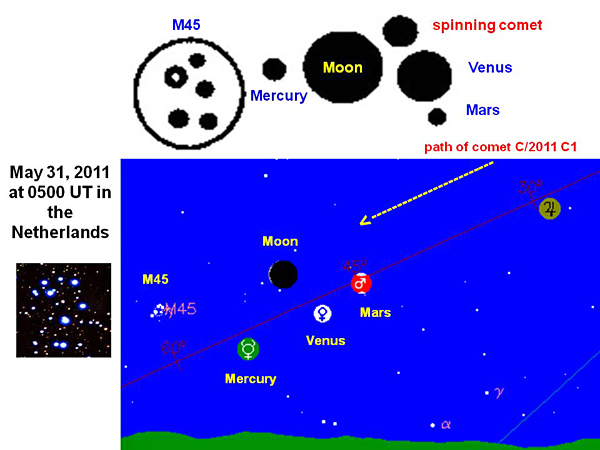
The
Moon and three bright planets Venus, Mercury and Mars have now
been drawn next to an extra circle for a “spinning comet”, which
again lies slightly to one side of the Moon as expected for the
path of comet C/2011 C1 (yellow dashed line). Five other circles
have been enclosed by a large ellipse in the field diagram,
seemingly to represent the Pleiades star cluster M45, which will
lie just to the left of Mercury on May 31. Yet the
correspondence between individual “stars” in that enclosed
region and actual stars in M45 is not precise.
In
summary, all five grass pictures from the Netherlands during
April or May of 2011 seem to show the astronomy of two currently
observable comets, namely C/2011 C1 (McNaught) or C/2010 X1 (Elenin).
We do not know why the crop artists are showing us schematic
astronomical images of “comets”, but their reason may soon
become clear, especially if one or both of those comets becomes
very bright during the summer of 2011.
Red
Collie
(Dr. Horace R. Drew, Caltech 1976-1981, MRC LMB 1982-1986),
CSIRO Australia (1987-2010)