The natural order of the sundial
This crop circle “formation” is super simple, but even in its
simplicity the crop circle makers want to put forward a message.
First of all it is striking that teedeleedee and teedeleedoo
appeared at a tramline at a large distance from each other. Moreover
2 days after the appearance of teedeleedee and teedeleedoo the owl
appeared in an adjacent field. This results in the following
picture:
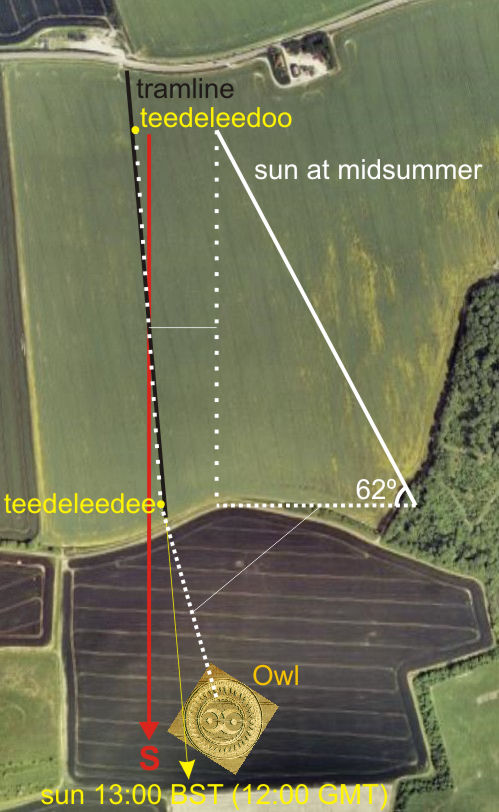
The extension of the tramline (yellow line) touches the owl. It’s
notable that the tramline is almost North-South, but there is a
deviation of 5°. It turns out that the tramline has exactly been
aligned with the direction of the sun at 13:00 o’clock British
Summer Time on the day of the formation, which corresponds with
12:00 o’clock universal time or Greenwich Mean Time. The position of
teedeleedee left of the tramline and teedeleedoo right of the
tramline indicate the direction in which the tramline should be
corrected to be aligned with the true North-South-direction.
So what do the crop circle makers want to put forward? The fact that
the direction of the sun on 12:00 GMT deviates from the
North-South-direction is the result of the division of the world in
Time Zones. Moreover, the alignment with 12:00 o’clock GMT actually
neglects the phenomenon of summertime. Both seem to refer to a
return to natural time, that means local time without an artificial
division of the world in time zones. Apart from the division of the
world in time zones and the effect of summer time, there is still
another effect through which the direction of the sun at 12:00
o’clock can deviate from the true South. The 24 hours of the day are
the result of the rotation of the Earth around its axis and
the revolution of the Earth around the sun. However through the
axial tilt and the elliptic orbit of the Earth, the length of the
day slightly fluctuates. The 24 hours of the day actually are an
average. However as at present our clock isn’t corrected for this
fluctuations, the sun in for example February is half an hour later
at its highest point in the South then in November (even at
Greenwich). Therefore one speaks of Greenwich Mean Time,
which essentially deviates from local apparent time, or the time in
accordance with the sundial.
In new age the world will go back to the true local time, the time
that a sundial would indicate. This is necessary to tune in again in
the natural order of time, as the time is going along with a
creative power. Also the biorhythm has a relationship with the
clock. This change will occur on the 14th June 2012, along with the
recreation of the world (see
recreation ). This date falls around midsummer and the sun is
practically at the highest point in the South (61.9°, 62° on
midsummer, the 21st June). Despite the earlier mentioned
fluctuations, on this date the sun has also been aligned with the
tramline on 12:00 o’clock GMT. Furthermore it turns out that the
ratio of the line from teedeleedee to teedeleedoo and the line from
the owl to teedeleedee correspond with the altitude of the sun in
the South on midsummer (62°, see picture). Apart from the
realignment of the clock with the South, on midwinter, the 22nd
December 2012, a new age clock will start to run (see
martinsellhill2 ).
What is the relationship with the owl? The owl is a so called “Solar
Seal” of the Tzolkin, the holy galactic calendar of the Maya. This
is a calendar with a cycle of 260 days. It turns out that the period
from the day of the appearance of the both circles (8th August 2009)
until the 14th June 2012 exactly equals 4 Tzolkincycles (4 x 260
days). On the 21st June 2012 – midsummer – the signature of the
classical Tzolkin is “2 Owl”, which perfectly corresponds with the 2
circles of teedeleedee and teedeleedoo and the owl! I found out that
the formation of the owl has a close relationship with the classical
Tzolkin; more about that later.
Marc Smulders