|
As always I use my sixth sense and
mathematics to guide me in the meaning of the symbols in crop circles
and so I get to the following conclusion.
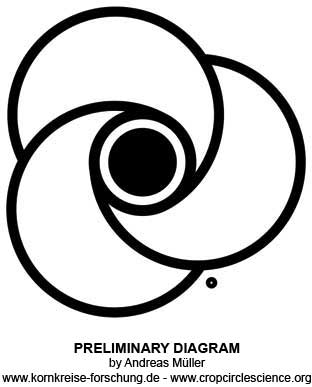

Watch the small
black dot, left picture. That’s the view point and so it resembles the
right picture exactly. The circle in the middle is added by the unknown
formation makers. It could be that they mean the Earth and that they
use this symbol to explain that Earth will last forever, whatever will
happen!
There is a lot to find about the Borromean Rings at Wikipedia, there is
even a site devoted to the rings,
http://www.liv.ac.uk/~spmr02/rings/index.html
Extracted from
Wikipedia
In
mathematics,
the Borromean Rings consist of three topological
circles
which are
linked
and form a
Brunnian link,
i.e., removing any ring results in two unlinked rings.
Although the typical picture of the Borromean rings (left picture) may
lead one to think the link can be formed from geometrically round
circles, the Brunnian property means they cannot (see
"References"). It is, however, true that one can use ellipses of
arbitrarily small
eccentricity
(centre picture).
|

Standard diagram of the Borromean rings |

A realization of the Borromean rings as ellipses |

Coat of arms showing padlocks locked in Borromean rings
configuration |
The Borromean rings give examples of several interesting phenomena in
mathematics. One is that the cohomology of the complement supports a
non-trivial
Massey product.
Another is that it is a
hyperbolic link:
the complement of the Borromean rings in the 3-sphere admits a complete
hyperbolic metric of finite volume. The canonical (Epstein-Penner)
polyhedral decomposition of the complement consists of two ideal
octahedra.
History of origin and depictions


The Borromean rings as a symbol of the Christian
Trinity,
from a 13th-century manuscript.
The name "Borromean rings" comes from their use in the
coat of arms
of the
aristocratic
Borromeo
family in
Italy.
The link itself is much older and has appeared in the form of the
valknut
on
Norse
image stones
dating back to the 7th century.
The Borromean rings have been used in different contexts to indicate
strength in unity, e.g. in religion or art. In particular, some have
used the design to symbolize the
Trinity.
The psychoanalyst
Jacques Lacan
famously found inspiration in the Borromean rings as a model for his
topology of the human mind, with each ring representing a fundamental
Lacanian component of reality (the "real", the "imaginary", and the
"symbolic").
The Borromean rings were also the logo of
Ballantine beer.
A
monkey's fist
knot is essentially a 3-dimensional representation of the Borromean
rings, albeit with 3 layers, in most cases.
It should also be noted that the Borromean rings appear in Ghandarva
(Afghan) Buddhist art from around the second century C.E.
Partial Borromean rings emblems
In medieval and renaissance Europe, a number of visual signs are found
which consist of three elements which are interlaced together in the
same way that the Borromean rings are shown interlaced (in their
conventional two-dimensional depiction), but the individual elements are
not closed loops. Examples of such symbols are the
Snoldelev stone
horns and the
Diana of Poitiers
crescents. |