|
What an
appropriate, to say the least, symbol at the beginning of the 2008 crop
circle season in Britain!! This well known and well loved symbol hails
from the East, yet is displayed ubiquitously in the Western world as
well. It is a veritable contemporary world symbol, one that denotes
Dynamic Duality within the One, and it is formed in a bright crop of
rapeseed. Yellow is the colour representing the Earth in ancient
Chinese tradition. It is most timely because we are just about to
witness the 2008 Olympic Games taking place in Beijing, China for the
first time in history. It is also presented to us in ‘double’ form,
with one full ‘yin-yang’ symbol visible, and one other slipping out into
view from beneath the first. This double aspect is very significant if
one chooses to interpret this event somewhat like a dream. A double
image in a dream signifies that a new understanding or a more complete
integration of the meaning of the symbol for the dreamer is immanent.
The understanding becomes an operative factor in the actual life of the
dreamer. If this concept can be applied to the appearance of this
formation, then what does it mean for, perhaps, humanity on this Earth?
First of all we must look at the
profound significance of this ancient symbol.
“This ideogram,
the Am duong, is the Eastern expression of androgyny, the double
principle of universal life, of every duality” (Mammoth, 434). It
represents the cyclic alternation of all sorts of dualities: light/dark,
good/evil, heaven/earth, sleeping/waking, birth/death, etc. Yin and
Yang represent the dark and light faces of all things; they are the
manifestation of the ‘twofold and complementary character of the
universe’ (Penguin, 1140).
The Am duong
“is the concentration of the deepest philosophy and one most
characteristic of the Chinese spirit, which hardly feels the need to
appeal to abstract notions of number, time, space, cause or harmony. To
translate such notions, the Chinese have this concrete symbol which,
along with the Tao, expresses the complete structure of the world and of
the Spirit.” (Penguin, 1141).
The profundity
and breadth of this symbol cannot be denied, but what more can we know
or experience regarding this perspective on Life, the Universe and
Everything?
What is very
interesting and crucial for me is that a particular passage in the Tao
Te Ching, as I know it from an English translation, addresses the whole
issue of good and evil and how the human being can deal with it without
damaging himself or others. It is a matter of balance and is expressed
so elegantly in passage # 60:
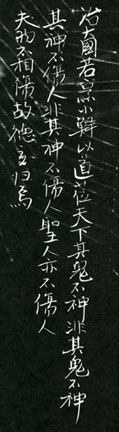
“Ruling the country is like cooking a small fish.
Approach the universe with Tao,
And evil will have no power.
Not that evil is not powerful,
But its power will not be used to harm others.
Not only will it do no harm to others,
But the sage himself will also be protected.
They do not hurt each other,
And the Virtue in each one refreshes both.”
It took me
twelve years to understand the first line: the sage (a human being)
rules the country (manages one’s life) in the manner one would cook a
small fish (by focusing closely and tending to it so that it does not
burn!). Tao is known as the Way; if we proceed with our lives according
to this humble, focused and non-aggressive way, then the forces of the
universe, both dark and light will actually manifest as beneficial in
our lives.
What struck me
most was the fact that Virtue exists in both the dark and the light
according to this philosophy, instead of Virtue being found only in the
Light, as Western philosophies seem to profess.
What is the
result of the double image integration lesson? Well, if as a race of
many different nations and cultures, we recognized those who understand
differently from us as part of ourselves, as another aspect that can be
embraced and related to, how would our world develop? Just as in the
magical symbol where we see in each swirl of white and black there is a
small seed circle of its opposite, could we somehow learn to exchange
and utilize the differences we perceive between us? It is only with the
opposites that life moves, lives, and breathes. What kind of politics
would exist if this were the principle we adopted and acted upon?
“Yin and Yang
exist only in relation the one with the other. They are inseparable and
the rhythm of the world is the rhythm of their alternation” (Penguin,
1140).
This is a
message encouraging us 'beloved' humans to spur ourselves on to greater
and more generous levels of understanding and compassion among our
various selves. As the Mayan saying goes: “In Lak’ech – I am Another
Yourself”
Michelle Jennings
Sources
Chevalier, J. & Alain Gheerbrant.
The Penguin Dictionary of Symbols. Penguin Group. London.
1996.
Feng, Gia-Fu & Jane English,
trans. Tao Te Ching, Lao Tsu. Vintage Books.
New York. 1972.
Julien, Nadia. The Mammoth
Dictionary of Symbols. Robinson Publishing. London. 1996.
Walker, Barbara. The Woman’s
Dictionary of Symbols & Sacred Objects. Castle Books.Edison, NJ.
1988. |