|
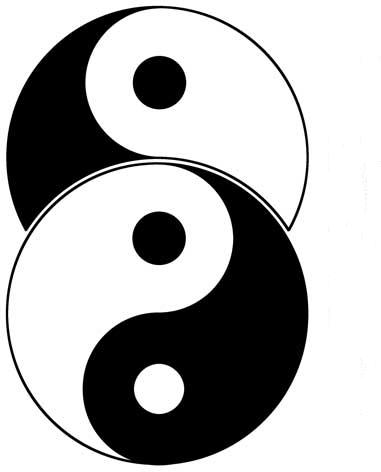
In
a recent essay, Red Collie drew connections between the 8 May 2008
Avebury crop circle (the Tai Ji, or the Yin – Yang symbol) and an
earlier crop circle, which appeared at Stantonbury on 7 July 2007. The
purpose of this essay is to explain in more detail the background of the
Stantonbury crop circle in terms of Chinese metaphysics.
As Red Collie describes, the Tai Ji symbol represents the annual
movement of the sun on the earth. In Chinese metaphysics, the year is
divided into two parts called, “Yin Dun” and “Yang Dun.” These halves
are divided by the solstices: Yang Dun begins at Winter Solstice and
ends at Summer Solstice, while Yin Dun begins at Summer Solstice and
ends at Winter Solstice.
During the Yang half of the year, Yang “Qi” or energies gradually
increase until they reach their maximum expression at the solstice. The
same holds true for the Yin half of the year, only in reverse.
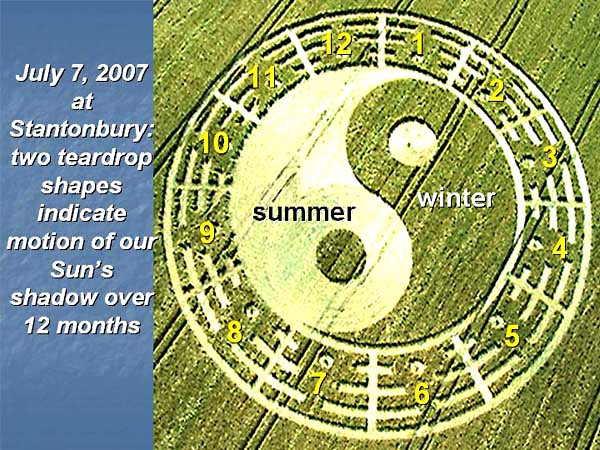
China
has long maintained its own traditional calendar, which is mostly based
on lunar movements. Each year is divided into twelve months and
generally contains thirty days. Each month is divided into three
segments. We may notice in the photo above that each segment in the
circle contains three segments of gradually increasing length. These
correspond the the Chinese calendrical notion of a month divided into
three phases: initial, middle, and final. The fifteenth of every month
corresponds to the full moon.
Traditional Chinese Time
The
traditional lunar calendar of China is founded on Base Sixty
mathematics, or the sexagesimal (base-60)
numeral system
with the Cycle of Sixty as the engine of temporal change.
The Cycle
of Sixty consists of matched pairs of the ten Heavenly Stems and the
twelve Earth Branches.
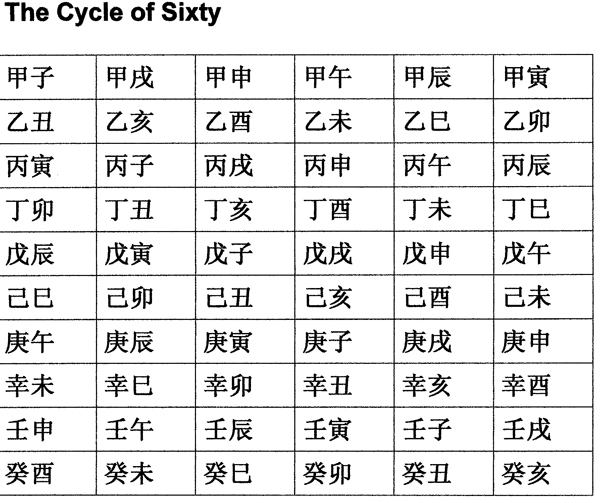
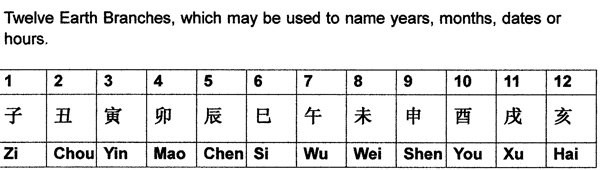
The stems
and branches are applied to the Chinese lunar calendar, for the names of
years, months, dates and hours, as the twelve numbers in the photo of
the Stantonbury crop circle correspond to the months below:
Readers
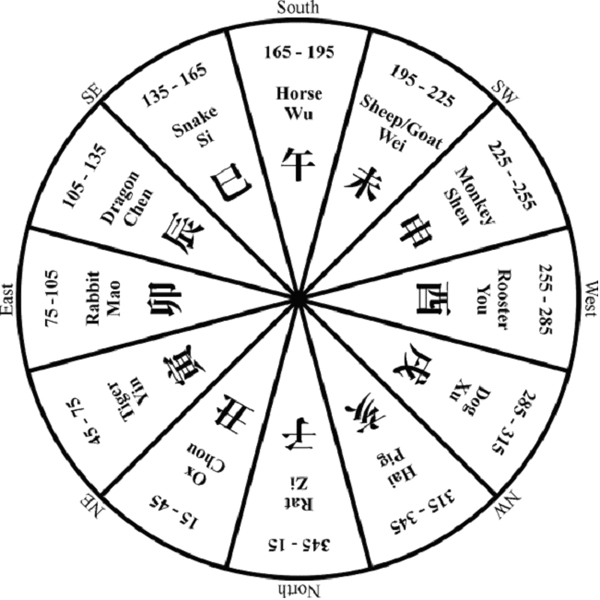
may be familiar with the twelve animals of the Chinese zodiac. These
animals are associated with years in Chinese cosmology, which recur in
cycles. The twelve Earth Branches are related to specific directions,
such as North, South, East and West and the Five Elements of Chinese
metaphysics.
For
example, Zi is always associated with North and Water, while Wu is
always associated with South, the Sun and the Fire element. In similar
fashion, Mao, Wood and the East are always associated, as are You, Metal
and West.
The
Chinese long ago built upon these associations to create systems of
divination, such as Qi Men Dun Jia (Magic Gates and Hidden Jia Stems) as
well as Da Li Ren (Six Great Ren Stems).
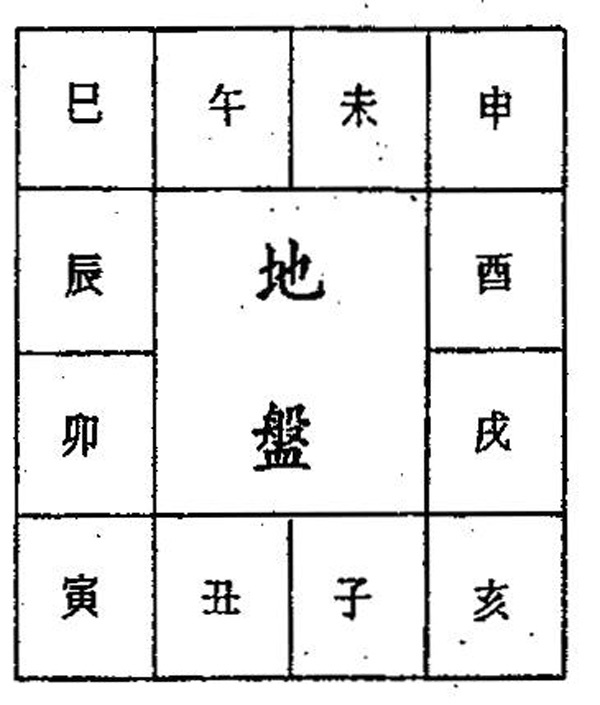
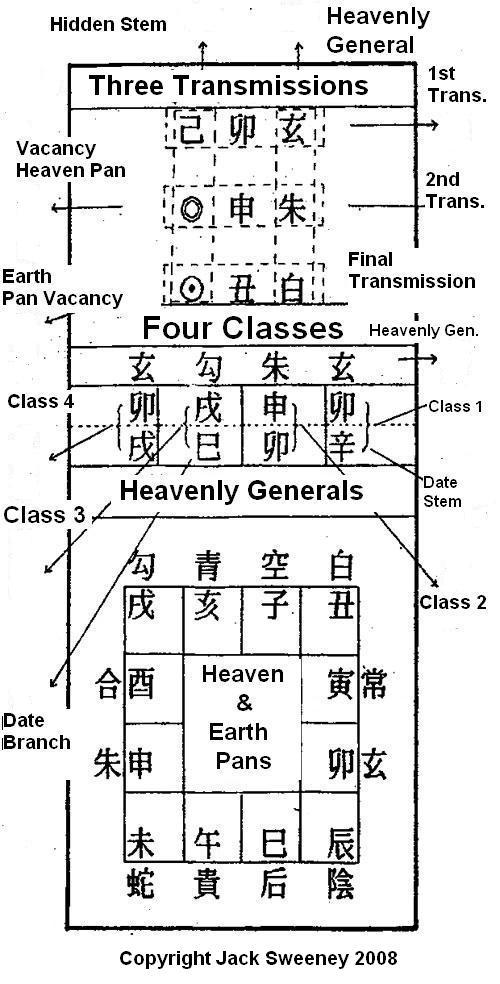
In Da Liu Ren, the twelve Earth Branches are arrayed around what is
called the Earth Pan. Each Earth Branch is assigned a fixed position in
the Earth Pan, and each position is associated with specific directions,
and assigned specific characteristics.
The Heaven Pan rotates around the Earth Pan. The twelve Earth Branches
are assigned rotating positions in the Heaven Pan, and these are further
matched with twelve generals or spirits:
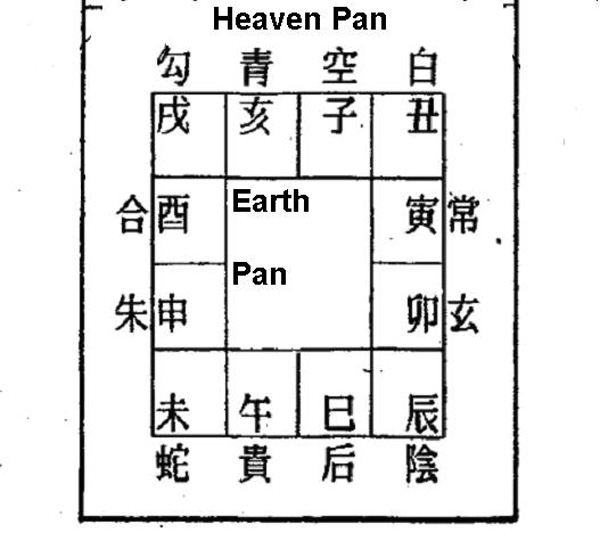
The twelve spirits are assigned names and characteristics as well, some
auspicious, others inauspicious.
Why
does Da Liu Ren have twelve spirits? Within the six yao (lines) of the
eight trigrams (and 64 hexagrams of the I Ching ) there are six spirits.
Yet Da Liu Ren uses twelve spirits. What is the function of these
spirits? These so-called spirits are a means of associating human
characteristics with the different qualities of phenomena. In other
words, Da Liu Ren has taken these phenomena and assigned them Yin and
Yang, Five Elements and Heaven and Earth qualities, to transform them
into archetypes with associations to Qi types and numbers.
Twelve Spirits of Da Liu Ren
|
1 |
Azure Dragon |
|
2 |
Heavenly Vacancy |
|
3 |
White Tiger |
|
4 |
Great Frequency (Tai Chang) |
|
5 |
Mystic Warfare |
|
6 |
Great Yin (Tai Yin) |
|
7 |
Celestial Empress |
|
8 |
Aristocrat |
|
9 |
Flying Dragon |
|
10 |
Vermillion Sparrow |
|
11 |
Six Unity |
|
12 |
Seduction |
If we return to the circle of 8 May 2008 at Avebury, we see that we have
not only one but two “Tai Ji” symbols, with one emerging from another.
What meaning might this possibly have.
Da Liu
Ren is based on the universal concept that, “there are no parts of
events or objects which do not comprise the Tai Ji,” of holistic theory
where “the smaller reflects the larger.” This is related as well to the
idea of a holistic model established by original principles concerning
Qi qualities.
The
so-called Earth Pan, which is also known as the “fixed pan,” means to
take the “Tai Ji Pan,” based on the rhythmic movements of Qi qualities
on Earth and to construct a model of these qualities, rhythms and
movements. This type of model idealizes the Earth’s twelve directions of
Qi and solidifies them.
The
four cardinal directions are Zi, Wu, Mao, and You, which represent
North, South, East and West. Chou, Yin, Chen, Si, Wei, Shen, Xu and Hai
define the four odd numbers, symbolizing four dimensions, along with
their Five Element characteristics and classifications among all beings
and objects.
The
so-called Heaven Pan is also known as the “dynamic pan” which is placed
over the fixed Earth Pan. The movements of the Heaven Pan follow the
Month General added to hourly movements. The twelve moving Earth
Branches of the Heaven Pan are divided and added over the fixed twelve
positions of the Earth Pan. Together, this creates a complete model
which reflects the movements of events and objects in the world.
In summary, the circle makers may be alluding to divination by
showing us different Tai Ji circles at different times. Tai Ji reflects
our physical reality on Earth, or as the Chinese say, the “ten thousand
creatures.” By illustrating a new Tai Ji emerging from the present Tai
Ji, the circle artists may be telling us to expect a new physical
reality emerging from our present reality, perhaps a world with more
dimensions than our present world.
 |