|
|
|
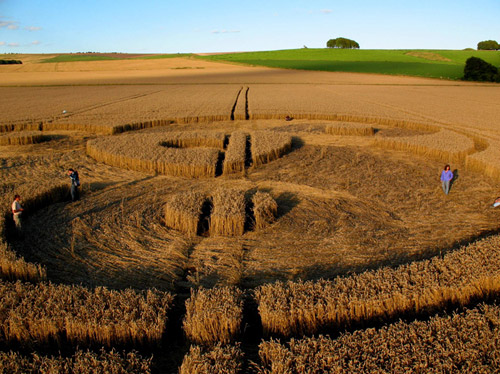
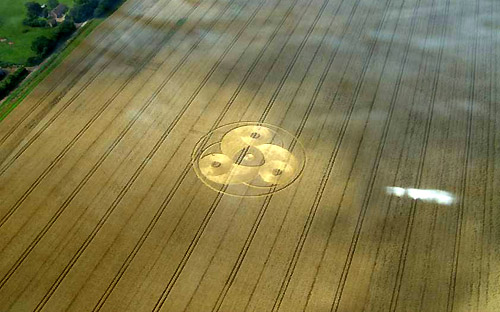
Green Street, Nr Avebury, Wiltshire. Reported 29th July.
Map Ref:
This Page
has been accessed

Updated Thursday 23rd August 2007 |
|
| AERIAL SHOTS |
GROUND SHOTS |
DIAGRAMS |
FIELD REPORTS |
ARTICLES |

Image
Philippe Ullens
Copyright 2007

Images
Busty Taylor Copyright 2007
|

FOR VISITING THE CROP
CIRCLES.
|

Click on thumbnails to enlarge
Image
Lucy Pringle
Copyright 2007
FIELD REPORT
Here is the last of the field reports I can
send from France this week - it concerns our visit to the small
but exquisite formation across from Avebury Manor farm on Green
Street at Avebury...
Although the 150 foot Trefoil formation in
mature wheat at Green Street in Avebury was first reported on
July 29, our group did not have the chance to enter it until
over a week later, on August 5, in the late afternoon.
Obviously, by that time, given its location near the Avebury
Henge and easy access across from the Avebury Manor farm, the
formation had been well visited by that afternoon. Thus, its
small central clockwise-swirled circle was quite "flat," its
centre clearly the scene of many meditations and placing of
various objects and so on. The main "pathways" among the
formation's three overlapping circles and the outer ring were
likewise quite flattened, evidence of the formation's popularity
and testament to the
improvement (temporary, alas) in the weather that week.
Nevertheless, despite its popularity, the
Green Street formation still felt quite "energetic" to those of
our group who took the time to walk the perimeter ring, then
along the three inner circles' edges, finally using the tram
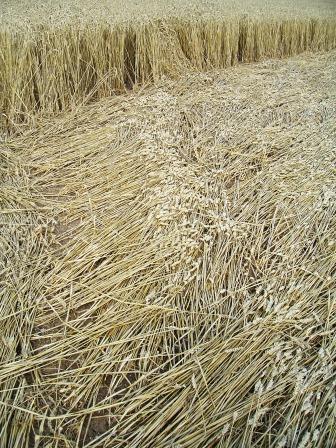
line to enter the central circle. Although the outer
perimeter ring was "walked to death," one of the inner circle's
shorter (and less walked on) arcs of laid-down wheat still
retained a beautiful flowing pattern of regularly-placed stalks
and seed heads in several places (see my photo). Also, one of
the inner-circles' arc's edges revealed what was to me at least
an important "anomaly": several individual or very small bundles
of stalks from outside the laid-down ring were bent at the first
node and actually lay UNDERNEATH the "flow" of the main grain
pathway, as if enticed to lay down before the 18"-wide arc was
swirled down over them. My close up photo clearly shows this
phenomenon, something virtually impossible to accomplish by
purely "mechanical" means.
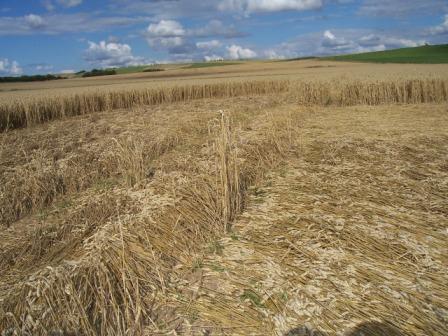
Further, the nearby tram line - that furthest
from the field's edge - showed many plant stalks still standing
in the middle of the otherwise laid-down spiral. This effect
was also present but less evident along the other tram line that
passed across another laid-down spiral in the formation and that
was used by more visitors as it was closer to the field's border
near the road. Finally, our group was impressed by several
beautiful "ridges" of laid-down crop nearly perpendicular to the
main flow of one of the three spirals' clock-wise flow. See
photos.
All in all, therefore, the Green Street
formation although far from the largest, most spectacular of
2007's offerings that I visited, and despite it's having been
literally pummelled by hundreds of human feet between it's
discovery and my opportunity to visit it a week later, remained
a visual delight for anyone taking just a bit of extra time to
examine its less-travelled pathways and to look at some of the
detail in laid-down and standing crop that made up its precise,
trinity design features. For me personally, visiting it even a
week late was a classic crop circle experience totally worthy of
a field that has seen many notable formations in the last dozen
years and
which highlights the Avebury Henge, one of England's most
important ancient monuments and long the "heart" of the crop
circle phenomenon.
All images Chet Snow Copyright 2007
Chet Snow
|

Diagram
Bertold Zugelder Copyright 2007
Click on thumbnails to enlarge
Images Bert Janssen Copyright 2007
|
|
 |