|
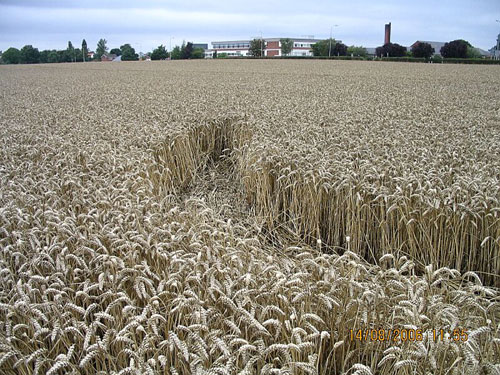
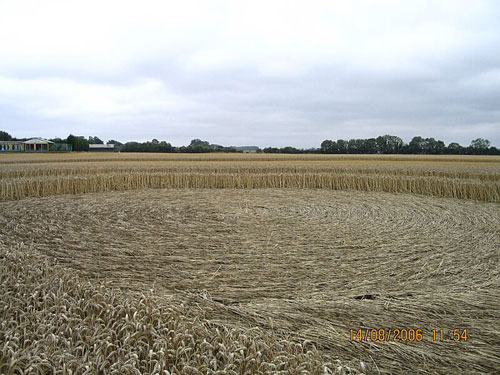
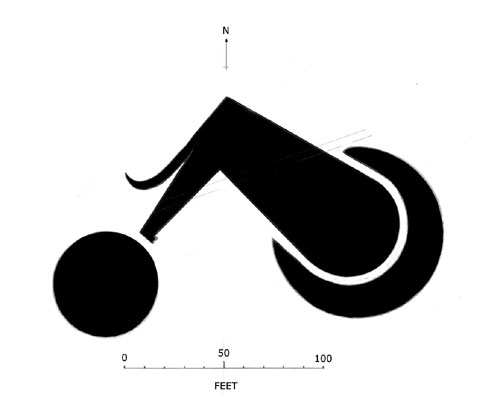
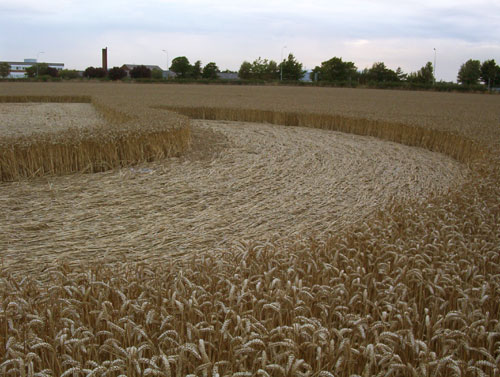
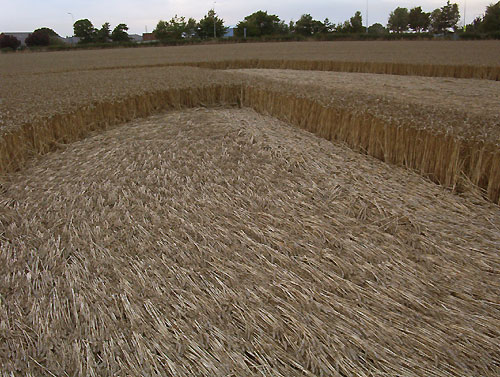
Waltham L-shape: Futuristic Design??
by Michelle Jennings
When I was researching more about black holes in
relation to the recent formations, I came upon
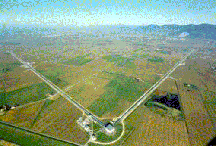
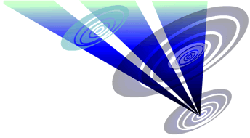
an illustration of an interferometric observatory which looked to me a
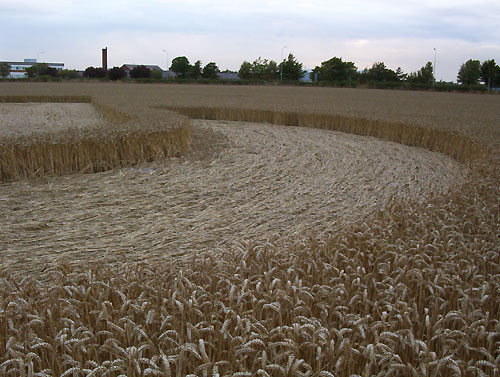
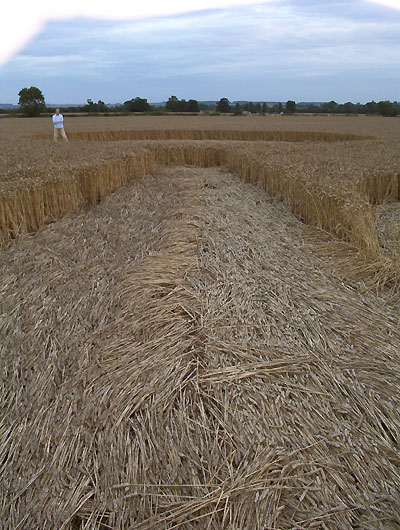
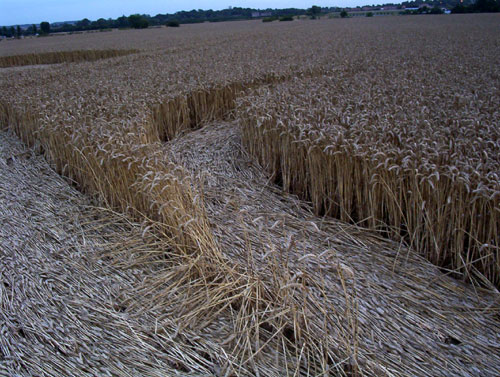
lot like the Waltham, Grimsby formation reported August 8. The
similarity made me wonder if the formation is not a more futuristic
design for these types of observatories that are designed to detect
gravitational waves.
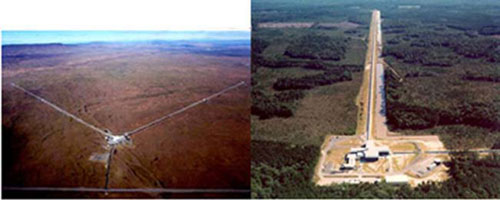
LIGO: Hanford and Livingstone Observatories
(USA)
If this guess is so, then the Waltham formation is
consistent with Avebury-Trusloe, Savernake, New Barn, as well as
Uffington Whitehorse, Chartley, Weyland Smithy. All of them could be
pointing to the idea of quantum change coming from the influence of the
core of the Milky Way to which our Solar System will be aligned in 2012.
As well, Blowingstone and Echilhampton could be illustrations of the
coming together of twin universes: a six dimensional one (Blowingstone)
and our four-dimensional one (Echilhampton). This of course would be on
the quantum level, making material changes on a scale we have not
experienced. The idea of the twin universes is consistent with string
theory which requires that there be 10 dimensions in order to include all
the forces we know about: strong and weak nuclear forces, electromagnetic
force and gravity.
Gravitational waves are evidence for this unity of
matter/energy. They are only detectable at quantum levels. Observatories
have been constructed around the world already, even though it is really
only since about 2000 that construction was begun on these facilities.
"Gravitational waves are somewhat analogous to the
waves of electromagnetic energy that we call light. Light waves are
created by electric charges in motion; similarly, gravitational waves are
created by masses in motion. Gravity waves are easiest conceptualize when
they are regarded in a similar sense as electromagnetic waves: they carry
information about a change in a gravitational field with time.
In reality, gravitational waves are oscillations in
the fabric of space-time itself, creating changing curvatures in the
space through which they pass. (In fact, gravitational waves were
predicted as an effect of general relativity, and are not part of
Newtonian physics at all as classical gravitational fields carry no
energy of their own.)" – http://web.syr.edu/~dmalling/projects.html
"In August 2002, LIGO began its search for cosmic
gravitational waves. Predicted significant emissions of gravitational
waves are expected from binary inspiral systems (collisions and
coalescences of neutron stars or black holes), supernova collapses of
stellar cores (which form neutron stars and black holes), rotations of
neutron stars with deformed crusts, and the remnants of gravitational
radiation created by the birth of the universe. Since the early 1990s,
interferometer physicists have believed that technology is at the point
where detection of gravitational waves—of significant astrophysical
interest—is possible." http://en.wikipedia.org/wiki/LIGO
VIRGO observatory (France/Italy) Futuristic
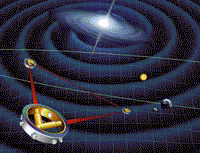
Space Observatory
|