|
|
|
Space-time wormholes or old record
labels?
by
Red Collie
This Page
has been accessed

Updated Tuesday 2nd August 2006 |
|
|
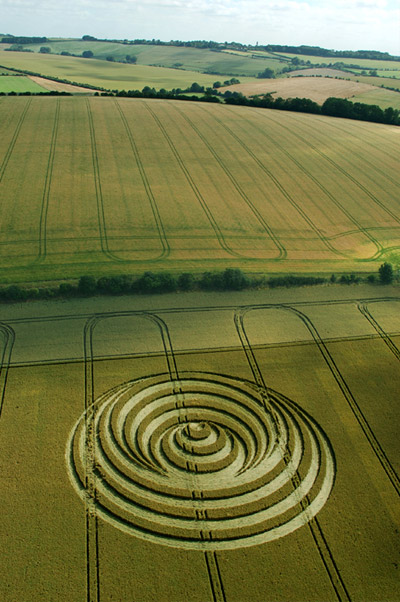
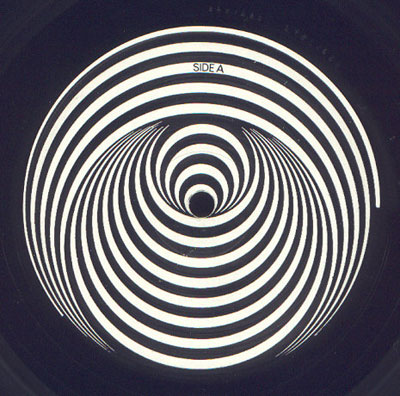
Bob Vernon has usefully
noted a similarity between the swirl
logo from an old record label called "Vertigo"
(www.vertigorecords.co.uk)
and the New Barn crop formation made prior
to this one :
|
When viewed
side-by-side, both images show broad circular stripes and an illusion
of depth. But there the
similarity ends: (a) stripes for New
Barn go up-down-up whereas stripes for Vertigo go
down-up-down; (b) stripes for New
Barn are symmetric about the centre
whereas stripes for Vertigo are offset
from the centre.
Hence if New Barn is simply
landscape art, then the hypothetical people who paid
for it were surely defrauded! Computer design alone would have
cost a fortune: see its reconstruction by M.A. Dousset on CCC.
Could other old
record labels explain Avebury
Trusloe, Savernake or Old Hayward, some of
which were harvested by farmers shortly after they appeared? I
did a search to check this possibility, but could not find any. The
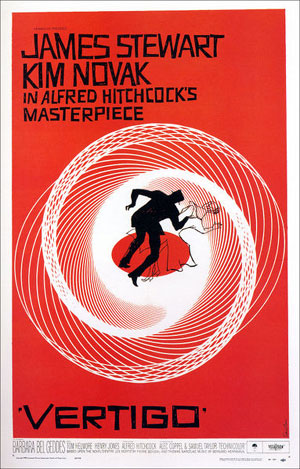
term "Vertigo" has been used however for an Alfred Hitchcock film and a
comic book character:

|
If not landscape art, then the alternative
seems astounding: unknown scientists from another place or time seem to
be teaching us advanced space-time physics, namely the engineering of
artificial wormholes. These are only theoretical constructs on Earth
today, although many physicists believe they could be made in our
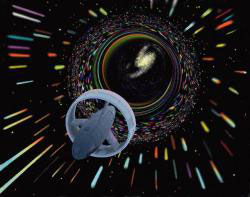
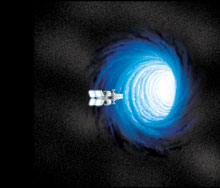
future. Most current conceptions of wormholes do not even look like New
Barn or any other of three similar crop pictures that have appeared
this year:
|
Nor is there even a hint from current
commercial or artistic literature, to suggest that two or four
wormholes might be placed into special ring-like
combinations as shown at Avebury Trusloe or Savernake Forest.
These are called "Roman rings" after Tom Roman who proposed them in
1992, followed by a confirming study by Matt Visser in 1997.
One can understand why contemporary
physicists, even great ones like Hawking, might be reluctant to accept
artificial wormholes. By analogy, would leading scientists from
classical Rome have been able to accept that humans from their
own future might produce computers and mobile phones?
But current astrophysicists do accept
(rightly or wrongly) that there exists a "repulsive energy" in space,
which makes the universe expand more rapidly than expected (as deduced
from studying supernovae in distant galaxies), and that such "phantom
energy" could be used to create artificial wormholes:
|
|
"Traversable wormholes
are useful as gedanken (thought) experiments," said Francisco Lobo,
an astrophysicist at the University of Lisbon. "Phantom energy could be
used to prop open wormholes .One could even imagine an advanced
civilization mining the cosmos for enough phantom energy to construct and
sustain a traversable wormhole."
"Relativity theory does
not allow travel into the past. But such travel could be achieved using
Einstein-Rosen bridges better known as wormholes. Kip Thorne, a theorist
at the California Institute of Technology, showed that wormholes could
be held open by a strange form of matter known as Casimir energy (a
repulsive energy of the vacuum)." |
|
|
"The bottom line is that
time travel is allowed by the laws of physics," said Brian Greene, a Columbia
University professor.
"We are not going to build a
wormhole with current technology, or even with foreseeable technology,"
said Matt Visser, a physicist at Victoria University.
In the 1980s, Stephen Hawking
argued that something fundamental to the laws of physics would prevent
wormholes being used for time travel.
Red Collie |
|
|
BACK |

Mark Fussell & Stuart Dike |
|
|