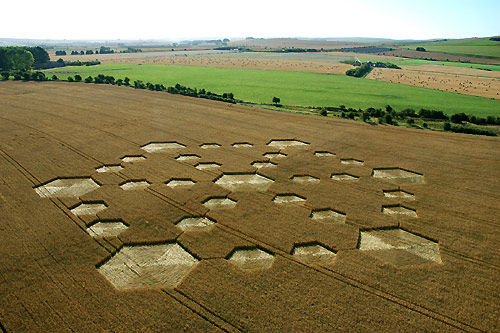
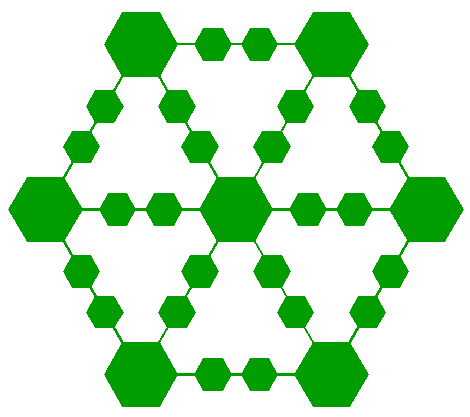
First of all, a real physical reference can be
inferred by this formation in that can be seen as a diagram of the
crystal structure of iron.

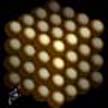
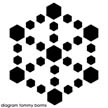
Compare with the diagram of formation by Tommy Borms
The solid core of our Earth is an iron crystal of the
hexagonal close-packed type. It is about 1,500 miles in diameter. The
extreme conditions of pressure allow the iron to exist as one solid
crystal 3,000 miles down from the Earth’s crust. It rotates in an
eastward direction, contrary to the Earth’s tectonic plates, and 100,000
times faster than the movement of the plates. More information about the
centre of our Earth can be found at
www.crystalinks.com/corecrystal.html .
I imagine that the ‘heart’ of Earth is like a huge
magnificent dynamo generating life up from Her core and holding all in
place and correct relation by Her tremendous force of gravitational
‘love’.
If this is not enough, the further symbolism of the
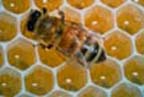
honeycomb, with its hexagonal segments and the honey produced by bees has
implications in the mythic/religious dimension of human life.
The honeycomb, honey, and the bee have long been
associated with the Goddess, –Demeter/Ceres, Aphrodite/Venus, Deborah,
and Melissa. As a preservative, honey in the hexagonal cells of the
honeycomb, came to represent rebirth through the influence and power of
Mother Nature. Chinese tradition associated honey with the element Earth
and with the concept of the Centre. As the Cosmic Egg, the Great Mother
is described: “Mother Earth lies in the world’s midst rounded like an egg
and all blessings are there inside her as in a honeycomb” (Walker 5).
The bee as a member of its hive is a loyal worker,
fulfilling its individual role within an orderly collective, devoted to
the queen bee. It is therefore a symbol of a prosperous civilized
state, ruled by means of wisdom and devotion as opposed to force of
arms. The bees organize their activities by orientation to the Sun, just
as our life on Earth is organized into seasons, and day and night because
of the Earth’s orientation to the Sun.
The hexagon itself is a symbol revealing the
underlying symmetry of the cosmos according to the Pythagoreans. They
perceived the endless network of equilateral triangles as a result of
extending the sides of the hexagonal cells in the honeycomb pattern. The
crop circle at Avebury Trusloe, near Beckhampton, Wiltshire reported June
23, 2005 is an example of this kind of symmetry.
The hexagon also contains the two equilateral
triangles joined to form the Sri Yantra of the Hindu tradition and the
later named Seal of Solomon/Star of David of the Jewish tradition. This
symbol represents the union of opposites, e.g. Fire/Water, Male/Female,
Light/Dark, etc. It is the sacred marriage between Heaven and Earth and
within each human being, the reconciliation and resolution of conflicting
tendencies and interests.
Both crop formations at: Avebury Henge, near Avebury,
Wiltshire, reported July 24, 2005, and Woolstone Hill, near Uffington,
Oxfordshire, reported August 13, 2005 display examples of the interlaced
triangles.
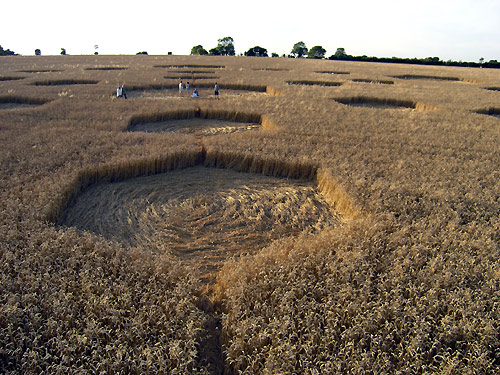
The Juggler’s Lane formation near Cherhill is an
elegant and ingenious combining of scientific, metaphysic and mythic
symbols to give us a hint of the New Cosmos and what it may mean to us–it
must be holistic at the very least! It is one of community and
reciprocal interaction, as the design in itself implies through the
connecting lines. It is, by extension, a paradigm in which there can be
no exploitation of one element for the benefit of the other, since the
structure depends on the integrity of the individual
components. Finally, this hexagonal symbol, like the symbol of the
scarab, indicates a kind of ‘death’ to an old pattern of managing on
Earth. However, the death required is none other than a confident
surrender to the benevolent forces that are already sustaining every form
of life on this planet. We are invited to welcome the ‘New’ with curious
and participatory anticipation.
Many thanks to the Circlemakers for this year of
abundant beauty and information!! Many thanks to Mark and Stuart for the
great work they do with The Crop Circle Connector!! Many thanks to those
who volunteer and share their knowledge and research to further insight
into this amazing miracle of the crop circles!!!
Michelle Jennings
Sources:
Chevalier, Jean & Alain Gheerbrant. The Penguin Dictionary of Symbols.
Penguin Books. London. 1996.
Stevens, Anthony. Ariadne’s Clue: A guide to the symbols of
humankind. Princeton University Press. Princeton. 1998.
Walker, Barbara. The Woman’s Dictionary of Symbols & Sacred Objects.
Castle Books. Edison. 1988.
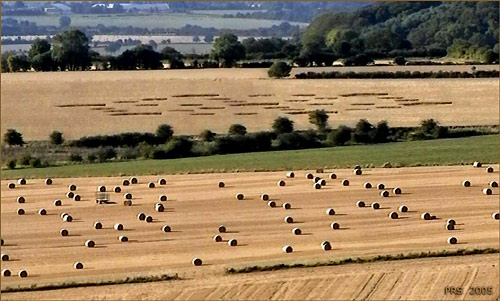
Image Peter
Sorensen Copyright 2005
|
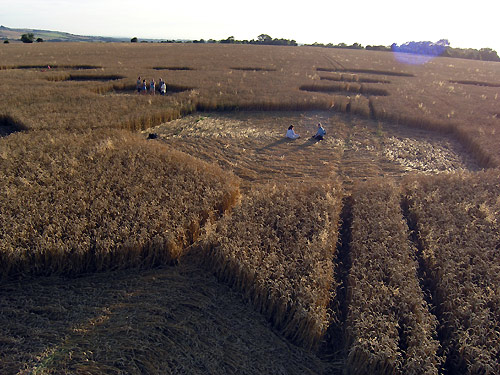
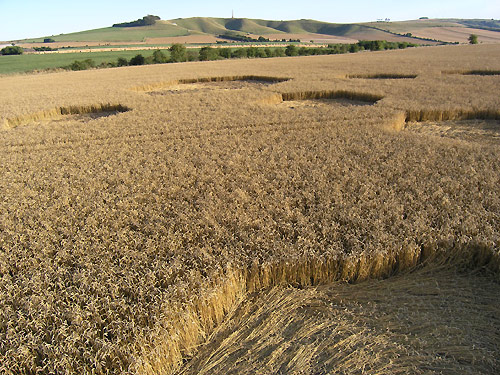
The big Hexagons formation that was discovered August 21st at Cherhill,
as seen from the hill where the Cherhill white horse is. It appears to
be a hexagonal constellation composed of 31 hexagons.
Peter Sorensen |

Image Lucy Pringle Copyright 2005
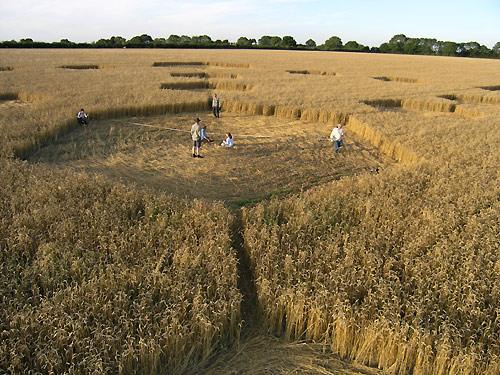
This formation is similar to:-
Milk Hill (3), Nr Stanton St Bernard,
Wiltshire. Reported 17th July.