|
CROP CIRCLES IN 2000 |
|
Stantonbury Hill, nr Bristol. Reported 18th May.
GPS Reference ST66716327
Updated Sunday 25th June 2000
Click on thumbnails to enlarge.
Video Images M.J.Fussell Copyright 2000
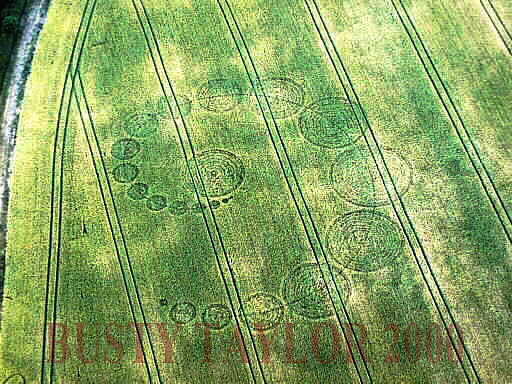
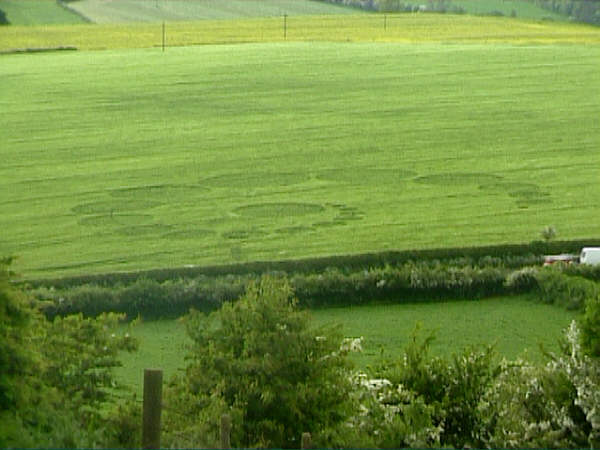
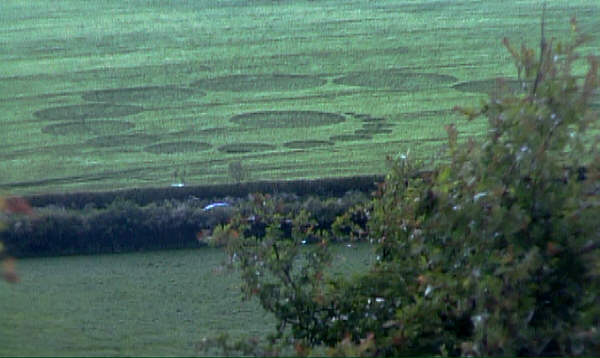
A 21 Circle Julia Set in Barley.

Video Image Stuart Dike Copyright 2000
Stitched together by AJ Samuels
FIELD REPORT
The Crop Circle Connector was delighted to hear about a formation, once again on our doorstep, and in an area well known to us both. We rushed out to capture an image of the design, in rather difficult weather conditions for video and still photography. To our dismay, we realised that it was too
late! Of course the formation was still there, but its age within the field, raised great concerns over future formations for 2000.
As you can see from the images we managed to capture, the crop had risen quite dramatically, indicating that it had to be over a week old in the
field, due to its brushed appearance. Because of the deteriorating weather at the time, we couldn't actually visit the formation, until another two days.
On entering the field, after taking a number of shots from the side of the field, we discovered that the Barley itself, inside the individual circles, was only a couple of inches lower than the rest of the field This made life very difficult to obtain any evidence from the ground, and a survey will not
be available, because we felt it would have been like walking through unaffected
standing crop.
There are 21 circles in total, including the central circle, diminishing, increasing, then decreasing in size around the tail. It is obviously a classic Julia Set formation, very similar to the design which appeared last
year at Newton St Loe. From the video wide image on the report, there is an evident
central connecting pathway, which links all the circles around the
tail. Interesting to note, that the same pathway was also on the Newton St Loe, and on other Julia Sets, like the famous 1996 Stonehenge formation.
Its location within the field, was almost in the exact position as the two designs which appeared in 1999. The fact that it was placed very close to
the hedgerow, meant that it could not be seen from the road, only from
Winsbury Hill, and possibly Stantonbury Hill. This was probably why it
hadn't been reported sooner after its appearance.
Report by Stuart Dike