|
CROP CIRCLES IN 1999 |
|
|
CROP CIRCLES IN 1999 |
|
Stanton Prior, nr Bristol. Reported 29th July.
Updated Sunday 22nd August 1999
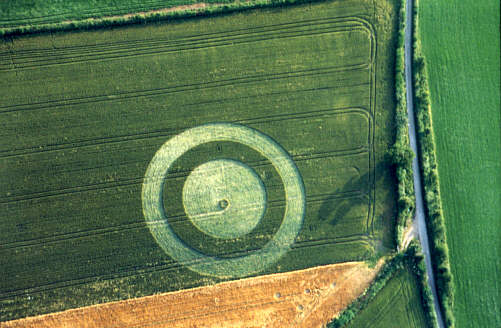
Image Michael Hubbard Copyright 1999

(C) 1999 Kox & Sorensen
FIELD REPORT


|
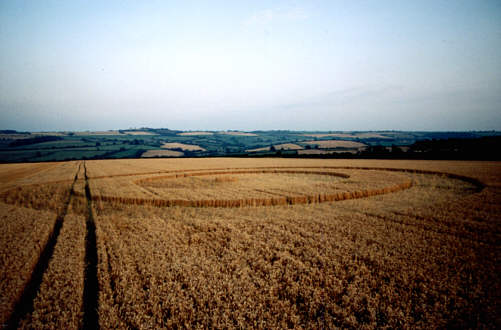
Field report to follow this week. Pole shots by Stuart Dike Copyright 1999 Click on Thumbnails to enlarge Yet another local formation for us to report on, but this one situated on high ground overlooking the Roman City of Bath was the one that nearly got away. It’s position was well away from any main roads and population and was one of the reasons why we didn’t manage to report on it sooner. It must have been sat there in the field for a few weeks prior to its discovery. However, on spotting the formation from the other side of the valley, it took us quite a few hours to actually find the field. Its elusive location almost got the better of the Crop Circle Connector, as we drove around the small country lanes with one eye on the road and the other on our 1:25.000 scale map. After two days of trying to find this formation, we finally located it, just off a small country lane leading to Stanton Prior. It was positioned not far from the lane, about 30 yards into the field. The circle and ring was constructed in Wheat, but rather strangely a small band of Barley was sowed directly next to the Wheat within the same field. Within the Barley was a cluster of Grapeshot circles about five in number, but only a few feet in diameter. Unfortunately the Barley had been cut, so we are unable to report on them. Returning to the main design, the outer ring had an anti-clockwise rotation, but the plants had recovered to about a 45 degree angle, so describing any detailed description of the floor construction would I feel be an injustice to its original quality some weeks earlier to our arrival. The width of the ring was 25 feet. The main circle itself had a diameter of around 100 feet, with the raised crop between the ring and the circle being 25 feet, with an anti-clockwise rotation. Probably its most unusual feature would be the off centre raised inner ring and circle, within the main circle. The diameter was 7.5 feet with also an anti-clockwise swirl. This ringed circle was located in a serene part of our local countryside, but probably positioned too remotely for us to have acted on it effectively. Nevertheless a worthy addition to our stunning formations in the Bristol and Bath area. Report by Stuart Dike. |