CROP CIRCLES IN THE YEAR 2000 - Steve Alexander & Karen Douglas share some of their recent crop circle experiences in this unique and beautifully illustrated series, exclusive to the Crop Circle Connector
Link here to further field reports and illustrations on the main Crop Circle Connector 2000 page
THE FIRST WILTSHIRE FORMATION
CHERHILL, April 27TH 2000
By Steve Alexander & Karen Douglas
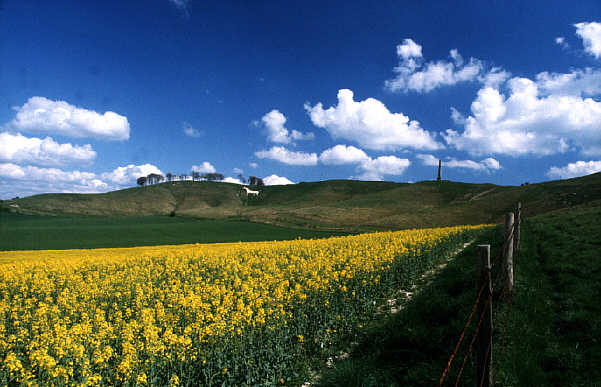
The Cherhill Landscape, White Horse, Landsdowne Monument &
Oldbury Castle Earthworks.
Image by Steve Alexander April 2000
Please click on the thumbnails below to enlarge
| Saturday 29th April 2000
It was the Saturday after the Friday on which it had poured with torrential rain all day. It was wet underfoot, very wet. The chalk of these Downs had congealed into a sticky and slippery sludge, which made walking up and down the steep embankments, precarious to say the least. However, raising our eyes from the state of our shoes, the sky today was bright and blue. The sun was warm and pleasant and the smell of cut grass and pollen was on the breeze, as we slowly (and carefully!) made our way upward toward the top of the Downs. The change in the weather could hardly have been more marked, today it really felt like spring, only yesterday it had seemed as if we were still in the grip of the cold winter. Perhaps things were changing. The Landscape Cherhill Down has been the site of many crop circles over the years. Many important formations have appeared below its rolling slopes – 1999 had seen one of the most beautiful formations of that year placed sympathetically beneath the White Horse, hundreds of visitors flocked to experience the circle and witness the phenomenon at first hand. It seemed fitting somehow that we should return here for the beginning of another crop circle season. This is a beautiful landscape, the undulating hills of the down, the chalk White Horse and at the summit the strange, but much-loved Landsdowne Monument create an atmosphere of ancient mystery, event though both are, relatively speaking, contemporary. However, what is here of real age is Oldbury Castle Hillfort which comprises the very top of the Downs, roughly triangular in shape it encloses approximately twenty acres and dates back to the iron age. This, as we would discover, gives the whole place a unique ambience which creates a location of natural power and splendour. |
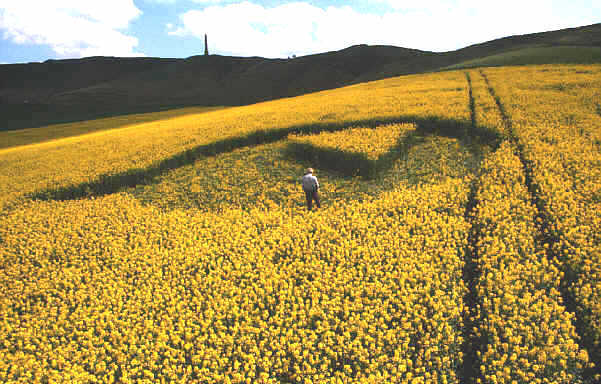
| The Crop Circle We had been able to get a reasonable, but relatively flat view of an oilseed rape formation which had appeared on Thursday morning. It was the first to appear in the area this year and had been described as a small flattened circle with a standing triangle inside. It was however, clear from our view from the road that there was a further feature to the formation, which we probably would not be able to discern until we |
Image © Steve Alexander 2000 The Cherhill Crop Circle (I) |
|
Image © Steve Alexander 2000 The Cherhill Crop Circle (I) |
had a closer look.
Along with that report of the first 2000 formation in Wiltshire comes
that familiar feeling of excitement and anticipation. A new year is
underway, and soon, we would be swept away with a tide of events as we
charted our way through the unpredictable seas of yet another crop
circle season.
Crop Circles in Oilseed rape Entering the formation, it was clear that it was somewhat worse for wear. Even though it had only been here for a matter of approximately |
| seventy-two hours - it had taken a beating. Most notable
was the way in which the crop appeared to be muddy and weather beaten,
this was really not surprising considering the rain of the previous day.
We were not the first inside this circle by any means, it was clear
there had been other visitors. The slope of the field was reasonably
steep and made walking around the small formation problematical, it was
easy to imagine that this difficulty in itself could account for much of
the damage we were observing – it was more like sliding around the
formation than walking. After looking around and admiring the wonderful
view of the landscape from the formation’s interior, we took our
photos for the record and decided to leave. Hopefully the formation
would stay further intact for other visitors to enjoy and fathom before
finally disappearing.
The circle of this formation measured approximately 61ft in diameter and the standing triangle feature was placed towards the top of this circle. Even on the ground the strange feature towards the bottom of the circle was hard to see, we would have to wait for aerial pictures or an accurate survey to see what this was all about. Still, this first quiet statement by the circlemakers seemed humble and appropriate, an initial stroke of mystery appeared to have presented itself before us already. At this early stage, the triangle feature seemed interesting as we had heard reports of another formation in Kent which had both circular and triangular features in it’s design – was the year 2000 to see more triangles? Only time would tell. |
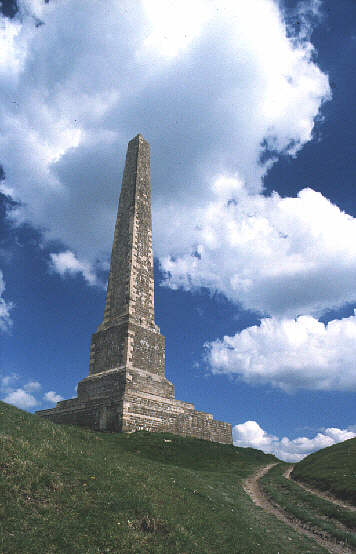
Image © Steve Alexander 2000 The Landsdowne Monument |
Further
Adventures.
We decided we would continue our walk skywards and explore the top of the Downs. Fate seemed to have given us the time, weather and energy to do more than just look at the circle. It felt as if we were being encouraged onwards that we might bear witness to the context in which this formation had occurred. The Lansdowne Monument Reaching the top was no mean feat! That familiar feeling of exhilaration and fatigue was soon upon us as we reached the summit and found ourselves, eyes raised to the heavens, looking up at the massive and imposing Landsdowne Monument. The Landsdowne Monument had been erected in 1843 by the Landsdowne family to commemorate a family ancestor, Sir William Petty. Sir William had lead a varied and colourful life, achieving celebrity for reviving Nan Greene, a woman who had been hanged for murdering her own child. He became both a Professor of anatomy, a professor of Music and was a celebrated Parliamentarian – being a |
| favourite of King Charles II - he was also the subject of one of John Aubrey’s Brief Lives. The monument was designed by Sir Charles Barry (1795-1860)who later designed the Houses of Parliament and 1991 it was restored from its derelict state by the National Trust which now owns much of the land around Oldbury Castle. The hillfort itself is much damaged by flint digging and excavations of the chalk for the many restorations of the famous White Horse. However, the views from this excellent platform are outstanding, including views over Calstone Coombs, all the way to a distant Hackpen Hill and over and into the Marlborough Downs. The stunning vista is simply inspirational. |
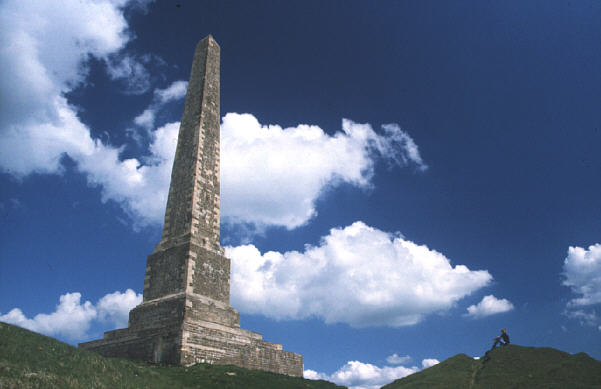
Image © Steve Alexander 2000. Eyes Looking at Heaven. |
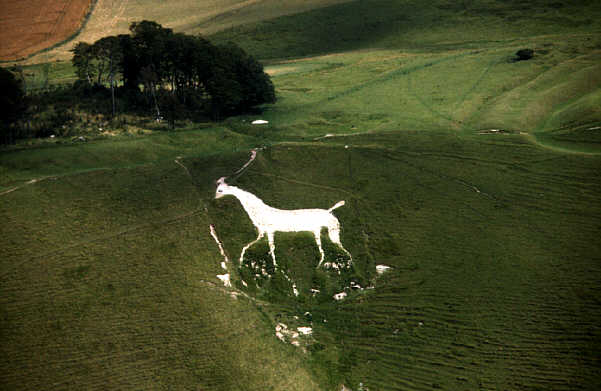
Image © Steve Alexander 2000. Cherhill Whitehorse. |
The White Horse
Soon we were making our decent and before long came eye to eye with Cherhill’s famous White Horse. The horse is cut into a near 45° slope were the hill falls away from the castle ramparts and it isn’t until you come within quite such a proximity of him that you appreciate his size. The horse is 129ft long and142ft in height and at one time had an eye made of the bottom of glass bottles which made it sparkle in the sunlight. The horse now seems to have a rather large bolder for an eye, more appropriate of his weary |
| looking appearance. The horse
was refurbished as recently as 1994 by Cherhill Parish Council who are
now responsible for the White Horses’ upkeep. The figure was
originally cut in 1780 and has been maintained and loved for over 200
years.
Endings It is a uncertain decent as you make you way down the sides of the castle and we were relieved to reach the bottom. Here relief set in with fatigue as we walked along the main road (A4) to our car. The village of Cherhill was an important route for stage coaches on their way from the West Country to London and was made famous for it’s notorious band of highway men called "The Cherhill Gang". The Black Horse Inn is the only surviving coaching inn in the area and is still open to this day serving meals and ales to the weary modern day traveller. The village also has a 15th century church a tithe barn and a manor house. Wearily we packed up the car and decided it was time to go and we finished the day sharing our adventures with a friend over a well-deserved cup of tea and a biscuit. |
Have you seen the CROP CIRCLE YEAR BOOK 1999
by Steve Alexander & Karen Douglas?