|
|
|
Stettler, Alberta.
Reported 25th August.
Map Ref:
This Page
has been accessed

Updated Wednesday 7th October
2009 |
|
| AERIAL SHOTS |
GROUND SHOTS |
DIAGRAMS |
FIELD REPORTS |
ARTICLES |
|
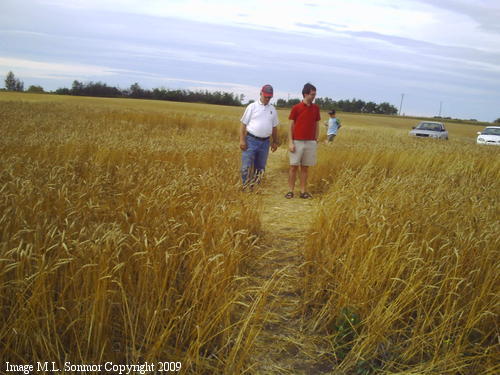
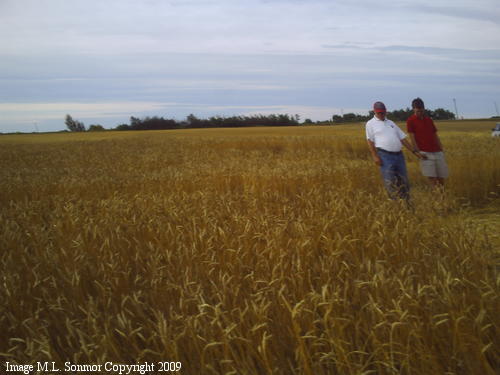
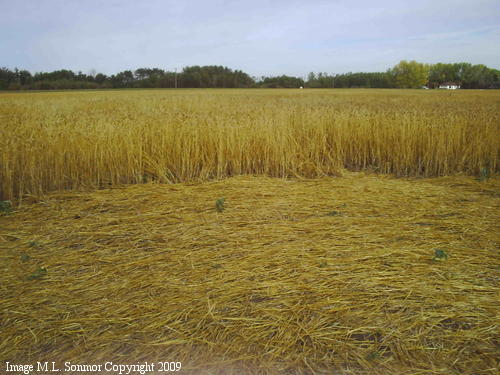
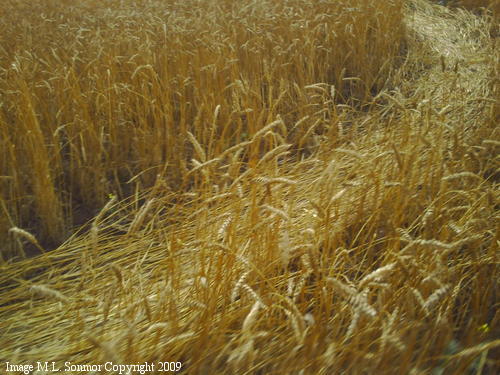
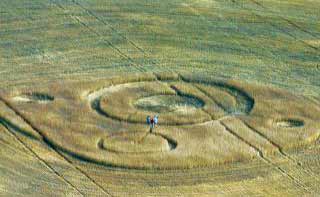
Type of Crop: Wheat
Description: Centre Circle, with surrounding
ring, bottom of surrounding ring is wider on
bottom than top, right and left solid circles. Top ring
is hollow. Missing here is a
'path to centre of top hollow ring. More Info at:
www.shrinesandsacredsites.com and
www.albertalocalnews.com
|
| |
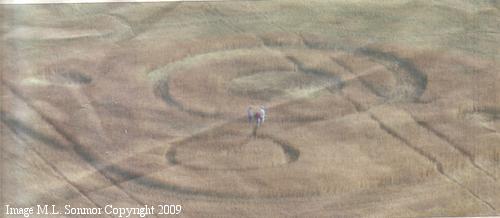
Click on thumbnails to enlarge
Images M.L. Sonmor Copyright 2009

Diagram Paul Scott Anderson (CCRN) Copyright 2009
|
This relatively simple
crop circle shows a comet which has acquired a coma, resulting in two
major fragments separating from the nucleus. This is a common theme
among earlier crop circles. Below, the earth with the intended impact
point illustrates the circle makers’ early anticipation of the final
outcome of the comet strike. More than one gas is indicated in the coma
by the thicker part of the top of the ring. The comet may be near the
Asteroid Belt where comas formed of water vapour begin to be detected.
The two major fragments suggest Comet C as most likely.
Kenneth Heck |
Many
crop pictures seem to predict the future. Three recent
examples from the summer of 2009 were: (i) a solar flare on June
13 (see
southfield), (ii) a giant sunspot on July 7 (see
eastfield) or (iii) a solar wind-aurora on July 22 (see badbury).
Although most of these future-predictive field images are found
in southern England, two excellent crop pictures appeared in
western Canada during August or September of 2009. Both appear
on detailed inspection to be paranormally authentic (see
www.earthfiles.com or www.earthfiles.com).
It seemed clear right away that
the first of those pictures at Stettler, Alberta on August 25
seemed to predict something concerning our
Sun,
while the other at Moosejaw, Saskatchewan on September 19 seemed
to predict something concerning a
bright comet.
Thus, the first picture at Stettler showed the standard
astronomical symbol for our "Sun", as a large circle with a
small dot inside (see
Astronomical_symbols). It also showed another double-ring
symbol for our "Sun" which has been used in crop pictures since
the 1980's (see
time2007f or
aveburymanor2008b). Likewise, the second picture at Moosejaw
showed a series of linked circles of increasing size, which have
often been used to describe a "bright comet" (see
windmillhill2).
Now in early October of 2009, we
can be pretty sure what that first Canadian crop picture was
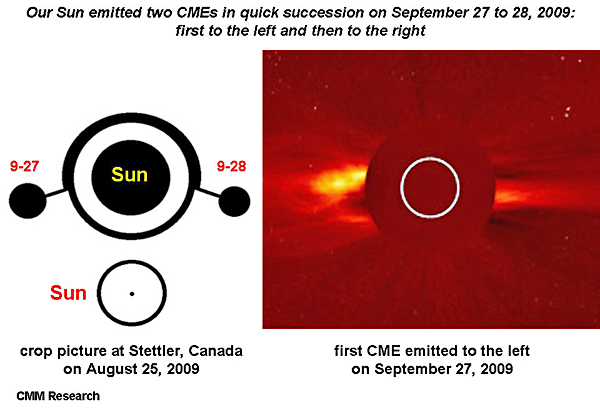
trying to tell us! On September 27-28, 2009, our Sun shot out
two large CMEs
(coronal mass ejections) to the left then
to the right, just as were shown schematically in
the crop picture at Stettler:
Please refer to the SOHO website for more details, or for a
movie of those two solar ejection events (see nasa.gov
for October 2, 2009 or nasa.gov).
The length of time between when
that Stettler crop picture appeared, and when two CMEs were
ejected from our Sun, equals
slightly more than one month
from August 25 to September 27-28, 2009. Might we also expect to
see a bright comet soon, based on what was shown in the second
Canadian crop picture at Moosejaw on September 19 (see
moosejaw)?
As well as in many crop pictures from southern England during
early August (see windmillhill2)?
PS
We would like to thank Paul Anderson for the schematic diagram
of Stettler shown above.
|
| AERIAL SHOTS |
GROUND SHOTS |
DIAGRAMS |
FIELD REPORTS |
ARTICLES |
|
|

BACK |

Mark Fussell & Stuart Dike |
|
 |