|
|

|
Secklendorf, Niedersachsen (Lower
Saxony). Reported 23rd June
Map Ref:
This Page
has been accessed

Updated Wednesday 15th October 2008 |
 |
| AERIAL SHOTS |
GROUND SHOTS |
DIAGRAMS |
FIELD REPORTS |
ARTICLES |

CLICK HERE FOR THE LATEST CROP
CIRCLE CONNECTOR DVD
Images Juliane von der Ohe
Copyright 2008
|

Make a donation to keep the
web site alive... Thank you |
|
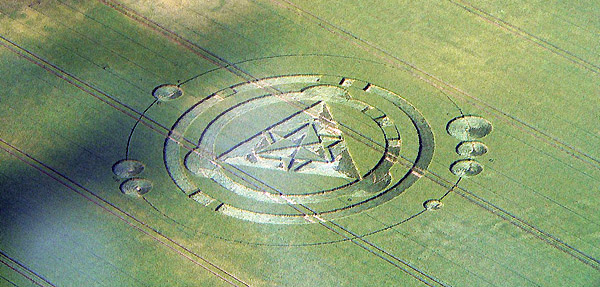
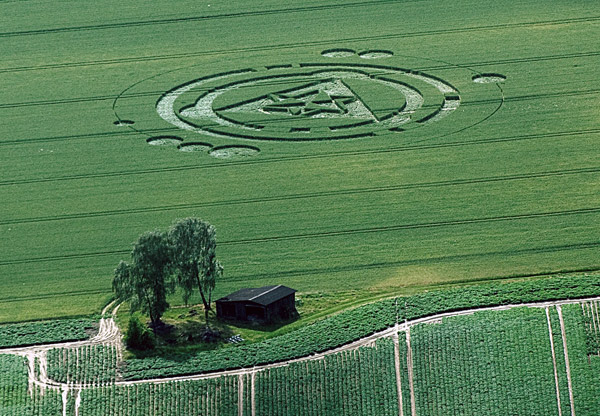
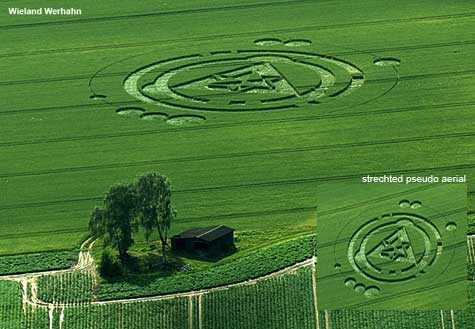
SECKLENDORF, NIEDERSACHSEN (Lower Saxony) - disc. June 23, 2008
Thisformation was discovered together with two other formations (atEdendorf
and Gifkendorf) in close proximity on the same day.
www.kornkreise-forschung.de
Andreas Müller |
The new crop picture from
Secklendorf, Germany
shows near-future
orbital locations for Earth,
Venus and Mars on
an upcoming date of June 6, 2012 (Venus transit),
as well as orbital locations for Earth and Venus on an
upcoming date of December 21, 2012 (end of the Mayan Long
Count calendar).
Two sets of binary numbers in
base-128 from its inner rings then confirm those two dates, when
read in terms of a Mayan Sun-Venus calendar.
A spectacular new crop picture
appeared at Secklendorf, Germany on June 23, 2008, in
combination with three other minor crop pictures on the same
day. What could they mean?
A six-pointed star in
three dimensions, overlaid upon a large triangle or pyramid
The Secklendorf picture shows at
first glance a "six-pointed star in three dimensions", overlaid
upon a large triangle or pyramid. What could such a strange
combination of symbols be trying to tell us? That star in one
sense may have a definite astronomical meaning, as "bright
Venus" in transit across the face of our Sun (see below):
Yet in another sense, it may have a
separate geometrical meaning, that could help to explain why two
great pyramidal monuments were built on Earth in a certain shape
long ago. Thus, if one were to draw a flat circle around the
four horizontal points of that star with radius h,
where h is the height of either of its two
vertical points, one would find a ratio for
circumference-to-height of C / h = 2 pi. For
purposes of comparison, the Pyramid of the Sun in Teotihuacan
shows a ratio of square-circumference-to-height
of 12.560, nearly equal to 4 pi = 12.566.
Similarly, the Great Pyramid in Egypt shows a ratio of
6.280, nearly equal to 2 pi = 6.283 (see
www.world-mysteries.com/mpl_7.htm). Could those crop artists
have interacted with local humans on Earth at many times in our
distant past?
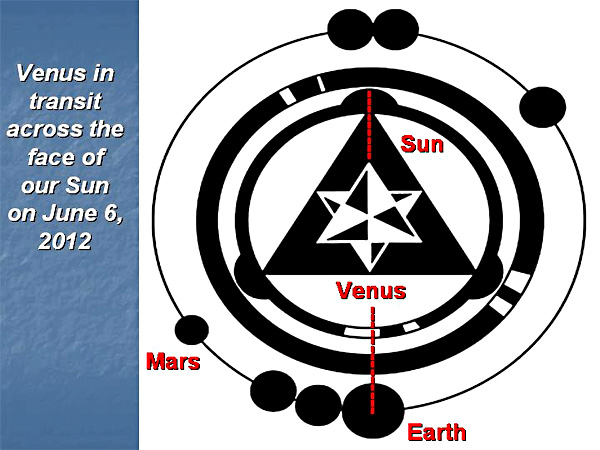
Bright Venus in
transit across the face of our Sun on June 6, 2012
Apart from its geometrical
symbols near the centre, the vast majority of symbols in that
new crop picture from Secklendorg, Germany refer to modern
astronomical phenomena. I therefore used the NASA NEO
website and its orbital diagrams
(see
http://neo.jpl.nasa.gov/orbits)
to solve for their meanings.
To be concise, the large
central triangle or pyramid shown
above seems to represents our "Sun"
in an astronomical sense. Its clever double meaning might be for
the famous Pyramid of the Sun in
Teotihuacan, Mexico, which has
been shown several times
before in crops (see
www.lucypringle.co.uk/photos/2001/uk2001ar.shtml#pic2).
Next, the six-pointed
star in three dimensions that
has been drawn over that
central triangle seems
to represent "bright Venus",
which will next be in solar transit across
the face of our Sun on June 6, 2012.
The largest outer circle
at the bottom represents "Earth",
as a constant (if moving) frame of reference
over four years from 2008 to 2012
Finally, the small
outer circle at lower left shows where "Mars"
will be located on June 6, 2012,
relative to Earth (largest
outer ball) and Venus in solar
transit (six-pointed star covering
the triangular
Sun):
Several other crop pictures from
the past seem consistent with those interpretations. For
example, another six-pointed star appeared at
Etchilhampton on August 1, 1997, again overlaid across the face
of our Sun (see
www.lucypringle.co.uk/photos/1997/uk1997cg.shtml):
It was accompanied by a 26 x 30 =
780-circle grid, meaning "780 weeks" or 15 years from the summer
of 1997 to Venus transit on June 6, 2012.
Stanton
Bridge of July 14, 2007
likewise showed a triangular
symbol for our
Sun, surrounded by various planets including Jupiter, Saturn
(two large balls), Mars
(three small balls) or Moon
(three medium-size balls). Those
orbital locations told similarly about Venus transit on June 6,
2012. Its two outermost
balls represented
Venus and Earth
during inferior conjunction with the Sun on August 18, 2007
(see
www.cropcircle.tv/archives/2007/stantonbridge/stantonbridge2007.html).
Stanton St. Bernard of August 12, 2007 then showed the Mayan
number six, meaning "six Venus-Sun conjunctions left until
transit in 2012". It appeared six days before a Sun-Venus
conjunction on August 18, 2007 as a clever double meaning
(see
www.cropcircle.tv/archives/2007/stanton/stanton2007.html).
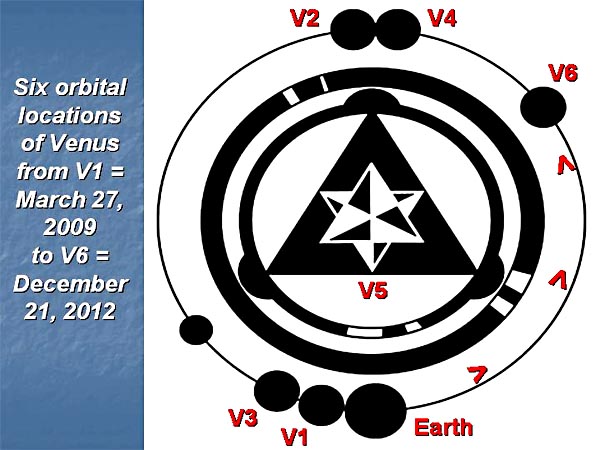
Six orbital locations
of Venus from March 27, 2009 to December 21, 2012
So far, so good. Now those five
other medium-sized balls
from Secklendorf seem to show where
Venus will be located relative to Earth (largest
outer ball) on upcoming dates of:
V1 = March 27, 2009, inferior conjunction with
Sun, next to Earth
V2 = January 11, 2012, superior conjunction
with Sun, opposite Earth
V3 = October 29, 2010, inferior conjunction
with Sun, next to Earth
V4 = August 16, 2011, superior conjunction with
Sun, opposite Earth
V5 = June 6, 2012, inferior
conjunction with Sun, solar
transit (bright central
six-pointed star)
V6 = December 21, 2012, three
months before superior conjunction
with Sun, far right opposite Earth (end of
Long Count).
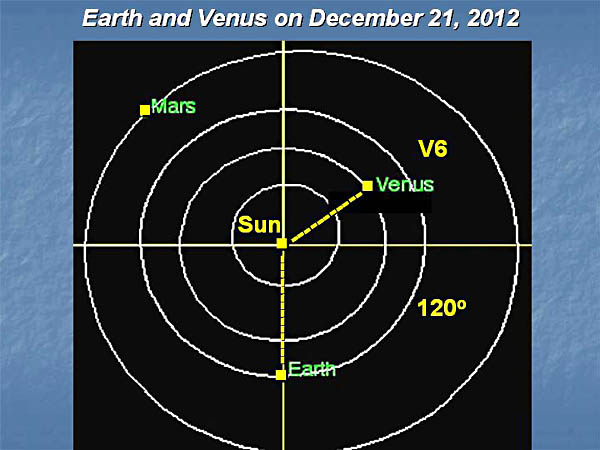
The most interesting of those
six near-future orbital locations will be December 21, 2012
(end of the Mayan Long Count calendar), when Venus at
V6 will lie separated from Earth in solar
orbit by one-third of a circular turn or 120 degrees:
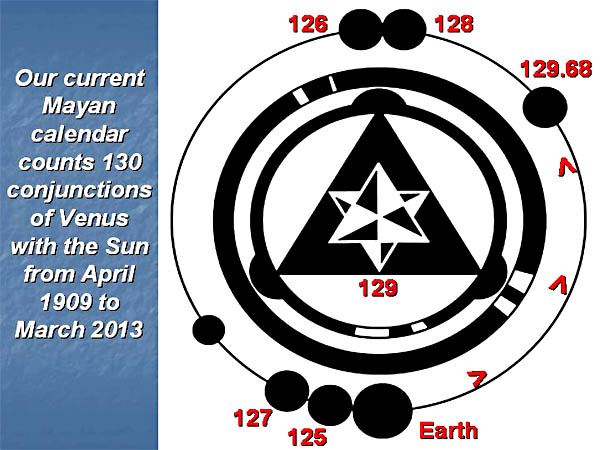
Our current Mayan calendar
counts 130 conjunctions of Venus with the Sun from April 23,
1909 to March 28, 2013
Now in addition to their Long
Count calendar, which lasts for 5125 years and was kept
mainly by the priests, the ordinary Mayans followed
another daily calendar that was based on visible motions of
Venus relative to our Sun, and which lasted for only 52 to
104 years. It was called the Short Count or Sun-Venus
calendar, and has featured prominently in many crop pictures
from the past (see
www.cropcircleconnector.com/anasazi/time2007c.html).
When read in terms of their
104-year Sun-Venus calendar, which began on April 23, 1909 and
will end on March 28, 2013, those six orbital locations of Venus
V1 to V5 would count as
conjunctions from number 125 to 129,
while December 21, 2012 would count as a fractional
129.68
Any two successive Sun-Venus conjunctions (whether inferior or
superior) are separated in time by 292 days. Hence 130
conjunctions will last for a total of 130 x 292 = 37,960 days,
equal to 104 years minus 26 days. We learned about that Mayan
Sun-Venus calendar originally from the Dresden Codex, which was
one of only a few ancient Mayan manuscripts not burned by
invading Spanish priests
(see
http://members.shaw.ca/mjfinley/4VENUS.htm or www.tulane.edu/~danny/dresden.html).
In summary, the astronomical
part of Secklendorf tells
us mainly about two
near-future dates of June 6, 2012 (Venus transit
or V5) and December 21, 2012 (end of the
Mayan Long Count calendar
or V6). Note
also that its final symbol V6 for Venus
lies two-thirds of the way between the last two Sun-Venus
conjunctions in our current 104-year
calendar as numbers 129
or 130. In other words,
V6 lies 120 degrees from
Venus transit V5 or conjunction 129 on
June 6, 2012, or equally from Earth as the biggest ball
at bottom. Likewise, V6
lies 60 degrees from 126 or 128
at top which mark where the final conjunction 130
of March 28, 2013 would be located, if it were shown.
Binary coding of those
same dates within two "inner rings" using the Mayan Sun-Venus
calendar
There have been several past examples
in crops, where the Mayan Sun-Venus calendar was used to date
certain events using binary code. For example at
Crabwood in 2002,
binary base-32 as
30-25-14 was
used to give a certain fraction of 104 / 2 = 52 years to remind
us that "50 years
had passed" since an
unfriendly alien
grey race contacted
Earth (see www.cropcircleconnector.com/anasazi/time2007o.html).
Likewise, Wayland's
Smithy 2005 used binary
base-16 as
13-10-7
or 14-5-11
to tell us two important dates in terms of their current 104 / 2
= 52 year Sun-Venus calendar: the date when
that crop picture appeared
on August 9, 2005, plus
the date when a
newly-exploded Comet Holmes would conjunct with a
bright star Mirfak in
Perseus two years later on November 20, 2007
(see
www.cropcircleconnector.com/anasazi/time2007g.html or
www.cropcircleconnector.com/anasazi/time2007h.html).
Wayland's Smithy 2006 then told
us that "56 Sun-Venus
conjunctions had passed since
April 10, 1961", meaning that
there were 9 left to go until March 28, 2013
(see www.cropcircleconnector.com/anasazi/time2007m.html).
Stanton St. Bernard in 2007 said
that 58 Sun-Venus
conjunctions had passed since
April 10, 1961, and that "6 were
left until Venus transit on June 6, 2012", while
7 were left until March
28, 2013 (see
www.cropcircle.tv/archives/2007/stanton/stanton2007.html).
Therefore, if those crop
artists wished to provide a second message to reinforce
the identities of two dates given at Secklendorf by means of
astronomical symbols, the Mayan Sun-Venus calendar would be
a good place to start! How might they code for those two dates
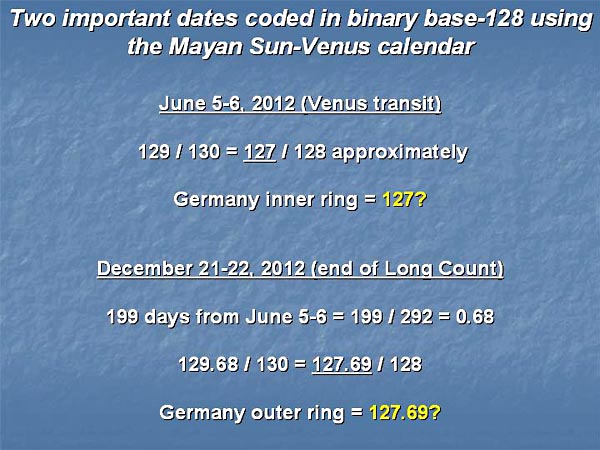
in a binary fashion, using their Sun-Venus calendar? The
simplest way would be to choose binary base-128, since since the
total number of conjunctions in any 104-year period equals a
similar 130:
Thus an upcoming date of June
5-6, 2012 for Venus transit could be written simply as "129
/ 130", which approximates closely to "127 / 128" in binary
base-128. One might expect therefore to see "127"
or "0111 1111" as a binary representation
of June 5-6, 2012 in the field?
Likewise, an upcoming date of
December 21-22, 2012 for the winter solstice (or end of the
Mayan Long Count) lies 199 days past June 6, which equals a
fraction 199 / 292 = 0.68 in terms of Sun-Venus
conjunctions. Hence its calendar date could be written
as "129.68 / 130" which converts slightly to "127.69 / 128"
in base-128. One might expect therefore to see
"127.69" as a binary representation of December
21-22, 2012 in the field?
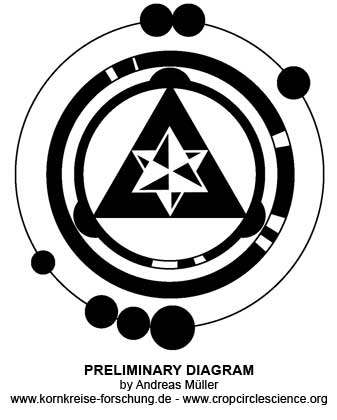
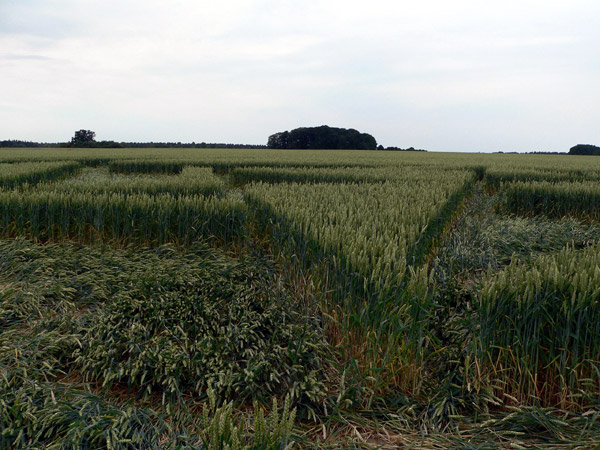
When we look at the real crop
picture from Secklendorf (a black-and-white drawing
shown above was only approximate), we can see a series of
standing or flattened bits of crop within its two inner
rings, that clearly provide some kind of binary code:
Reading
carefully along its first inner ring, we can see two
bars of relative length "3-space-space-4"
that may be read as 0111-xx-1111
in binary code. Those
translate into base-128 as "127"
= 0 + 64 + 32 +16 + 8 + 4 + 2 + 1 =
0111-xx-1111. Hence
we seem to see the correct binary representation of June
6, 2012 within that first inner ring as expected!
Reading next along its second
inner ring, we can see a series of three binary symbols: "127"
as 0111-xx-1111,
then an unstructured "decimal
point" 111, and
finally another binary string 0100-xx-0011
meaning "67" = 0 + 64 + 0 + 0
+ 0 + 0 + 2 + 1, or possibly
0100-xx-0110
meaning "70" = 0 + 64 +
0 + 0 + 0 + 4 + 2 + 0.
Those three
symbols add together to give either 127.67
or 127.70. Both
possible field values lie close to our theoretical value
of 127.69
for December 21-22, 2012 as derived above.
Three other minor crop
pictures in Germany on the same day
Three other minor crop pictures
appeared in Germany on the same day as Secklendorf. One from Edendorf
showed a central Sun with 12 wavy lines, which is the
standard signature for Quetzalcoatl as a "Feathered
Serpent"
(see
www.cropcircleconnector.com/inter2008/germany/Edendorf/Edendorf2008a.html).
I have argued elsewhere, following a
proposal by Jaime Maussan, that Quetzalcoatl may have
been a benevolent extra-terrestrial visitor to Earth 2000 years
ago, and may also be
our modern crop artist today
(see
www.cropcircleconnector.com/anasazi/time2007k.html).
A second minor crop picture from
Reinsdorf seemed to show in schematic form the Pyramid of
the Sun from Teotihuacan, along with 12 linked sundial motifs.
It was signed using an ancient German rune for "algiz" or "Z"
(see
www.cropcircleconnector.com/inter2008/germany/Reinsdorf/Reinsdorf2008a.html)
A third minor crop picture from
Gifkendorf showed orbital diagrams for Venus, Earth and
Mars in highly schematic
form. Each planet was symbolized
by a "clock",
which told how long it
takes to orbit the Sun by 120 degrees. Venus showed the least
increase of time, Earth somewhat greater, and Mars even greater,
consistent with the
relative speeds of those planets about Sun.
see
www.cropcircleconnector.com/inter2008/germany/Gifkendorf/Gifkendorf2008a.html).
The purpose of those three minor crop pictures was apparently to
help us interpret the major one
at Secklendorf. We were shown: (a) Quetzalcoatl as a crop
artist, (b) the Pyramid of the Sun, and (c) orbital diagrams for
Venus, Earth or Mars. Since Quetzalcoatl first taught those
Olmecs or Mayans all
about Venus astronomy, it became a simple matter to look for
near-future orbital locations of
Venus, Earth or Mars in the major drawing,
and subsequently to confirm its two astronomically-derived dates
using binary code from the inner rings.
In summary, the overall
intent of that new crop picture from Secklendorf, Germany
was apparently to remind us of the following:
"Venus will transit the Sun on June 6, 2012, while the Mayan
Long Count calendar will end on December 21, 2012.
Those are both very significant dates that you should pay close
attention to!"
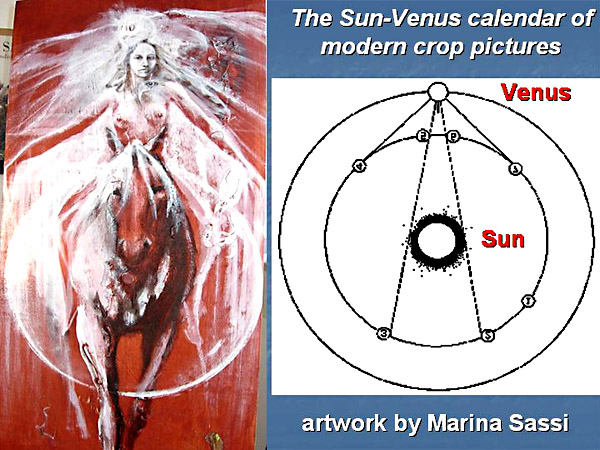
The Mayan Sun-Venus
calendar from an artistic perspective
This essay has been dry and
mathematical, and may be hard for the ordinary person to
understand. Yet the same subject may be perceived in a very
different and more beautiful way through art! While preparing
this essay, the Italian crop circle researcher Marina Sassi sent
me one of her original oil paintings, that she had made to
illustrate her personal conception of the Mayan Sun-Venus
calendar. It is shown below, along with real planetary
configurations for Venus in orbit about our Sun:
Enough said: a good picture tells 1000 words!
Red Collie
PS
Many thanks to Mike Reed and Marina Sassi for their help.
|
|

FOR VISITING THE CROP
CIRCLES.
|

Images Juliane von der Ohe Copyright 2008
|

COMMENTS
|
Symbol at
the centre of German Circle
The
reviewer, ( Red Collie? ) refers to the three dimensional
symbol in the centre of the circle as "six-pointed star in
three dimensions". This symbol has a name, Merkaba. Although
the name may be new and often used in New Agey
practises, the symbol itself is ancient and very significant
to the interpretation.
"Merkaba is
from the Hebrew language: Mer- meaning Light. Ka- meaning
Spirit. Ba- meaning Body. MerKaBa means 'chariot' in
Hebrew. Relating to spiralling energy of consciousness
moving us from one reality to another. It consists of
counter-rotating fields of energy that surround each of us.
The merkaba has are two star tetrahedrons - polarities -
duality - male/female. The male tetrahedron -
electrical energy - the apex faces up towards the sun, the
second point facing front. The female - magnetic energy -
the points face the back and downward towards the earth.
from this site
HERE
There are more ancient meanings
for it from different cultures described
HERE.
"History has
talked about the Mer-Ka-Ba mostly as the vehicle that allows
a person to ascend or descend into the higher or lower
worlds. But actually the Mer-Ka-Ba is much more than just a
vehicle of ascension. It can be, really, anything — since it
is the primal pattern that created all things and all
universes, both visible and invisible (see The Ancient
Secret of the Flower of Life, volumes I & II).
In the Bible there is reference to Ezekiel and the wheels by
which Ezekiel ascended into heaven.[3]
This was the Mer-ka-Ba.
In the Torah, there is reference to the Merkavah (as it is
spelled in Hebrew) which has two different meanings: One
meaning is ''chariot,'' which is a vehicle; the other is the
''Throne of God.'' When the two definitions are combined,
the true meaning comes to life.
In Ancient Egypt, this primal pattern was called the
Mer-Ka-Ba. It was actually three words, not one. Mer
meant a kind of light that rotated within itself. Ka
meant spirit, in this case referring to the human spirit.
And Ba meant the human body — though it also could
mean the concept of Reality that spirit holds. And so the
entire word in ancient Egypt referred to a rotating light
that would take the spirit and the body from one world into
another.
I once spent a couple of hours with Credo Mutwa, the
spiritual leader of the Zulu tribe in Africa. He explained
to me that Merkaba (one word) was a Zulu word meaning a
space/time/dimension vehicle. He told me that according to
Zulu legend his entire tribe had come from another dimension
here to Earth using the Merkaba."
Sorry if I'm the kazillionth person to let you know the name
and significance of the symbol, I guess it's one of those
things where you'll either have no info or too much!
Sue Craig
|
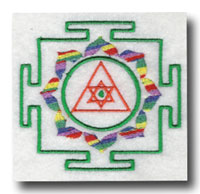
Ganesh Yantra:
The Ganesh Yantra is a good focal point for good luck
and success in new ventures. Ganesha is viewed as the remover of
obstacles. Meditate upon this yantra when you perceive
roadblocks in your life – spiritual or physical. When you need
direction or you need the rivers of abundance or creativity to
flow, concentration upon the blockage-stopping energy of the
Ganesh yantra will help get the flow going again.
Ganesh
Obstacles
Ganesha is Vighneshvara or Vighnaraja, the Lord of
Obstacles, both of a material and spiritual order.[82]
He is popularly worshipped as a remover of obstacles, though
traditionally he also places obstacles in the path of those who
need to be checked.
Paul Courtright says that "his task in the divine scheme of
things, his
dharma, is to place and remove obstacles. It is his
particular territory, the reason for his creation."[83]
Krishan notes that some of Ganesha's names reflect
shadings of multiple roles that have evolved over time.[28]
Dhavalikar ascribes the quick ascension of Ganesha in the Hindu
pantheon, and the emergence of the
Ganapatyas, to this shift in emphasis from
vighnakartā (obstacle-creator) to
vighnahartā (obstacle-averter).[84]
However, both functions continue to be vital to his character,
as Robert Brown explains, "even after the
Purānic Ganeśa is well-defined, in art
Ganeśa remained predominantly important for his dual role
as creator and remover of obstacles, thus having both a negative
and a positive aspect".[85]
Buddhi
Ganesha is considered to be the Lord of letters and
learning.[86]
In Sanskrit, the word
buddhi is a feminine noun that is variously translated as
intelligence, wisdom, or intellect.[87]
The concept of buddhi is closely associated with the personality
of Ganesha, especially in the Puranic period, when many stories
stress his cleverness and love of intelligence. One of Ganesha's
names in the
Ganesha Purana and the
Ganesha Sahasranama is Buddhipriya.[88]
This name also appears in a list of 21 names at the end of the
Ganesha Sahasranama that Ganesha says are especially important.[89]
The word priya can mean "fond of", and in a marital context it
can mean "lover" or "husband",[90]
so the name may mean either "Fond of Intelligence" or "Buddhi's
Husband".[91]
Aum
G anesha is identified with the Hindu
mantra
Aum (ॐ,
also called Om). The term
onkārasvarūpa (Aum is his form), when identified with
Ganesha, refers to the notion that he personifies the primal
sound.[92]
The
Ganapati Atharvashirsa attests to this association.
Chinmayananda translates the relevant passage as follows:
Christy Lewis
|
Click above to join the Crop Circle Connector
Membership
| AERIAL SHOTS |
GROUND SHOTS |
DIAGRAMS |
FIELD REPORTS |
ARTICLES |
|
|

BACK |

Mark Fussell & Stuart Dike |
|
 |