|
County of Akershus
Holter in the community of Nannestad
Øvre Elton farm
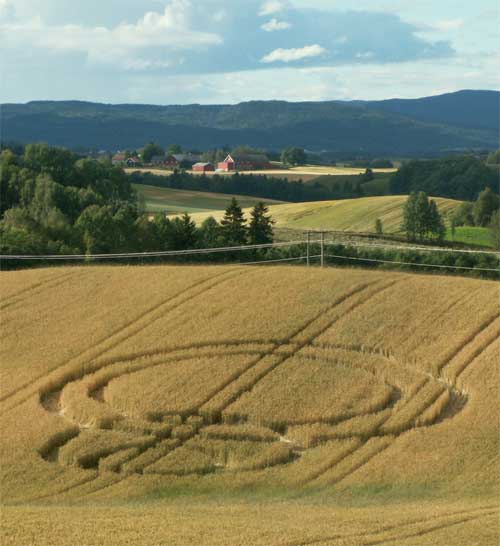
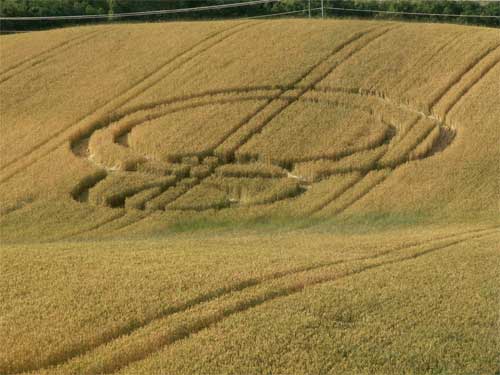
The crop circle
was discovered by the farmer, Dag Bjørgesæther, on Monday the 30th
of July.
On Thursday the 31st of July, the local newspaper "Romerikets Blad"
contacted the Norwegian Crop Circle Group.
Two
representatives for the group, Guro Parvanova og Eva-Marie Brekkestø,
examined the circle on the 31st of July.
The circle is located in a sloping wheat field easily seen
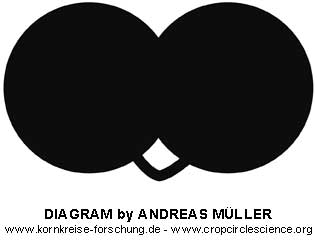
from the road. The formation's total length is 36 metres. The
largest ring has a diameter of aprx 28 metres with an average width
of 130 cm. The smaller ring, concentric with and placed
inside, the larger, has an aprx diameter of 24 meter, and is just
over a meter wide in average. An additional ring, aprx 10 metres in
diameter, partly cuts into the two largest. Within this
smallest ring is a semi circle.
There are several characteristics pointing towards a human origin to
this circle. And after close inspection the ground, we found clear
evidence for it being man made.
Click here for
detailed photographic evidence.
1) The pattern is
rather imprecise and messy.
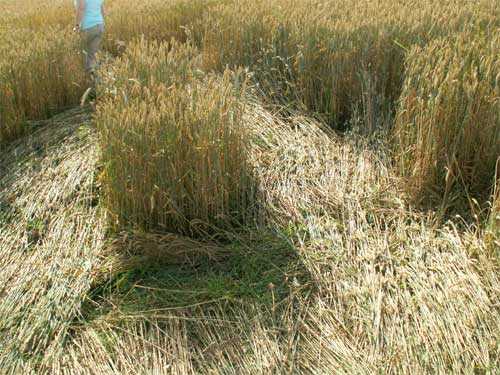
2) The centre of the two largest rings was found in the middle of a
tram line. And exactly where we estimated the centre to be, we found
a large hole in the ground, seemingly left by a pole. A rope has
probably been attached to the pole to mark out the periphery of the
two concentric circles. It is, however, quite difficult to hold a
12-14 metres long rope constantly stretched out while moving around
in a circle. The result is thus often an uneven and rugged ring.
The fact that the hole is a cone (far wider at the top than at the
bottom), indicates a heavy pull at the pole. Around the hole some
stalks were trampled down, probably by the person who held the pole.
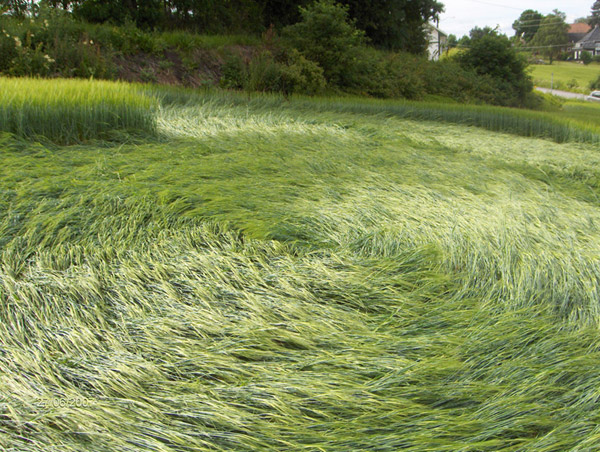
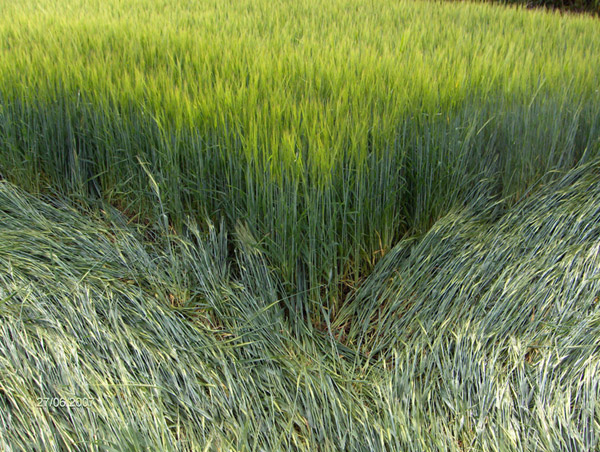
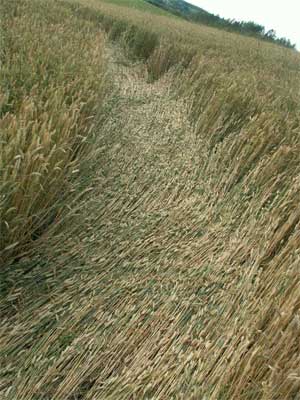
3) In all the areas of the circle that we examined, we found visible
marks across the parallel downed stalks. The edge of a hard object,
for instance a board used to push down the crop, will leave marks on
the stalks just like the ones found in this formation.
We still
have to point out, that due to the fact that the formation was two
days old when we examined it, we cannot with absolute certainty,
conclude that the formation is man made. There is a possibility that
people who have visited the circle after is was discovered, have
made the hole in the centre and inflicted the damage to the downed
stalks. We consider this possibility to be very faint one, however.
Eva-Marie Brekkestø
31st of July 2007
©
Norwegian Crop Circle Group
http://www.kornsirkler.org
|
post @kornsirkler.org |