|
Symbols for
“cometary outburst” appeared once again in English crop pictures
during the summer of 2009: can we use that information to predict
the exploding comet beforehand?
Abstract. Many
different crop pictures from the summer of 2009 seemed to show
symbols for comets or “cometary outburst”. This would seem to imply
that some faint comet may explode (or outburst) soon in Earth’s
skies. No astronomer or astronomical organization on Earth today has
predicted such an explosion. Thus if such an event comes to pass, it
will provide rigorous proof that: (a) modern crop pictures are
paranormally real, and (b) that they can sometimes predict the
future.
Using detailed
information concerning orbital paths, orbital periods or dates of
close approach to Sun or Earth as provided by those crop pictures,
we will try here to evaluate scientifically and objectively, using a
comprehensive astronomical database, which faint comet might be
about to explode.
Modern crop pictures
sometimes show detailed images which predict the future. Sometimes
those images portray human events far in advance of their time, for
example a recent decoding of the Greek Antikythera device (see
time2007u or
time2007w). Yet more
often they portray unexpected astronomical events before they
happen: for example a solar flare on our Sun (see
southfield), a
giant sunspot (see
eastfield), or a
strong solar wind that led to an aurora borealis (see
badbury).
Comet
Shoemaker-Levy 9 in 1994: an impact on Jupiter shown in crops
Some of the first
future-predictive crop pictures concerned an impact of comet
Shoemaker-Levy 9 on Jupiter in July of 1994 (see
seds.org or
Comet_Shoemaker-Levy_9). A whole
series of crop pictures from the early summer of 1994 portrayed that
event accurately, including not only images of the comet, but also
the detailed shape of its largest impact scar on Jupiter (see
time2007i or
scorpious_hour).
Comet 73P
Schwassmann-Wachmann 3 in 1995: an outburst and fragmentation near
Earth orbit shown in crops
Another series of
future-predictive crop pictures appeared during the summer of 1995.
Many of those 1995 crop pictures showed images from three months
into the future, concerning a comet that was about to explode or
“outburst” near Earth orbit. On September 20, 1995, comet 73P
Schwassmann-Wachmann 3 unexpectedly outburst as it was approaching
the heat of the Sun, then broke into more than 60 small pieces. Some
of those cometary fragments passed close to Earth again in January
of 2001, then May of 2006 (see
ast.cam.ac.uk or
cometography).
The sudden break-up of
comet 73P Schwassmann-Wachmann 3 had in fact been predicted three
months earlier in English crop pictures: for example at Bishop’s
Sutton on June 20, or at Longwood Warren on June 26. Indeed, the
famous “missing Earth” feature of Longwood Warren told exactly where
in space, that Earth-orbit-crossing comet would outburst three
months later (see
longwoodwarren2006 or
time2007a).
Comet 17P Holmes in
2007: a bright outburst between the orbits of Mars and Jupiter shown
in crops
Comet 17P Holmes appeared very
unexceptional at a faint magnitude of 17 during early 2007 (see
ast.cam.ac.uk).
Yet after reaching perihelion (closest approach to the Sun) on May
4, it outburst suddenly six months later on October 24, then joined
in Earth’s sky (or conjuncted) with a bright star Mirfak in Perseus
on November 20 (see
cometography).
Both of those spectacular
astronomical events had been predicted in English crop pictures more
two years earlier, during the summer of 2005 (see
time2007g or
time2007h).
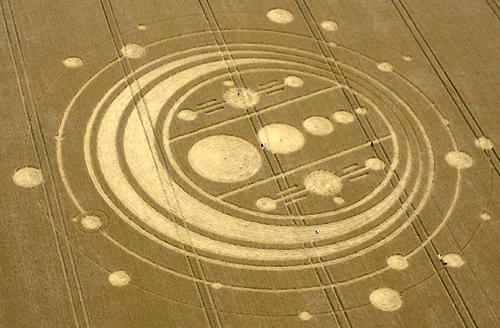
Symbols for “cometary outburst”
appeared once again in English crop pictures during the summer of
2009: is another comet about to explode?
Following on from those three
previous examples in 1994, 1995 or 2005, symbols for “cometary
outburst” appeared once again in English crop pictures during the
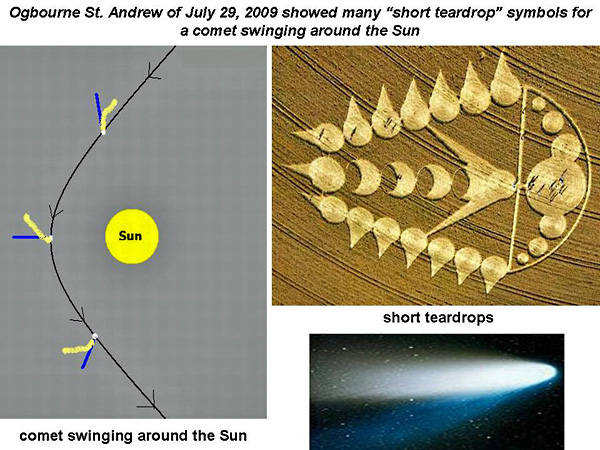
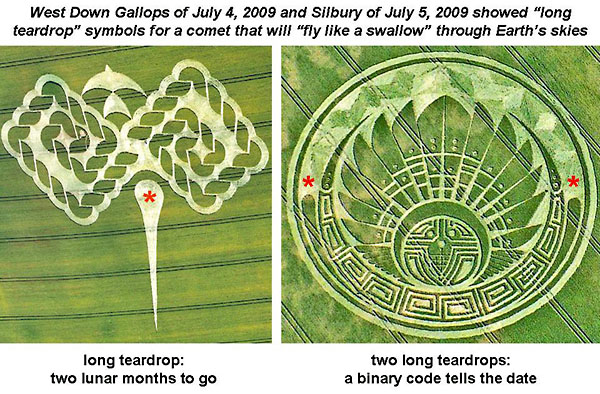
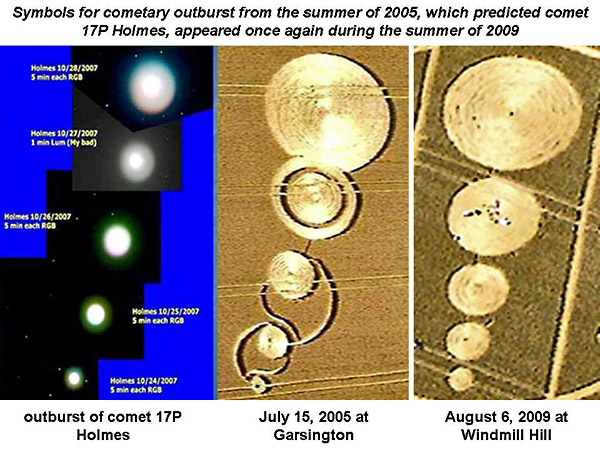
summer of 2009. Two kinds of symbol were shown: (a) short or long
“teardrops” which resemble a bright comet with a short or long tail,
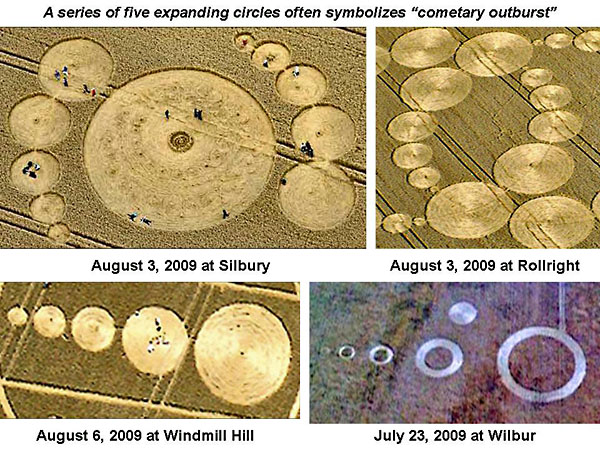
or (b) a series of five expanding circles that resemble the early
stages of cometary outburst.
Cometary images as “short
teardrops” were shown at Ogbourne St. Andrew on July 29 (see
/ogbourne2009):
Cometary images as “long teardrops”
were shown at West Down Gallops on July 4 (see
westdown2009) or
Silbury on July 5 (see
silburyhill2009):
Likewise, some five-circle symbols
for “cometary outburst” that had been used to predict in 2005 the
subsequent outburst of comet 17P Holmes, appeared again during the
summer of 2009 at Windmill Hill and other places:
A series of five expanding circles
has often been used to symbolize “cometary outburst”. Such
five-circle symbols appeared during the summer of 2009 at Silbury on
August 3 (see
silbury2009),
Rollright Stone Circle on August 3 (see
rollright2009),
Windmill Hill on August 6 (see
windmill2009b),
or Wilbur in Washington state on July 23, 2009 (see
Wilbur2009):
The date of cometary outburst may
be as early as September or October of 2009
Now if an unknown comet will soon
explode or outburst in Earth’s skies, when might such an unexpected
event be scheduled to happen? All of the current evidence suggests
fairly soon, perhaps in September or October of 2009.
For example, West Down Gallops of
July 4 showed a long teardrop shape (“bright comet”) that will “fly
like a swallow” through Earth’s skies, after another two lunar
months of 29 days (close to the full Moon of September 4).
Silbury of July 5 showed the same
long teardrop shape (“bright comet”), along with a binary code that
could be read to give a date of September 6, 2009 (see
silburyhill).
Four years earlier in 2005, a similar binary code had been shown at
Wayland’s Smithy, in order to predict the outburst of comet 17P
Holmes in 2007 (see time2007g
or
time2007h).
Ogbourne St. Andrew of July 29
showed a two-tailed comet which will supposedly orbit around the
Sun: sometime after the lunar eclipse of August 6, 2009, and as we
approach the full Moon of September 4.
Finally, Silbury of August 3 showed
fine details of crop within its five expanding circles for “7-7”
(the full Moon of July 7), followed by “6 around 1” (the full Moon
of August 6), followed by an empty space (see
silbury or
earthfiles.com). Those
symbols could imply that we will see a cometary outburst just after
the next full Moon of September 4.
Other crop pictures, however, for
example Morgan’s Hill of August 2, 2009 (see
morganhill2009),
seemed to show a Mayan “bright star” in 80 days, leading to a
somewhat later date estimate of October 20.
Likewise, Wayland’s Smithy of
August 12, 2009 (see
waylandsmithy2009c)
showed 52-56 then 72-76 days, leading to date estimates of October 5
then October 25 (perhaps for a second outburst).
Silbury of July 5, 2009 showed
similarly a second “teardrop” next to the first, which was
associated with a slightly later date in binary code of November 17,
perhaps for a second outburst (see
silburyhill).
Can we identify the exploding comet
beforehand?
Supposing that a faint
comet is soon to explode in Earth’s skies, just like comet 73P
Schwassmann-Wachmann in 1995, or comet 17P Holmes in 2007, can we
use the many kinds of astronomical information given in 2009 crop
pictures, to identify it before it explodes?
Interestingly enough,
the slightly elliptical orbit of that comet about the Sun seems to
have been drawn in two different crop pictures from 2009, namely at
Silbury on August 3, or at Windmill Hill of August 6:
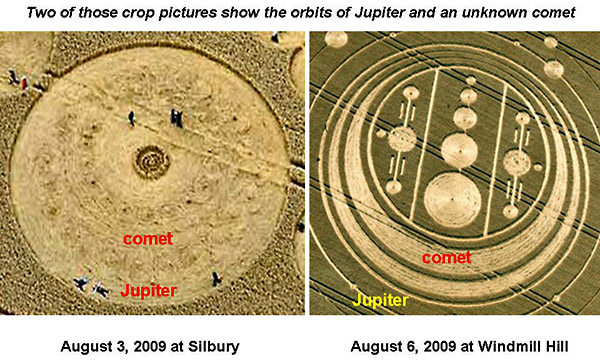
In other words, the
two large circles shown there might plausibly represent the orbits
of planet Jupiter and some “exploding comet”, especially since the
smaller circle in each case lies slightly off-centre from a central
“Sun”. Three tight inner circles which surround that central “Sun”
in Silbury of August 3 could represent the orbits of Mercury, Venus
and Earth.
Should we next compare
the shapes of those two large circles in crop, to known orbits for
Jupiter and many different comets, to try and identify the faint
comet before it explodes? The NASA Near Earth Object website offers
an easily accessible database of cometary orbits on its Orbit
Diagrams page (see
orbits).
In order to research
this topic comprehensively, we will consider all known comets that
will reach perihelion (closest approach to the Sun) during a wide
range of dates from March 2009 to September 2010 (see
ast.cam.ac.uk or
ast.cam.ac.uk).
Our first criterion:
look for an overall similarity of shape between the crop picture
“orbit” and the comet orbit
To get started, we
will look simply for an overall similarity of shape between two
large outer circles that were drawn in crop at Silbury on August 3,
2009, or Windmill Hill on August 6, 2009, to the orbits of planet
Jupiter and a wide range of comets listed in the NEO database.
Results of the orbital
comparison for all known comets:
59P Kearns-Kwee March
8, 2009 (no match to orbit)
2008 J3 March 11, 2009
(no match to orbit)
2002 Q1 March 21, 2009
(no match to orbit)
145P Shoemaker-Levy
March 27, 2009 (no match to orbit)
2008 G2 April 10, 2009
(no match to orbit)
2004 CB April 16, 2009
(no match to orbit)
18D Perrine-Mrkos
April 17, 2009 (no match to orbit)
2008 O2 April 24, 2009
(no match to orbit)
137P Shoemaker-Levy
May 14, 2009 (no match to orbit)
22P Kopff May 25, 2009
(no match to orbit)
143P Kowal-Mrkos June
12, 2009 (no match to orbit)
64P Swift-Gehrels June
14, 2009 (no match to orbit)
2003 A1 June 16, 2009
(no match to orbit)
2003 H4 June 22, 2009
(no match to orbit)
2008 Q3 June 23, 2009
(no match to orbit)
2008 P1 July 3, 2009
(no match to orbit)
2006 W3 July 7, 2009
(no match to orbit)
77P Longmore July 8,
2009 (no match to orbit)
116P Wild 4 July
19, 2009 (possible match to orbit)
1999 XB69 July 26,
2009 (no match to orbit)
74P
Smirnova-Chernykh July 30, 2009 (possible match to orbit)
24P Schaumasse August
10, 2009 (no match to orbit)
89P Russell August 17,
2009 (no match to orbit)
2002 T1 Augusr 25,
2009 (no match to orbit)
2004 X1 September 3,
2009 (no match to orbit)
2001 MD7 September 9,
2009 (no match to orbit)
2008 N1 September 25,
2009 (no match to orbit)
2007 Q3 October 7,
2009 (no match to orbit)
88P Howell October
12, 2009 (possible match, but too elliptical)
127P Holt-Olmstead
October 21, 2009 (good match to orbit)
54P de Vico
November 28, 2009 (possible match, too close to Jupiter)
169P NEAT November 30,
2009 (no match to orbit)
100P Hartley
December 6, 2009 (possible match to orbit)
2004 K2 December
15, 2009 (possible match, but too elliptical)
2005 JQ5 December 29,
2009 (no match to orbit)
118P Shoemaker-Levy
January 2, 2010 (good match to orbit)
82P Gehrels January
12, 2010 (possible match to orbit)
2003 XD10 January
31, 2010 (good match to orbit)
2009 K2 February 7,
2010 (no match to orbit)
203P Korlevic February
8, 2010 (no match to orbit)
149P Mueller February
19, 2010 (no match to orbit)
157P Tritton February
20, 2010 (no match to orbit)
81P Wild February 23,
2010 (no match to orbit)
126P IRAS February 23,
2010 (no match to orbit)
2004 R1 February 24,
2010 (no match to orbit)
65P Gunn March 2,
2010 (good match to orbit)
219P LINEAR March
6, 2010 (good match to orbit)
162P Siding Spring
March 8, 2010 (possible match, but too elliptical)
2001 R6 March 26, 2010
(no match to orbit)
94P Russell March
30, 2010 (good match to orbit)
30P Reinmuth April 19,
2010 (no match to orbit)
2007 VO5 April 27,
2010 (no match to orbit)
2009 K5 April 30, 2010
(no match to orbit)
104P Kowal May 5,
2010 (possible match, but too elliptical)
141P Machholz-A May
24, 2010 (no match to orbit)
141P Machholz-D May
30, 2010 (no match to orbit)
142P Ge-Wang May 31,
2010 (no match to orbit)
1978 R1 June 7,
2010 (possible match, but too elliptical)
215P NEAT June 8, 2010
(no match to orbit)
43P Wolf-Harrington
July 2, 2010 (no match to orbit)
10P Tempel July 5,
2010 (possible match, but too elliptical)
1999 U3 July 19, 2010
(no match to orbit)
2P Encke August 7,
2010 (no match to orbit)
2002 S1 August 15,
2010 (no match to orbit)
2004 EW38 September 4,
2010 (no match to orbit)
2002 UY September 9,
2010 (no match to orbit)
31P
Schwassmann-Wachmann 2 September 29, 2010 (possible match)
2008 FK7 September 30,
2010 (no match to orbit)
Short list of
candidates based on the first criterion of orbital similarity:
116P Wild 4 July 19,
2009 (possible match to orbit)
74P Smirnova-Chernykh
July 30, 2009 (possible match to orbit)
88P Howell October 12,
2009 (possible match, but too elliptical)
127P Holt-Olmstead
October 21, 2009 (good match to orbit)
54P de Vico November
28, 2009 (possible match, too close to Jupiter)
100P Hartley December
6, 2009 (possible match to orbit)
2004 K2 December 15,
2009 (possible match, but too elliptical)
118P Shoemaker-Levy
January 2, 2010 (good match to orbit)
82P Gehrels January
12, 2010 (possible match to orbit)
2003 XD10 January 31,
2010 (good match to orbit)
65P Gunn March 2, 2010
(good match to orbit)
219P LINEAR March 6,
2010 (good match to orbit)
162P Siding Spring
March 8, 2010 (possible match, but too elliptical)
94P Russell March 30,
2010 (good match to orbit)
104P Kowal May 5, 2010
(possible match, but too elliptical)
1978 R1 June 7, 2010
(possible match, but too elliptical)
10P Tempel July 5,
2010 (possible match, but too elliptical)
31P
Schwassmann-Wachmann September 29, 2010 (possible match to orbit)
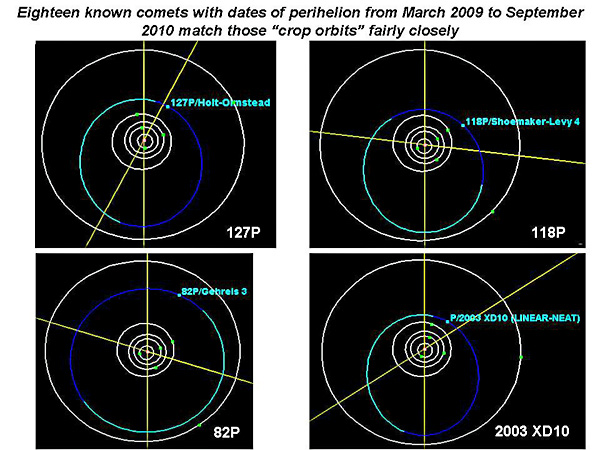
Thus after studying
all known comets (68) which will reach perihelion between March 2009
and September 2012, we came up with a short list of 18 possible
candidates to be evaluated further. Some typical orbits for four of
those 18 candidates are shown below:
Our second
criterion: look for a comet which will be approaching the Sun in
December of 2009
Unfortunately, Silbury
of August 3 gave no clear indication of where Jupiter or that comet
might be located within those two “crop orbits”, as a possible guide
to picking the correct candidate. The cometary orbit at Silbury did
include an “extra tuft” in one place (thereby increasing the total
number of standing tufts from 19 to 20), while the Jupiter orbit at
Silbury showed a “missing tuft” in one place (thereby reducing the
total number of standing tufts from 24 to 23). Yet those are
relatively weak criteria that cannot be used for a comprehensive
search.
Still, we need to add
a second criterion in order to refine our search further. After
careful study, we believe that the best second criterion might be as
follows: Windmill Hill of August 6, 2009 suggested that some faint
comet will outburst while it is approaching the Sun in four lunar
months, as indicated there by four dumbbell-type symbols for “Moon”
(see
/time2007f):
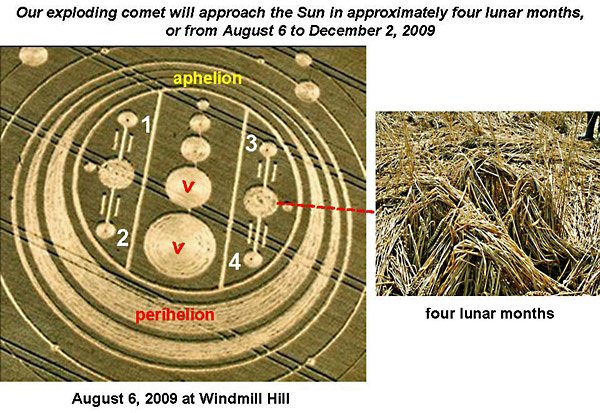
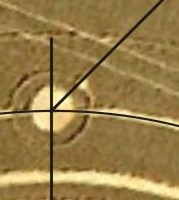
The fallen crop within
one of those symbols for “Moon” was even patterned carefully into
four standing knobs (above right), as if to confirm that there will
be “four lunar months” from August 6 when the crop picture appeared,
to December 2, 2009 when our comet will be bright and close to the
Sun (see
windmillhill2).
Both of those dates are full Moons.
The symbol for “Sun”
was not shown explicitly at Windmill Hill, but would be located
between its fourth and fifth large expanding circles. A similar
motif appeared on July 23, 2009 near Wilbur, Washington, with an
extra symbol for “Sun” located off to one side, between its fourth
and fifth expanding circles. (see
Wilbur2009a or
www.khq.com).
Second criterion:
look for a comet from our short list of candidates which will be
approaching the Sun in December of 2009 (or not far past it), after
an initial outburst in September or October of 2009. At the same
time, rank each orbital match by the first criterion more accurately
as “good”, “fair” or “poor”.
116P Wild 4 July 19,
2009 (fair match to orbit) (no)
74P Smirnova-Chernykh
July 30, 2009 (fair match to orbit) (no)
88P Howell October 12,
2009 (poor match to orbit) (no)
127P Holt-Olmstead
October 21, 2009 (fair match to orbit) (yes)
54P de Vico
November 28, 2009 (fair match to orbit) (yes)
100P Hartley
December 6, 2009 (fair match to orbit) (yes)
2004 K2 December
15, 2009 (fair match to orbit) (yes)
118P Shoemaker-Levy
January 2, 2010 (good match to orbit) (yes)
82P Gehrels January
12, 2010 (fair match to orbit) (yes)
2003 XD10 January
31, 2010 (good match to orbit) (yes)
65P Gunn March 2,
2010 (good match to orbit) (yes)
219P LINEAR March
6, 2010 (good match to orbit) (yes)
162P Siding Spring
March 8, 2010 (poor match to orbit) (no)
94P Russell March 30,
2010 (fair match to orbit) (no)
104P Kowal May 5, 2010
(poor match to orbit) (no)
1978 R1 June 7, 2010
(poor match to orbit) (no)
10P Tempel July 5,
2010 (poor match to orbit) (no)
31P Schwassmann
September 29, 2010 (poor match to orbit) (no)
Short list of
candidates based on the first and second criteria combined:
127P Holt-Olmstead
October 21, 2009 (fair match to orbit) (yes)
54P de Vico November
28, 2009 (fair match to orbit) (yes)
100P Hartley December
6, 2009 (fair match to orbit) (yes)
2004 K2 December 15,
2009 (fair match to orbit) (yes)
118P Shoemaker-Levy
January 2, 2010 (good match to orbit) (yes)
82P Gehrels January
12, 2010 (fair match to orbit) (yes)
2003 XD10 January 31,
2010 (good match to orbit) (yes)
65P Gunn March 2, 2010
(good match to orbit) (yes)
219P LINEAR March 6,
2010 (good match to orbit) (yes)
Our third criterion:
look for a comet with an orbital period of 5.9 to 6.3 Earth years
Now we have reduced
our short list to nine likely candidates, from a large starting list
of 68. Might any of those 2009 crop pictures contain further
astronomical information, which will help us to reduce the size of
our list further?
Well, at the very
centre of Silbury from August 3, we can see a series of three tight
circles that were clearly meant to represent the orbits of Mercury,
Venus and Earth:
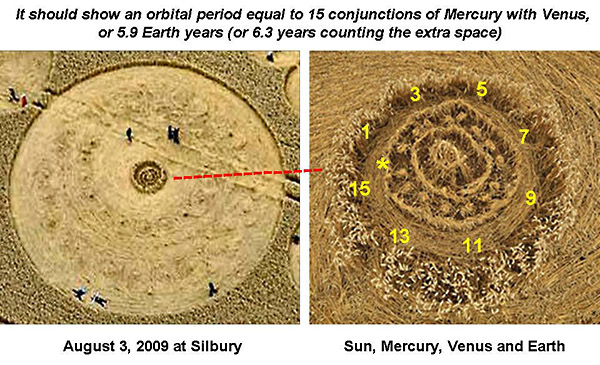
Next, between the two
inner circles for Mercury and Venus as drawn there, we can see 15
“standing knobs” of crop, which might well be intended to tell us
the orbital period of our comet. Supposing that each “knob”
represents one Mercury-Venus conjunction of 0.391 years, then 15
knobs would give a time period of 15 x 0.391 = 5.9 years for our
comet to rotate once about the Sun.
August 3, 2009 was
itself a Mercury-Venus conjunction, which may explain why they drew
a “space” (yellow asterisk) in one place, instead of a sixteenth
knob. If we count that “space” as well, then we get 16 x 0.391 = 6.3
years for our comet to rotate once about the Sun.
The cometary orbit at
Silbury was marked out using 19 standing tufts. For a three-repeat
returning comet, could that number be meant to give (19 / 3) = 6.3
years? The Jupiter orbit at Silbury was marked out using 24 standing
tufts, where (24 / 2) = 12 lies close to Jupiter’s orbital period of
11.86 years.
Now if we return to
our short list, and look to see which comets have an orbital period
of 5.9 to 6.3 Earth years, we find the following results.
Table 1. Which comets
show an orbital period of 5.9 to 6.3 Earth years?
|
Comet |
Orbital period
in years |
Matches crop
picture? |
Expected
magnitude without outburst |
|
127P
|
6.4
|
yes |
18
|
|
54P |
7.4 |
no |
16
|
|
100P
|
6.3 |
yes |
16
|
|
2004 K2 |
5.5 |
no |
19
|
|
118P |
6.4 |
yes |
12
|
|
82P |
8.4 |
no |
17
|
|
2003 XD10 |
6.3
|
yes |
20
|
|
65P
|
6.8
|
no |
12
|
|
219P
|
7.0 |
no |
17 |
Only four comets out
of nine show orbital periods within (or close to) the specified
range.
Should we be looking
for a comet with a short orbital period of 3.6 to 3.9 years?
Alternatively, if
those 15 standing knobs as drawn at Silbury were meant to describe
Mercury-Earth conjunctions of 0.241 years, then we might calculate
15 x 0.241 = 3.62 to 16 x 0.241 = 3.85 years for the orbital period
of our comet.
There are hardly any
known comets with such a short period, which are expected to reach
perihelion during 2009 or 2010. The best candidate might be 169P
Neat with an orbital period of 4.2 years. It will reach perihelion
on November 30, 2009 (close to December 2, 2009) at an expected
magnitude of 12, and will be very close to (or headed toward) Earth
and Moon at that time (see below).
Another possible
choice might be 2P Encke with an orbital period of 3.3 years, which
will not reach perihelion however until August 7, 2010. Both of
those comets show such highly elliptical orbits, that they did not
pass our first criterion for “orbital similarity” described above.
Our fourth criterion:
look for a comet which will lie close to Earth and Moon in December
of 2009
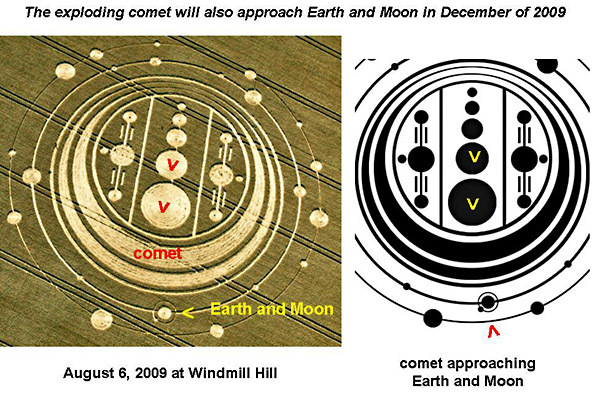
Finally, as a fourth
useful criterion for correctness, we can require that the exploding
comet should be approaching Earth and Moon during December of 2009,
as well as the Sun. That interesting feature was shown clearly at
Windmill Hill on August 6:
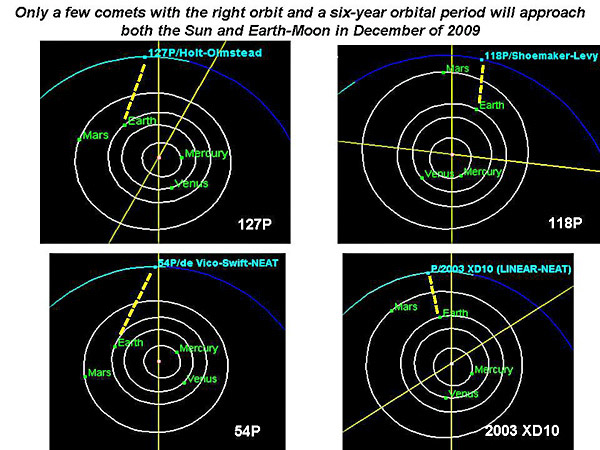
Out of nine possible
candidates which show suitable orbits, and will approach the Sun in
December of 2009, how many will also approach Earth and Moon?
127P
Holt-Olmstead
October 21, 2009 (fair match to orbit) (maybe)
54P de Vico November
28, 2009 (fair match to orbit) (no)
100P Hartley
December 6, 2009 (fair match to orbit) (no)
2004 K2 December 15,
2009 (fair match to orbit) (no)
118P
Shoemaker-Levy
January 2, 2010 (good match to orbit) (yes)
82P Gehrels January
12, 2010 (fair match to orbit) (no)
2003 XD10
January 31, 2010 (good match to orbit) (yes)
65P Gunn March 2, 2010
(good match to orbit) (no)
219P LINEAR March 6,
2010 (good match to orbit) (no)
Comets which passed
the third criterion concerning “orbital period” have been
underlined. The best matches to this fourth criterion are shown
below:
A small crop picture
in Germany on July 19, 2009 likewise suggested that some unknown
comet (circled) will “line up” with Earth and Mars around January
29, 2010, when Mars reaches opposition to Earth (see
berlin2009a
or
www.kornkreise-forschung.de):
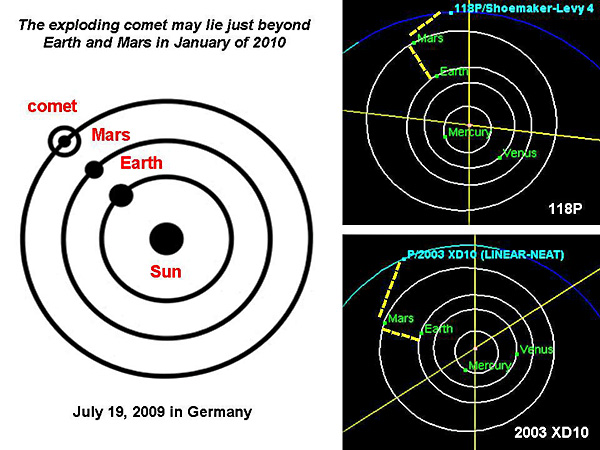
It would be unwise to
use that German crop picture as a fifth criterion, because no one
can be sure whether it is real or a fake. Yet if it is real, then
only two comets from our short list could meet the astronomical
alignment as shown there (see above). They are both already on our
final shortlist for a close approach to Earth and Moon.
Short list of
candidates based on the first, second, third and fourth criteria
combined:
(a) 118P
Shoemaker-Levy, perihelion January 2, 2010, orbital period 6.45
years, three past repeats, expected magnitude 12 (without outburst),
(b) 2003 XD10,
perihelion January 31, 2010, orbital period 6.29 years, one past
repeat, expected magnitude 20 (without outburst), or
(c) 127P
Holt-Olmstead, perihelion October 21, 2009, orbital period 6.39
years, three past repeats, expected magnitude 18 (without outburst)
(see
ast.cam.ac.uk or
aerith.net or
aerith.net).
Comet 118P
Shoemaker-Levy 4 would certainly the brightest and best
characterized of these three comets. Hence it might plausibly be
expected to outburst as it approaches the Sun during the autumn of
2009? Yet its date of perihelion as January 2, 2010 is somewhat
later than the date of December 2, 2009 suggested at Windmill Hill.
Could they be telling
us about some faint comet that is not currently in the astronomical
database here on Earth?
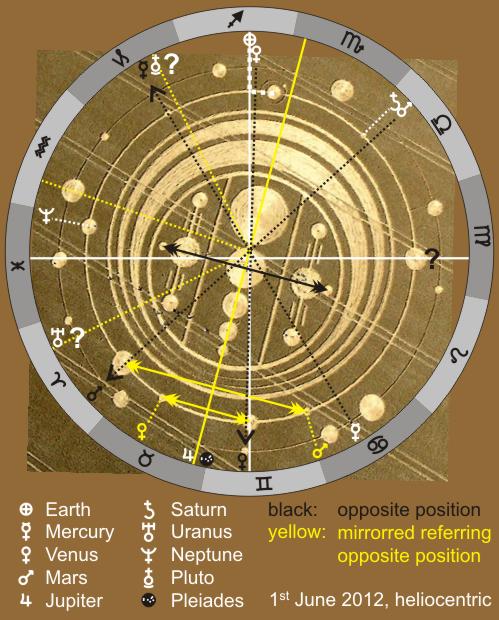
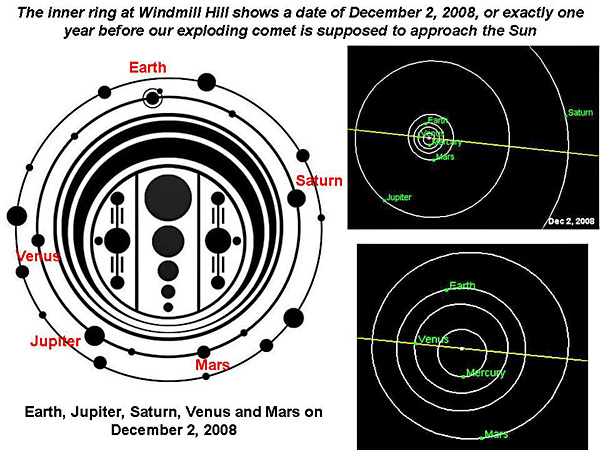
The inner ring of
planetary symbols at Windmill Hill gives a date of December 2, 2008
(one year before December 2, 2009)
To conclude, let us
discuss briefly two rings of planetary symbols which were shown at
Windmill Hill on August 6, 2009. They might be expected to provide
detailed information about some upcoming cometary outburst, but have
been hard to interpret with confidence so far.
Now after further
study, we can state confidently that the inner ring at Windmill Hill
shows a symbol for Earth and Moon, accompanied by two large circles
for Jupiter and Saturn, plus two medium-sized circles for Venus and
Mars. All five of those symbols then code (by means of their orbital
locations) for a date of December 2, 2008, which is precisely one
year before our exploding comet is supposed to approach the Sun:
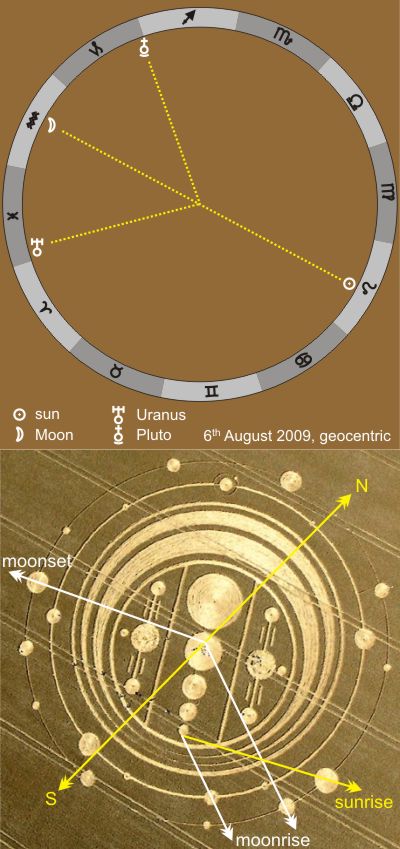
The outer ring of
planetary symbols at Windmill Hill seems to provide three past dates
of perihelion for a short-period comet
The outer ring at
Windmill Hill seems to shows three more large circles for Jupiter as
J1, J2 or J3 (because Saturn moves too slowly to serve as a useful
time marker), along with five more medium-sized circles for Venus or
Mars (but we cannot tell which). It may perhaps code for three dates
in the past when our unknown comet approached the Sun:
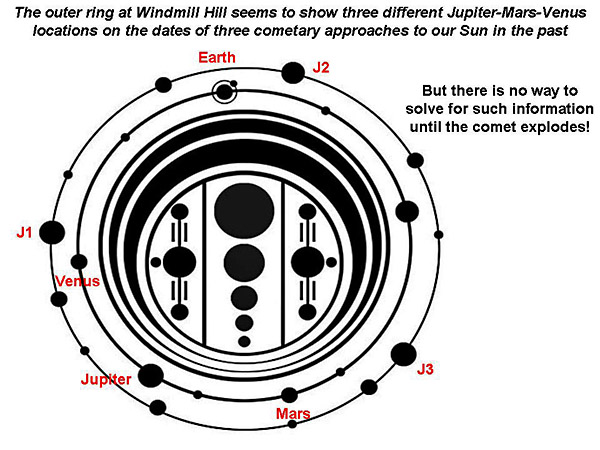
Yet without knowing
which comet is about to explode, the precise meaning of those
slightly ambiguous symbols cannot be determined with any certainty.
Interestingly enough, the orbital intervals shown there for Jupiter
match 4.0 to 4.5 years (or one-third of its 11.9-year orbit), and
not 5.9 to 6.3 years as favoured above.
If we are looking for
a short-period comet that has reached perihelion several times in
the recent past, then comet 169P NEAT (see
aerith.net) might be our best
candidate. It will reach perihelion on November 30, 2009 (very close
to December 2, 2009) while headed directly for Earth and Moon. It
will also line up close to Earth and Mars in January of 2010. Yet it
shows such a poor match to the two “crop orbits” drawn at Silbury or
Windmill Hill, that it was excluded from our current shortlist of
candidates for that reason.
Summary and
conclusions
We have tried here to
describe all that may be gleaned scientifically from the crop
pictures of 2009, concerning a bright comet which has seemingly been
predicted to explode or “outburst” soon in Earth’s skies. The first
stages of outburst are expected in September or October of 2009,
although there may be a second outburst in November, before it
passes close to the Sun in December of 2009.
Using information
provided in those 2009 crop pictures about orbital shape, dates of
approach to Sun or Earth, and length of orbital period, we have
reached a shortlist of cometary candidates with a long orbital
period of 5.9 to 6.3 years that includes 118P Shoemaker Levy,
2003 XD10 or 127P Holt-Olmstead. We have
also noted one possible candidate with a short orbital period of 3.9
to 4.5 years as 169P Neat.
Once (or if) any faint
comet does explode soon in Earth’s skies, during the autumn of 2009,
then it will be interesting to go back and re-evaluate all of the
crop pictures cited here, in light of astronomical images from the
future. Only those crop artists seem to know what is going to happen
soon, and not ordinary humans on Earth.
The CMM Research Group
P.S. We would like to
thank Olivier Morel, Jack Turner, Jack Roderick, Lucy Pringle, John
Montgomery, Russell Stannard, KHQ Channel 6, Stian, Frank Laumen,
Adam Beamish and Andreas Muller for some of the photographs or
drawings used here. |