|
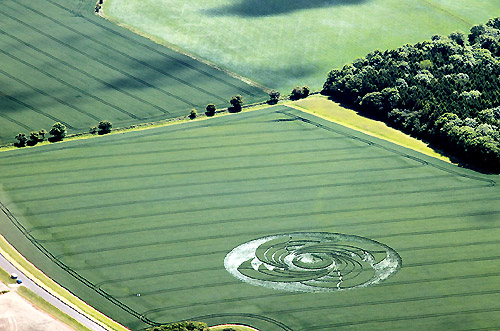
Tawsmead Copse
of June 13, 2009 shows a series of
“coronal mass ejections” and “current sheets” emerging from our Sun,
on the upcoming date of a lunar eclipse as July 7, 2009
A whole series of crop pictures from April or May of 2009 have
seemed to imply that Earth and Moon will be subjected to an intense
solar storm around the full Moon date of July 7, 2009, which is also
a penumbral lunar eclipse (see
waylandsmithy or
yatesbur). Now a new and impressive crop picture that appeared
in South Field on June 13, 2009 seems to give us more hard
scientific information, on when and if that solar event might truly
happen?
Two central
symbols for eclipse: July 7 or July 22, 2009?
The new picture first shows us at its very centre two standard
symbols for “eclipse”:
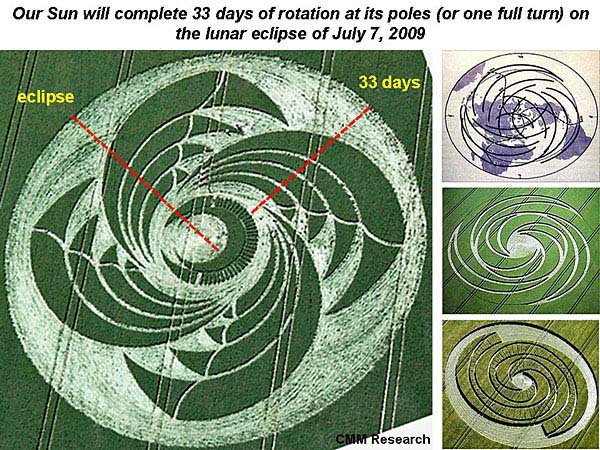
There will be a penumbral lunar eclipse on July 7, 2009, as well as
a total solar eclipse on July 22, 2009. In principle it could be
telling us about either of those, but which one?
It was drawn in the style of many Saros-type eclipse crop pictures
from the past (see insets on the right above), to suggest that we
are looking down onto the polar regions of some large astronomical
object, whether that be the Sun or the Earth.
Our Sun
takes 33 days to complete one turn of rotation at its poles
Now the second or outer of those two “eclipse” symbols tells us more
precisely what they are talking about, because it has been
subdivided into
33 equal
parts
(see above). Those match precisely the number of days required for
our Sun to complete one full turn of rotation at its two poles, as
seen from Earth:
“An
early finding has been a pronounced differential rotation near the
solar surface, where equatorial regions rotate in about 25 days, yet
the poles in about 33 days”
(see
soi.stanford.edu)
“The
Sun does not rotate like a solid body. Solar rotation equals 25-27
days at the equator or 33 days at the poles. That rotation is
believed to be the source of sunspots”
(see
SolarSystem).
So they
are definitely telling us about “our Sun” on an upcoming eclipse
date of either July 7 or July 22, 2009. No other common astronomical
cycle requires 33 days for anything! For example, eclipses are
spaced from one another by 29 to 30 days (see
eclipse.gsfc.nasa.gov).
What did our Sun look like on June 4, 2009, or 33 days before the
July 7 eclipse?
The
question next becomes: what did our Sun look like on June 4, 2007,
or 33 days before an upcoming lunar eclipse on July 7, 2009? We can
see in the picture below that a new and highly active sunspot region
from solar cycle 24 faced directly toward Earth on that day:
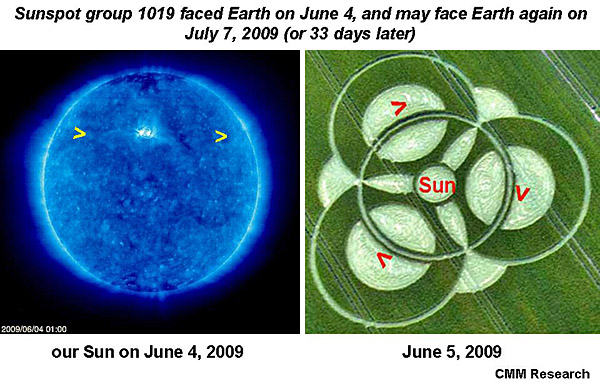
One leading astronomical website called it a
magnetic
maelstrom:
“Since
that sunspot first emerged on May 3, it has rapidly grown and
organized itself into the large double spot visible today. The
region is literally crackling with A- and B-class solar flares”
(see
spaceweather.com).
Knoll Down of June 1, 2009 seemed to show that same sunspot group
1019, rotating by one full turn around our Sun, then turning into a
large “solar flare” (see
knolldown)
New Farm of June 5, 2009 seemed to show current images of our Sun
(see
newfarm), and implied that one turn of solar rotation from June
4 to July 7 would somehow be important, for bringing sunspot group
1019 back into alignment with Earth again (see above on the right).
Those two
eclipse symbols from South Field point due east, where our Sun will
be located during a penumbral lunar eclipse on July 7, 2009
If we look next at how the new crop picture from South Field is
oriented geographically, we can see that its two central eclipse
symbols point almost due east:
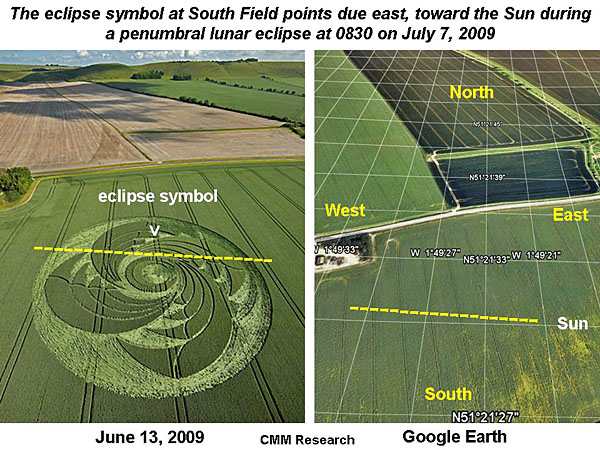
That is where our Sun will be located on July 7, 2009 from 0830 to
1040 UT during a penumbral lunar eclipse. So they are definitely
telling us about a date of July 7, 2009 for a lunar eclipse, rather
than July 22, 2009 for a solar eclipse.
The solar
physics of South Field: coronal mass ejections and current sheets
When we look next at the four large outer parts of that South Field
crop picture, we can see a series of symbols that any good
astrophysicist would recognize immediately as “coronal mass
ejections” and “current sheets” from our Sun (see
/solar_flare_031028 or
solar_flares_031103):
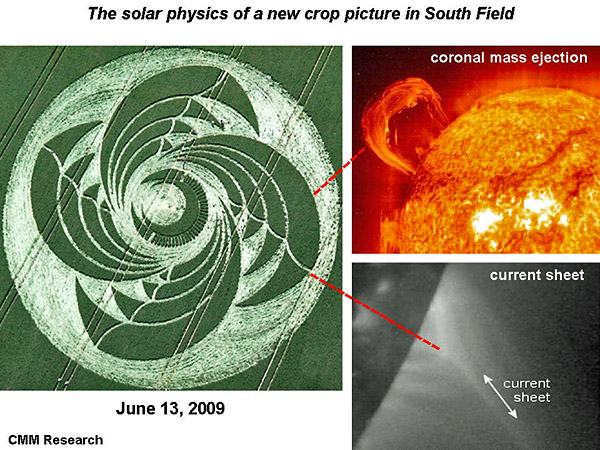
Who else could have made such a crop picture, except for some
advanced astrophysicist, perhaps from another world?
A series of
coronal mass ejections seem to be predicted for the lunar eclipse of
July 7, 2009, following one turn of solar rotation from June 4
Finally, we seem to understand now the underlying message that was
given to us in South Field on June 13. Thus after one turn of solar
rotation starting on June 4, 2009 (when sunspot group 1019 was
pointing at Earth), that active sunspot group will rotate around the
Sun for another 33 days, until it points directly at Earth again on
July 7, 2009:
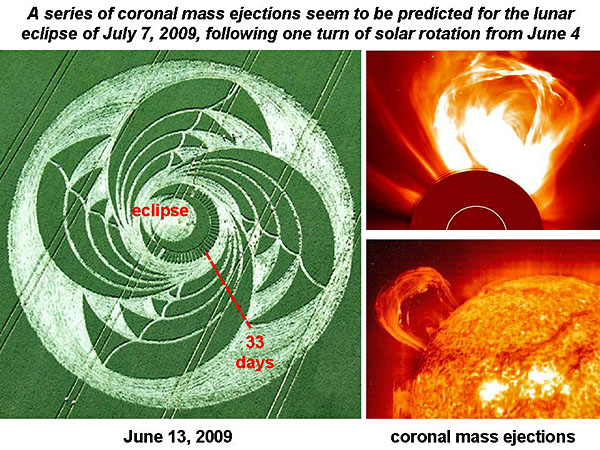
And on that day, which incidentally happens to be a barely visible
lunar eclipse, our Sun will erupt (according to those crop artists)
with a series of large, powerful coronal mass ejections, some of
which may perhaps pass close to Earth or Moon.
Okay, who wants to watch football matches or talent shows on TV for
the next 23 days? Would you not more wisely be advised to follow the
current behaviour of our Sun on the SOHO website (see
nascom.nasa.gov)? Or to inspect the latest crop pictures as they
appear in southern England (see
2009), in order to determine what new messages for the
inhabitants of Earth they might contain?
Could July
2009 be a precursor to major solar activity in December of 2012?
Some London newspapers recently speculated that we might be on the
receiving end of a major solar storm in 2012 (see
dailymail.co.uk). Although we cannot know yet what might happen
in late 2012, modern crop pictures can perhaps shed some light on
this interesting and controversial subject!
Thus to our great surprise, we found that the new “coronal mass
ejection” picture from South Field on June 13, 2009 bears a striking
resemblance to the famous “Mayan Sunstone” crop picture from near
Silbury Hill on August 2, 2004:

Our current South Field crop picture seems to be predicting some
kind of anomalous solar behaviour for July 7, 2009, while the Mayan
Sunstone crop picture seems to be predicting more of the same for
late December of 2012.
Thus, we can see around the centre of that Mayan crop picture a
series of 6 + 6 = 12 long arcs, which clearly match the shape of
those new “coronal mass ejections” from South Field. We can also
see, close to the centre, two fan-like regions with 19 long lines
each. When studied together, all of those symbols suggest a date
12.19.19.0.0
in the Mayan Long Count Calendar, which corresponds in our modern
calendar to December 28, 2011.
One year (or 360 days) later on December 23, 2012, the Mayan Long
Count calendar will end. Our current Fifth Sun will come to an end,
while a new Sixth Sun will be born. By another kind of symbolism,
the “old phoenix” will die, while a “new phoenix” will be born. We
should learn soon in another 23 days on July 7, 2009 whether all of
their impressive field symbolism has been simply metaphorical, or
rather astrophysical as might also be the case.
The CMM
Research Group
P.S. We would like to thank Olivier Morel, Steve Alexander and
Russell Stannard for some of the photographs used here. |