|
Two sets of 25 binary numbers from
Silbury Hill on July 5, 2009 can be read in base-32, to give near future
dates of September 6, 2009 or November 17, 2009 in a Mayan Sun-Venus
calendar
A new
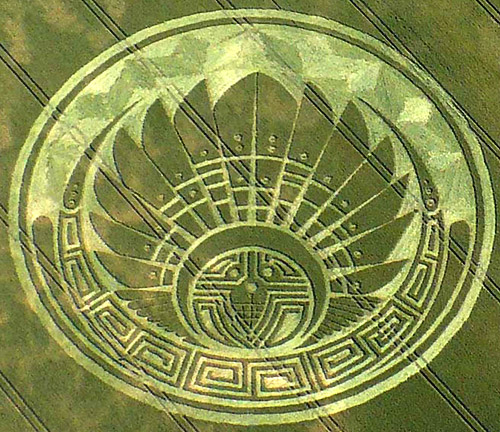
Mayan-type crop picture which appeared near Silbury Hill on July 5, 2009
has stimulated great interest worldwide. One English newspaper suggested
that it might be intended to warn us of a “Mayan apocalypse” in the year
2012 (see
Mayan-apocalypse-crop-circle-appears-at-Silbury-Hill). Other
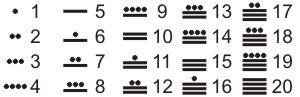
researchers have attempted to interpret its codes in terms of Mayan
counting systems, where bars equal “5” and dots equal “1” (see
silburyhill or
article).
Our
approach has been to study this new crop picture in terms of other
related crop pictures that have appeared over the years, and are well
understood. Using those crop pictures from the past as guides, we will
attempt here to correctly interpret the new one.
Two crop pictures from early July of 2009 seem to
predict a “long teardrop” shape in our near future
Two crop pictures which
appeared at West Down Gallops on July 4, or Silbury Hill on July 5,
2009, seem to predict that a “long teardrop” shape will soon “fly like a
swallow” through Earth’s skies:
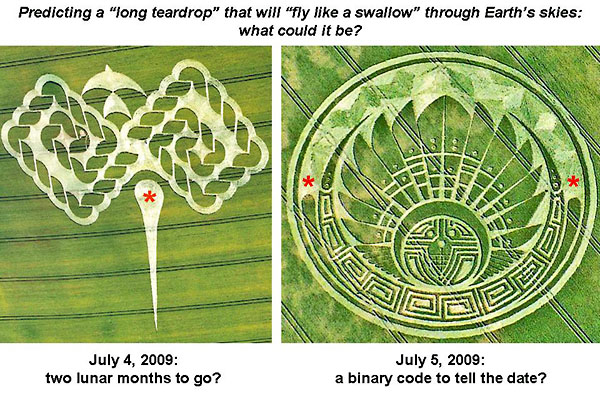
What are those long
teardrop shapes meant to represent? One possibility might be a bright
comet with a long tail. Another possibility might be coronal mass
ejections from our Sun, often symbolized by “teardrops” in the
scientific literature.
One
of those two crop pictures (above left) showed a series of Mayan symbols
for 2 x 29 days, or two lunar months, until the “teardrop” may arrive.
The other (above right) showed a series of lines and dots, which might
represent some kind of binary code to tell the date.
Silbury of July 5, 2009 resembles Wayland’s Smithy of
August 9, 2005, which predicted Comet Holmes in 2007
How
can we ever hope to understand such intricate and enigmatic messages?
Well, Silbury of July 5, 2009 also resembles Wayland’s Smithy of August
9, 2005, which predicted a spectacular and unexpected outburst by Comet
Holmes in 2007, by means of a binary code:
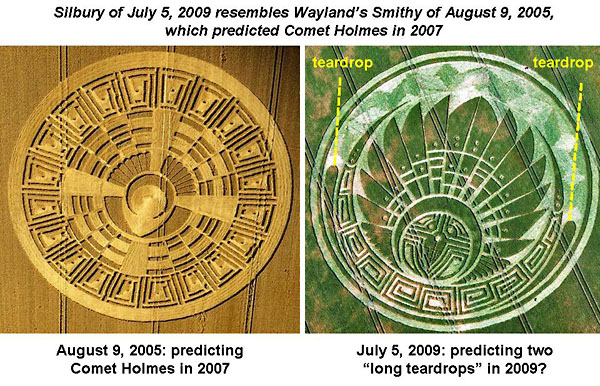
A
good clue perhaps toward solving the new one?
How did Wayland’s Smithy of 2005 predict Comet Holmes
in 2007?
How
did Wayland’s Smithy of 2005 predict the outburst of Comet Holmes in
2007? First, it showed a whole series of binary numbers as either bars
(1) or spaces (0). Those were quickly decoded to arrive at two series of
numbers in base-16 as 13-10-7 or 14-5-11. If those numbers
represent “dates”, then what kind of calendar should we read them in?
Looking again at the same crop picture (above left), one can see twenty
Mayan symbols for “time” along its outer perimeter. Those symbols tell
us to use a Mayan calendar with 20 days per month. The most likely
choice would be a Mayan Calendar Round (or Sun-Venus calendar), which
lasts for approximately 52 years or 18,980 days.
Our
current Sun-Venus calendar began on April 10, 1961 and will end on March
28, 2013 (see
time2007c). By converting each series of base-16 numbers into a
decimal fraction, then multiplying by 18,980, one can calculate how many
days have passed since that Sun-Venus calendar began on April 10, 1961.
By that method, 13-10-7 gives a date in our modern calendar of
August 9, 2005, which was when the Wayland’s Smithy crop picture
appeared.
The
other series 14-5-11 gives a date of November 20, 2007, which was
when a newly exploded Comet Holmes joined closely in Earth’s sky to a
bright star called Mirfak in the constellation Perseus. When studied in
retrospect, many crop pictures from 2005 predicted Comet Holmes, but in
a visual rather than mathematical fashion (see
time2007g or
time2007h).
Another binary code was shown at Crabwood in 2002
Another binary code was shown in crops at Crabwood on August 15, 2002.
Most of the Crabwood code consisted of an English text message in ASCII.
Yet certain patterns of “false capitalization” in its primary message
also gave us another 25 numbers in binary (see
time2007n).
When
those 25 extra binary numbers were arranged into groups of five, they
could be read in base-32 as 30-25-14-27-26.
After converting into a decimal fraction, and multiplying by 18,980 days
(the length of a Mayan Calendar Round), they told us that “50 years had
passed” since unfriendly grey aliens flew over Washington DC in July of
1952 (see
time2007o).
So our current situation
is not as dire as one might imagine! Silbury of 2009 is the
third in a series
of binary codes that have been shown in English crop pictures over the
years. We now understand their two previous codes pretty well, since the
events which they predicted have already happened. What might this third
binary code be trying to tell us?
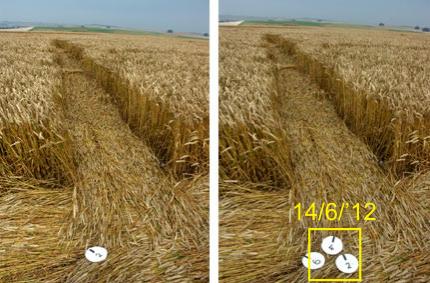
Each side of the Silbury crop picture contains 25
binary numbers
To
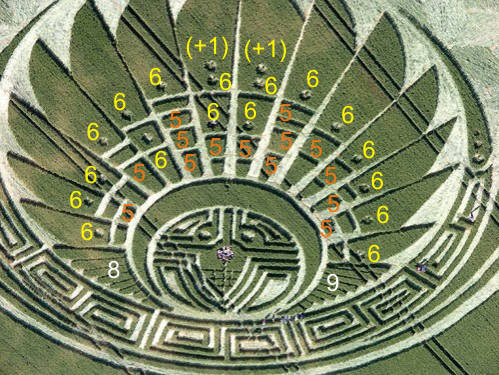
get started, we may simply count the total number of lines (1) or dots
(0) on each side of the Silbury crop picture. By careful inspection, one
can count 15 lines on its left-hand side, or 16 lines on its right.
Likewise, one can count 10 dots on its left-hand side, or 9 dots on its
right:
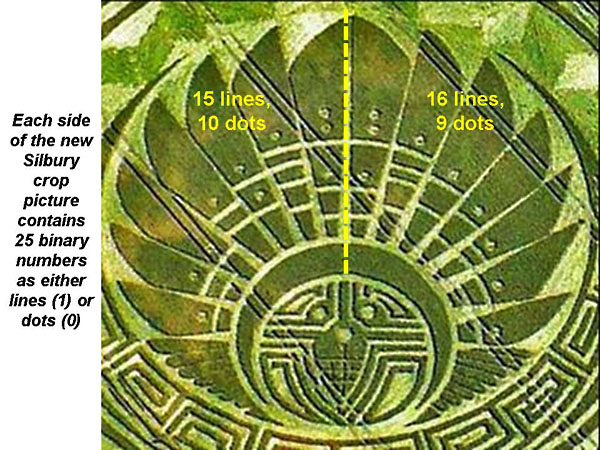
Each
side of the new crop picture therefore contains 25 binary numbers, as
the sum of 15 and 10, or 16 and 9. That is a very useful result,
since any binary code that contains a total of 25 numbers may be read in
base-32, once we arrange those 25 binary numbers into five equal parts
of 1-5, 6-10, 11-15, 16-20, or 21-25.
There
were likewise 25 extra binary numbers shown at Crabwood in 2002, which
could be read by grouping them into five parts, then converting into
base-32.
Reading all 25 binary numbers on left or right
Now
we need to read all 25 binary numbers on each side of the new crop
picture, with as much precision and care as possible. The general
process by which we will do this is shown below:
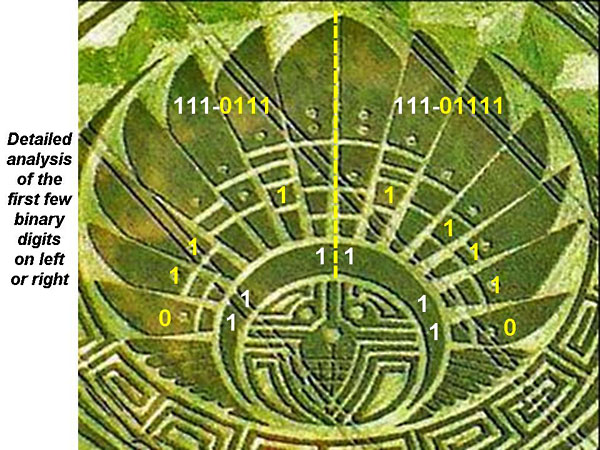
Reading on
the left along layer line one, we can see
“1-1-space-space-space-space-1”. Then on layer line two, we can see
“0-1-1-space-space-1-space”.
Reading on the right along layer line one, we can see
“1-1-space-space-space-space-1”. Then on layer line two, we can see
“0-1-1-1-space-1-space”.
Continuing that process for the entire left-hand side, and removing all
spaces, we can find a series of 25 binary numbers as:
111 0111 00111 1010 011 011 00 0
On
the right, we can find a different set of 25 binary numbers as:
111 01111 0111 0110 011 011 00 0.
Arranging into groups of five, then reading in
base-32
Our
next task will be to convert each set of 25 binary numbers into some
kind of mathematically significant format. Clearly we cannot read them
in base-16, since 25 is not a multiple of four! Nor can we read them in
base-8, since 25 is not a multiple of three. For base-64, we would need
a multiple of six, or for base-128, a multiple of seven.
Our
only real choice is to arrange them into groups of five, and read them
in base-32. Indeed, that is what a long outer arc filled with Mayan
symbols in the lower part of that crop picture seems to be telling us:
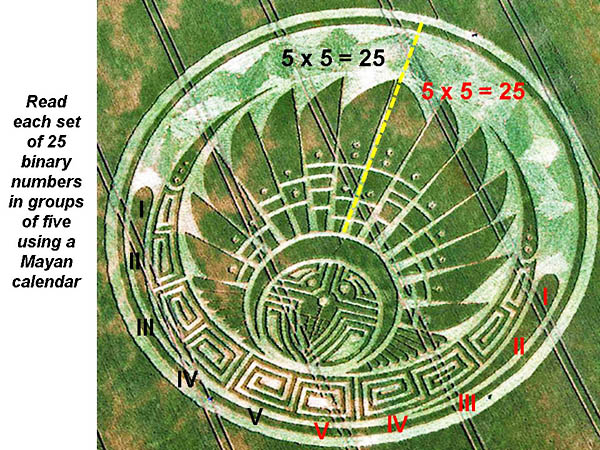
Arranging 25 binary numbers from the left into groups of five, we find:
11101 11001 11101 00110 11000.
Arranging 25 binary numbers from the right into groups of five, we find:
11101 11101 11011 00110 11000.
Translating into base-32, we find for the left:
29-25-29-6-24
or
for the right:
29-29-27-6-24.
Calculating dates in a Mayan Sun-Venus calendar
Now
we have two series of numbers in base-32, but what do they mean in terms
of a Mayan calendar? Let us first consider the date on which that
Silbury crop picture appeared, or July 5, 2009. It lies 17,618 days past
the start of our current Sun-Venus calendar on April 10, 1961. Dividing
by 18,980, we get a fraction of 0.928240. Translating into base-32, we
find:
0.928240 = 29 / 32 + 22 / (32 x 32) + 17 / (32 x 32 x 32) = 29-22-17.
Both
of series of numbers in base-32 from Silbury as 29-25-29 or
29-29-27 lie close in time to the series just calculated, but are
slightly larger (or further into the future). Translating into a decimal
fraction, then multiplying by 18,980, we find for the left:
29 /
32 + 25 / (32 x 32) + 29 / (32 x 32 x 32) = 0.93155 =
17,681 days past April 10, 1961 = September 6, 2009
or
for the right:
29 /
32 + 29 / (32 x 32) + 27 / (32 x 32 x 32) = 0.93539 =
17,753 days past April 10, 1961 = November 17, 2009.
Finally we have reached some kind of useful result! Those two dates of
September 6 or November 17, 2009 may mark important astronomical events
in our near future. Other images in the Silbury crop picture suggest
that we will see one or more “long teardrops” in Earth’s skies, on one
or both of those days.
Could
they be telling us about a bright comet with a long tail? Or coronal
mass ejections from our Sun? Or something else that we cannot yet
foresee?
Two other crop pictures gave us instructions on how
to read the Silbury code
A
crop picture in Germany on July 12, 2009 showed two long, connected
spirals with six turns each (see
Barterode or
www.kornkreise-forschung.de). It may have been telling us to read
the Silbury code “like a spiral”, from inside to outside, and over six
layers or turns as we did above.
Another crop picture in Switzerland on July 12, 2009 showed a long piece
of “magnetic tape”, with four series of binary stripes drawn along it at
regular intervals (see
switzerland or
Horhausen2009):
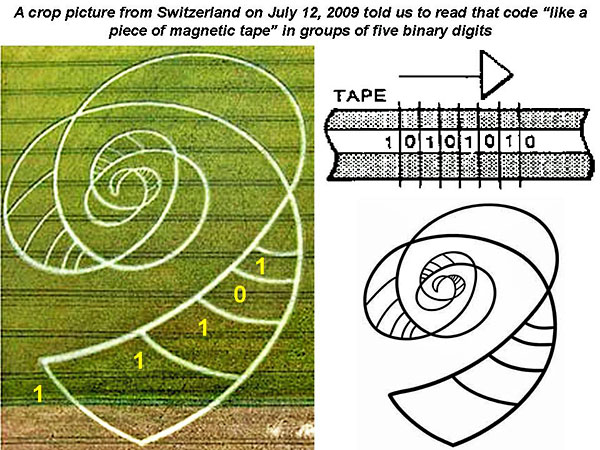
It
may have been telling us to read the Silbury code “in groups of five” as
we did above.
Two other crop pictures support a date of September
6, 2009
A
crop picture at Peaks Down on May 9, 2009 showed a “teardrop” in close
proximity to their symbol for the full Moon of September 4, 2009, which
lies two lunar months after an apogee full Moon of July 7, 2009:
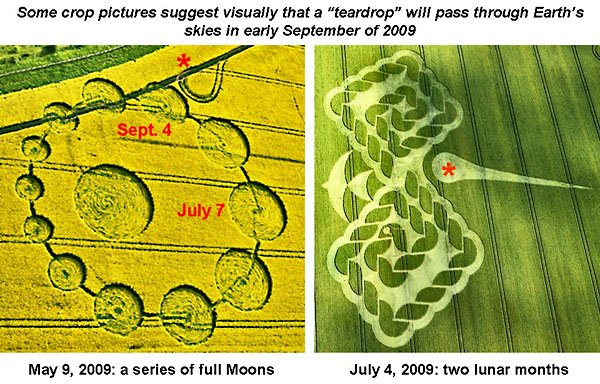
Another crop picture at West Down Gallops on July 4, 2008 showed the
same “long teardrop” shape as drawn at Silbury, next to Mayan symbols
for “two lunar months”. Those Mayan symbols suggest a two-month interval
between July 4 when the crop picture appeared, and early September of
2009.
The CMM Research Group
PS We
would like to thank John Montgomery, Lucy Pringle, Jack Roderick, Beni
Sidler and Jack Turner for some of the field images used here.
|