Slight opposing distortions of
the “solar flares” shown at Rutland’s Farm on April 23 suggest a
partial magnetic field reversal in our “quiet Sun”
A new crop picture at Rutland’s
Farm on April 23, 2009 has stirred much interest, because it
seems to show a series of “solar flares” emerging from our Sun.
Many people have speculated that such a picture might be
intended to warn us about a potentially catastrophic event in
late 2012, when the current solar cycle ends.
We
would like to suggest another, less catastrophic explanation, in
terms of turbulent magnetic fields within our abnormally quiet
Sun. Fox News reported recently:
“The
Sun has been unusually quiet lately, with fewer sunspots and
weaker magnetic fields than in nearly a century” (see
www.foxnews.com).
A possible turbulence of underlying magnetic fields in our quiet
Sun
Solar flares happen when the Sun’s
magnetic field becomes turbulent or, in other words, when one
part of it points in one direction, while another part points in
another direction. This is well known from the astrophysics
literature:
“Solar flares occur when magnetic
fields in the Sun’s atmosphere rapidly change shape, and
generate currents of electrically charged plasma” (see
exploring magnetism in Solar Flares)
“In
this study, I propose that the emergence of a current carrying
magnetic field causes most, if not all, solar flares.”
(see C.J. Schrijver, Astrophysical Journal 655, L117–L120,
2007).
Thus, the relative quietness of our Sun may not suggest a strong
directional field (like a river flowing in one direction,
halfway between low tide and high tide), but rather an
underlying turbulence where many small magnetic fields may be
flowing in different directions (like a river with small eddies,
close to low tide or high tide): see also
“Turbulent Magnetic Fields in our Quiet Sun”
by J. P. Graham et al.,
Astrophysical Journal
693,
1728-1735, 2009.
How do large solar flares form?
Large solar
flares form when some curved coronal loop of magnetic field
extends, then pinches off, from the main body:
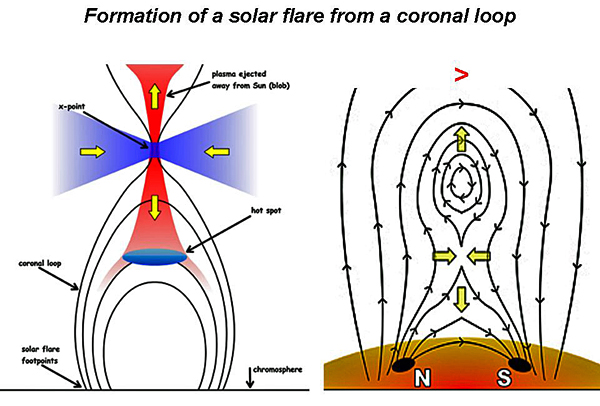
Look carefully
at the small red arrow
shown above (upper right). It tells in which direction the
magnetic field of that coronal loop is flowing: say from left to
right, or else from right to left.
The crop picture from Rutland’s Farm seems to show solar flares
of two different magnetic field directions
When we study
closely that new crop picture from Rutland’s Farm, we can see
there a similar “curved tip” feature, just as indicated for most
large solar flares in the previous diagram above.
Yet now the
angular distortion of those “flares” or “curved tips”, away from
an idealized straight geometry, seems to show two different
field directions:
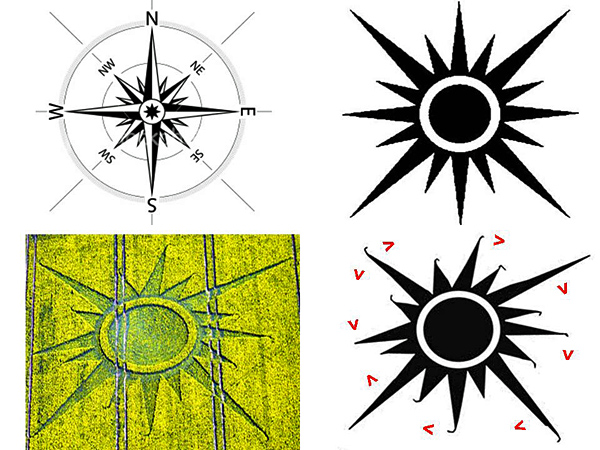
Most of the red
arrows (or magnetic fields) flow
clockwise
around the Sun’s perimeter as seen from Earth. Yet a few of them
(on the left) flow counter-clockwise in an opposite direction.
Such a mixed distribution of field polarities is just what one
might expect for flare emissions from a quiet but turbulent Sun
(see also
www.reuters.com).
“Turbulent
magnetic fields, driven by highly chaotic fluid motions, may
pervade relatively quiet regions of the solar photosphere”
(see
PP04043.pdf).
If our quiet Sun is going to flare, when will it happen?
Some people
have argued that our Sun is most likely to flare in late 2012,
when its overall magnetic field changes polarity by a regular
11-year cycle, and also (incidentally) when the Mayan Long Count
calendar ends. That may still be true!
But another
possibility certainly exists, where our currently “quiet” Sun
may flare in a minor fashion later this year, or even later this
summer, as new sunspots finally start to emerge.
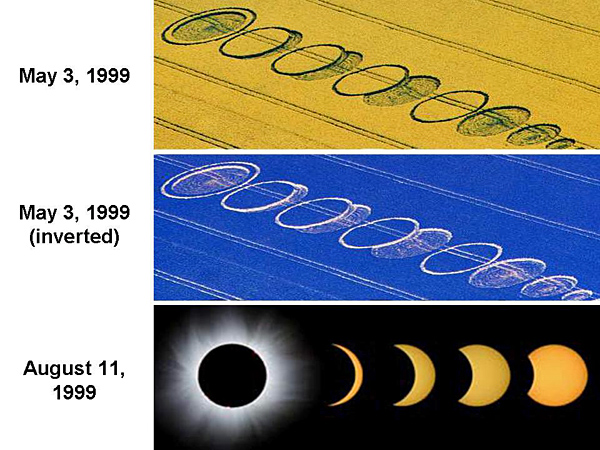
In the past,
those crop artists have shown upcoming astronomical events in
oilseed rape during April or May, when some important
astronomical event is scheduled for June, July or August of the
same year. For
example, in May of 1999 they showed us a “solar eclipse” picture
in oilseed rape, which referred to a total solar eclipse on
August 11, 1999:
Thus it would
not seem impossible that we will see a
minor solar flare
later this year, when new sunspots finally begin to emerge,
although its precise date remains to be determined. Morgan’s
Hill of April 24, 2009 perhaps suggests “three cycles of new and
full Moon” from April 25 to July 7, yet remains so cryptic that
one cannot be sure (see
/morgans2009).
We have to wait for more information
If a minor
solar flare really is going to occur, later this summer or later
in 2009, when new sunspots finally start to emerge, and when the
Sun’s magnetic fields become very turbulent, then we should see
further predictive crop pictures in May or June which will give
us more information.
The importance
of such an event would be that it
cannot be predicted
according to current theories of Earth science. Thus if it does
occur, then the paranormal validity of the crop circle
phenomenon will be completely validated in an a priori
fashion (except for ostriches and emus, or members of the Flat
Earth Society).
Charles Reed and his friend Mike
PS We would
like to thank Nick Nicholson, Andreas Muller, Bertold Zugelder
and Lucy Pringle for some of the photographs or diagrams used
here.