|
Roundway Hill (2), nr Devizes, May
10th
Cyclic Regeneration: Don’t Panic!
This
familiar feeling, yet quite novel and succinct presentation of
seasonal, solar and life cycles is beautiful to behold and invites a
closer look to grasp its upbeat and hopeful message.
The curved arms of the formation are reminiscent
of the swastika and its meaning, ‘so be it’ or ‘amen’. Because the
arms are curved, the formal name for this pattern is the ‘tetrascele’.
As with the swastika, this depiction of rotation indicates the
acknowledgment of the cyclic powers of creation, related to the
Great Goddess, the Buddha and artifacts dating from the 13th
century B.C. onwards in Asia Minor, Greece, China, Persia, Libya,
Scandinavia, Britain and Iceland. Both the tetrascele and the
swastika originally symbolized good fortune.
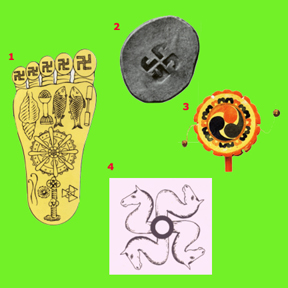
1. Swastika
– an auspicious sign on Buddha’s foot. 2. Ancient swastika on
Corinthian column c. 540 B.C. 3. Chinese triskele – symbol of good
fortune. 4. Tetrascele with solar disc and steeds.
In this formation, the arms suggest a
counterclockwise motion, so the whole formation seems to move in a
clockwise motion. Thus, as in the swastika as well, the feminine
lunar principle (counterclockwise) and the masculine solar principle
(clockwise) are both presented as active complementary forces in the
wheel of life, ‘la respiration universelle de la vie et de la mort’
(Encyclopédie), dark and light moving in harmony.
The tetrascele aspect of this formation holds
four small circles in its arms. Perhaps they represent the four
phases of the moon? This then, could be understood as representing
the monthly cycles we experience on Earth. The solar disc in the
centre with its four protruding rays of light energy alternating
with the lunar arms gives us the representation of the daily and
yearly cycles we experience on our planet. The four arms and rays
also indicate the four directions belonging to many traditional
definitions of our Earth.
Then there appears eight very definite ‘tear
drop’ shapes aligned with, and on each side of the sun’s rays. This
form could be considered a stylized version of the ‘Yod’, the tenth
letter of the Hebrew alphabet. ‘Yod’, in the Tarot is associated
with the astrological sign Virgo and with the Hermit, Key 9, of the
Tarot deck. The Hermit symbolizes initiation, the end of the cycle
of the trinity of trinities, the gathering of all numbers to begin
in a new cycle of 10. The ‘Yod’ itself in the Tarot tradition
signifies “the descent of the Life-force from above into the
conditions of material existence” (Gray).
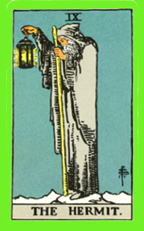
The Hermit
stands for initiation, introspection,
Receiving
wisdom from above.
“In the
Jewish mystical tradition, Yod represents a mere dot, a divine point
of energy. Since Yod is used to form all the other letters, and
since God uses the letters as the building blocks of creation, Yod
indicates God’s omnipresence.”
(www.hebrew4christians.net
)
There are 8 arms in total to this Roundway Hill
formation; there are also 8 ‘Yod’/’teardrop’ symbols in this
formation. ‘8’ is the number for the ‘Infinite’. The sign Virgo
begins in August, the 8th month of our calendar.
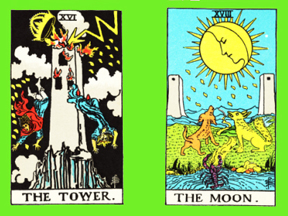
The yods in
the Tower Key represent Cosmic Consciousness breaking through
material ambition in order to rebuild. In the Moon Key they
represent the fertilization of Matter by Spirit, the rebirthing.
Is this communication telling us that something
to do with ‘newness in creation’ will be introducing itself to Earth
around the month of August this year? Is there an anticipated
celestial event to occur during that time? Whether a specific event
is being presented here or not, the inclusion of references to all
the cycles of life and creation on Earth, and the references to some
kind of Divine influence cannot be denied. This beauty is like an
encouraging greeting card telling us potential galactic hitchhikers:
‘DON’T PANIC!’.
Michelle Jennings
Sources:
Bruce-Mitford, M. The Illustrated Book of Signs &
Symbols. Reader’s Digest. Montreal. 1996.
Cooper, J.C. An Illustrated Encyclopaedia of
Traditional Symbols. Thames & Hudson. London. 1978.
Encyclopédie des symboles. Michel Cazenave, dir.
Le LIvre de Poche. 1996.
Gray, Eden. A Complete Guide to the Tarot.
Crown Publishers, Inc. New York. 1972.
Walker, Barbara. The Woman’s Dictionary of
Symbols & Sacred Objects. Castle Books. Edison, NJ. 1988.
http://www.hebrew4christians.net/Grammar/Unit_One/Aleph-Bet/Yod/yod.html |