Counting the days of the Maya-year
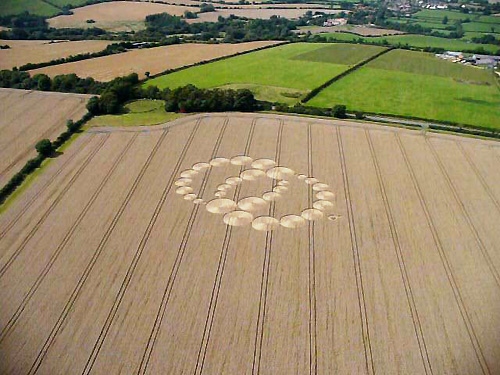
The fact that this formation has been created near the Rollright
Stone Circle has a deeper meaning. Legend has it that it is
impossible to count the King’s Men. As will be explained this
refers to the confusion that exists among Maya-researchers about
the true count of Maya-calendars! In the Maya civilization,
counting of the years was done by stones (called “Tun”). A Tun
(stone) is a cosmic “year” of 360 days. The Maya made use of a
count that kept up with the number of Tuns and days (“Kin”) that
had been elapsed. This count is called the “Long Count” and
nowadays this count is subject to a lot of discussion, as the
end of the Long Count refers to the end of present age and the
end of time in the year 2012. It turns out that this formation
not only has a relationship with the Long Count, but
particularly with the “normal” Mayan year of 365 days.
We can count the “stones” as follows:

This formation tells us: today is day 9 or 10 of “Vinal” 4 (a
Vinal is a period of 20 days). This makes use of the fact that
the formation consists of 2 circles of the Vesica Piscis. The
Vesica Piscis is an old symbol that sometimes is connected with
the Gospels and symbolizes the connection of the male with the
female, from which people return to their origin, symbolized by
the stars. As will be explained this relates to this calendar.
We actually find day 10, but it’s notable that the tenth circle
is remarkable smaller. Moreover day 9 – in connection with day 3
– forms a perfect triangle with month 4. Apart from that day 3
has perfectly been aligned with a sign with a swirl at the edge
of the formation and it will turn out that day 3 of Vinal 4 (“Zotz”)
has a special meaning, that will be clarified later.
The days of the Vinals aren’t numbered from 1 to 20, but from 0
to 19 and this is the reason why the counting starts with 0. The
Vinals themselves have names, but it makes sense to assign
number 1 to the first Vinal, number 2 to the second etc. The
Maya-year has 18 Vinals of 20 days (total of 18 x 20 = 360 days)
plus a leftover of 5 days “out of time” (sometimes 6). These 5
days out of time at the end of the year can be considered as
Vinal number 0 that precede the real start of the year. That’s
why it makes sense to start also with number 0 referring the
Vinals. Moreover, it will turn out that day 0 of “Vinal 0”
(called Vayeb) has a special meaning.
Regarding the Maya-year there exists a big problem: nobody knows
when the year actually starts and that explains the connection
with the legend of the Rollright Stone Circle!! What is the
reason? Maya-researchers know the relationship between the
Maya-year and the Gregorian calendar in the past. It is known
that in the past the Maya-year didn’t have leap days and
“drifted” away from the Gregorian calendar. However when the
Spanish conquered Meso-America, they decided to fix the
beginning of the Mayan year on the 26th July. This date has also
been found back in the books of Chilam Balam (actually the 16th
July in the Julian calendar). As a result the Mayan year starts
on the 26th July.
The question is: is this really true? The point is that the
Mayan year can be divided into “months” in 2 different ways.
Apart from the division in 18 Vinals, they sometimes also
divided the year in 13 months of 28 days. This
“13-moon-calendar” nowadays made it’s revival among followers of
the Mayan calendar and this calendar starts on the 26th July
indeed. However a calendar actually is based upon the divine
creation and to the calendar of 18 Vinals, the starting-date of
the 26th July doesn’t apply despite the decision of the Spanish
…
From my spiritual guide, I got the true starting date of this
calendar, namely the 26th of May (note the relationship of “May”
with “Maya”!). Nowadays also this calendar has been synchronized
with the Gregorian calendar, but this didn’t happen before the
13th January 1756 (on that day 9 days have been skipped in this
calendar), while the 13-moon-calendar already has been
synchronized in the year 1540 (by the Spanish). With the
starting date on the 26th May, the third of August, the date of
the formation, indeed is day 9 of the 4th Vinal (called “Zotz”
or bat)!! The Vinal Zotz stands for experiences that lead to
renewed insights and knowledge.
The crop circle artists added several indications that provide
us with extra information. First of all there is a tiny dot – a
reference point – that connects circle number 4 (Vinal Zotz)
with the large circle, that represents 0. This means that day 0
of Vinal Zotz can be considered as a reference point. This turns
out to fall on the 25th July. This indeed is an important
reference as it marks the end of the 13-moon-calendar (the day
out of time, which is to be considered as 0)!
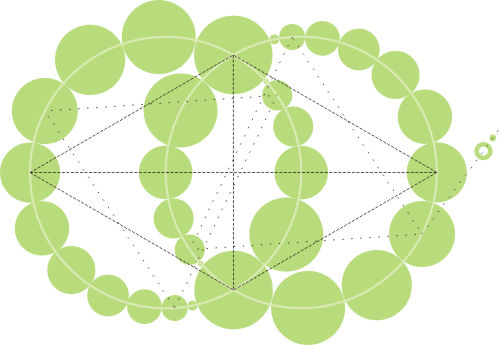
The formation can also be connected with the Gregorian calendar.
Also in this case we again make use of the Vesica Piscis: The
intersection point of both circles is the common point of two
circles from which we start the count of the months as well as
the day. Regarding the day-count, we continue with the
remaining circles:

In the Gregorian calendar, the number 0 has no meaning, so in
this case the count starts with number 1. We find the month
number 5 (yellow) and day number 26 (black) or the 26th May, New
Years day, indeed!! Note that the other intersection point got
number 12, which also refers to the 12 months of the Gregorian
calendar. In this case a reference point results in a connection
between 5 and 12, which can also be considered as 5 x 12 = 60.
The 60th day of the year is the leap day (the 29th February) in
leap years. So this refers to leap years. This also makes sense
as this calendar has been synchronized with the Gregorian
calendar in a leap year (1756). Moreover also the year of
transformation, 2012, is a leap year. Through the
synchronization of this Mayan calendar with the Gregorian
calendar, the number of days of the year during a leap year
equals 366 and there are 6 days out of time. The first day (day
number 0) of this period falls 6 days before the 26th May and
this explains the special ring near the number 20, which refers
to the 20th May! This ring can be considered as 0, but can also
refer to the annular eclipse on the 20th May 2012 in a
conjunction with the Pleiades! So in this case the dot (swirl)
near this ring refers to the Pleiades. As this is month number 0
and referring the formation the count of the year actually
starts with month number 0, the 20th May can be considered as
the beginning of the year during leap years (the 21st May during
other years).
Even the number of stones of the Rollright Stone Circle (77)
tells us something. Starting from day 0 of Vinal 0, 10 Zotz (the
forth August) is the 77th day of the year (in leap years the
76th in other years)! The other way around: when we count 77
days back from the third or fourth August (9 or 10 Zotz), this
falls on the 18th or 19th May. These dates have a special
meaning, while during the 256 years from 1756 to 2012, the 18th
to 19th May is the average date on which the sun and the
Pleiades are conjunct. In the year 1756 this fell on the 17th
May, but nowadays this falls on the 20th or sometimes the 21st
May. Why did this shift happen? The reason is the so called
precession-cycle. To make a long story short this has the result
that the tropical year and the year in relation to the stars
aren’t equal. This is important as the reason that the Maya-year
nowadays actually starts on the 20th or the 21st May is that
this is the day of a conjunction of the sun with the Pleiades!
However as the Gregorian calendar has been based upon the
tropical year (and not on the sidereal year) in future a problem
would rise. For this reason, from 2012 onwards, the Mayan year
will be “uncoupled” from the tropical year of the Gregorian
calendar and get a different pattern of leap days (every 4 years
plus additionally every 260 years and every 400 years an extra
leap day will be added).
In the diagram there is also a reference point near circle 16:
this refers to the 16th May. The last days of the actual Mayan
year from the 16th until the 20th May (vinal “Cumku”) have a
special meaning. As the 16th May falls precisely 12 lunar months
or 13 sidereal months after the start of the solar year on the
26th May, this date actually completes the cycle referring the
moon. There also exists a relationship with the Earth on 19°39’
North latitude: This latitude is connected with energetic points
of light as these are connected with the South Pole by a
tetrahedron (pyramid of 4 triangles). On the 16th and 17th
May, the sun is in the zenith on this latitude in the
Northern hemisphere. On a subconscious level there is an
evaluation of the past year. This is emphasized by the fact that
the period from the 17th (1756) to the 20th May (2012) is also
the period on which the sun is in a conjunction with the
Pleiades.
In the year 2012, the reprogramming from the 16th until the 20th
May in connection with the moon, the Pleiades, the tetrahedron
of the Earth and the solar eclipse on the 20th May in
conjunction with Mercury and Jupiter, will lead to a permanent
reprogramming of mankind. The conjunction of Mercury with the
sun also appeared on the 17th May 1756: from then on people
started to explore their inner child.
Still the question remains if there is a special reason that
this formation arose in 2009. Indeed there is a reason for that.
As already noticed, the last circles of the 2 outer rings are
considerably smaller than the other circles. When we leave out
this 2 circles and also leave out the small reference points and
the marking ring and swirl at the edge, the formation consists
of 28 = 4 x 7 circles. However the Vesica Piscis actually is an
old symbol for infinity and the number 8. So we can also
consider number 8 x 7 = 56 instead of 28 as a key-number of this
formation. This also links up with the earlier mentioned year
1756. It turns out that when we count back 56 x 56 (3136) lunar
months (29.5306 days) from the day of the formation, the outcome
is exactly the 13th January 1756, the day on which the
synchronization of the Mayan calendar with the Gregorian
calendar took place!! Furthermore, the fact that the marking
ring with a swirl has perfectly been aligned with day 3 (see
first diagram above) and the triangle between Vinal 4 (Zotz) and
day 3 tell us that not only 9 or 10 Zotz, but also 3 Zotz has a
special meaning. When we go back in the past and consider the
last year that new year started on 3 Zotz (in the Julian
calendar), this turns out to be 1/1/1120. The number 1120 equals
20 x 56! This is interesting as this is not only a multiple of
56, but the number 20 is an important number regarding time,
especially regarding the 20 days of the 18 Vinals of the Mayan
year!
Finally, I did intensive research regarding the orientation of
the formation (using Google Earth amongst others). The formation
has been orientated almost precise East-West. Although there is
an error of 2.5 to 3 degrees, I neglected this in the first
instance.
This leads to the following diagram:

Despite the error regarding the East-West-orientation of the
formation (dotted lines), the orientation of the formation to
sunrise and sunset is very notable, because the Vesica Piscis
has the property that the tangent of each intersection point
corresponds with an angle of 30 degrees, while sunrise at 52°
North latitude (the latitude of the formation) on the third
August (date formation) is exactly 30° North of the East! The
same is true for sunset in the direction of West North West (30°
North of the West). From the upper intersection point of the
circles of the Vesica Piscis, The Whispering Knights are
situated to the East exactly parallel with the quasi
East-West-line. Furthermore it’s is very notable that the
direction of sunrise is exactly the same as the signs at the
edge of the formation that refer to the conjunction of the sun
with the Pleiades and the solar eclipse on the 20th May! However
when we correct the error, we find out that the orientation has
been based upon the tangent of the lowest circle (true
East-West-line):

In this case the tangent of the Western circle in the direction
of sunset has exactly been aligned with the centre of the stone
circle The King’s Men. The difference with the orientation of
the Whispering Knights is very notable. The direction of sunset
has a relationship with the seasons and the tropical year.
However from a symbolical point of view sunset also refers to an
end. In this case this is connected with the end of the
connection of the Maya-calendar with the tropical year. In
contrast to that the East is connected with a new start. This
start hasn’t been connected with sunrise, but the reference to
the monumental burial chamber of the Whispering Knights in the
East, refers to a revival, like Phoenix that rises out of its
ashes.
It turns out that thanks to the slight rotation of the
formation, the tangent at the intersection point of the Western
circle has perfectly been aligned with the rise of the Hyades, a
star cluster in Taurus. This is important as on the 26th May,
the start of the new year, the sun is conjunct the Hyades. I
also found a perfect alignment with the Pleiades in connection
with the sign in the East, that refers to this star cluster.
This alignment with stars and star clusters holds all the year
round.
The alignment of the formation towards the Pleiades as well as
the Hyades clarify that the calendar from the year 2012 won’t be
related with the tropical year, but the sidereal year
(synchronized with the stars!). This is emphasized by the fact
that in the West, the formation has been aligned with the set of
Jupiter on the end of the Maya-year in May 2012. This contrasts
with the rise of Jupiter at midnight on the 13th January 1756,
when the synchronization with the Gregorian calendar took place!
The set of Jupiter in the West has been connected with the signs
in the East that refer to the connection with the stars,
especially the Pleiades (dotted line), which will take it over
from Jupiter.
It’s also very notable that the East-West-line refers to the
lowest circle. This gives rise to the idea to count the circles,
starting from the central circle. From there we come out at
number 1. However the circle invites us to go one time around
and then we find number 17. It’s very notable that also the
tangents in the direction of sunrise and sunset precisely fall
on an intersection point that corresponds with the centre of a
circle. In the diagram we find that sunrise corresponds with 2
and sunset with number 7 (see yellow numbers). So we found the
numbers 17.2.7. This is very interesting, because according to
the Mayan Long Count the 4th August, the day to which the
formation actually refers, corresponds with count 12.19.17.2.7.
The last 3 ciphers correspond with the ciphers we find in the
formation! This is very important, because even at present
Maya-researchers weren’t able to a full reconstruction of the
Long Count (see
www.33mm.eu/en/
): the deviation from the true Long Count equals 203 days.
Apart from the Long Count, we can also define a count referring
the industrial age. This started on the 19th March 1756 (with
count 0.0.0.0), about 2 months after the synchronization of the
Maya calendar with the Gregorian calendar. This age is 20 times
shorter than the age of world religions, on which the Long Count
has been based. In that case we find the count 12.17.2.7 instead
of 12.19.17.2.7. It’s interesting to note that also the number
12, can be derived from the formation (see numbers in red
above).
Marc Smulders