|
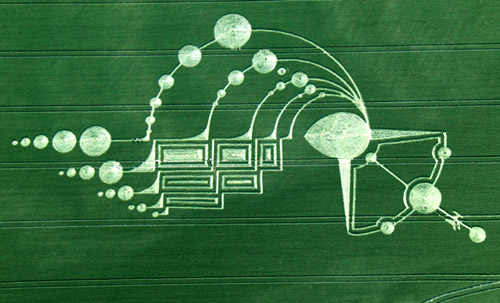
A new two-part crop picture at Milk
Hill on June 21-22, 2009 shows the symbolism of a “sextant” and an “orrery”,
plus a clever astronomical time code for the emission of some small
astronomical body by our Sun
A new two-part crop
picture at Milk Hill on June 21-22, 2009 has stunned the world, or at
least that small part of it who are intelligent and open-minded enough
to follow English crop pictures! What could it possibly mean?
Several readers have
already made the following helpful suggestions (see
milkhill3):
"It
looks like a sextant used by the Navy for navigation at
sea by the stars. It also seems to be pointing towards some specific
planetary alignment" (Paul Anderson).
"The first thing I
saw in that new Milk Hill crop formation was our planetary system"
(Sascha Klein).
"It resembles a pair
of compasses as an instrument used for measuring distance"
(Mark Vidler).
"Its teardrop shape has
been noted in other commentaries as signifying a solar storm.
This new image speaks of what appears to be a technological relationship
to such a storm"
(Steve).
Here we will expand
upon those helpful suggestions, in order to determine in precise detail,
what this new and amazing crop picture might really mean.
Part I of Milk Hill on June 21, 2009 showed the
symbolism of a “sextant”
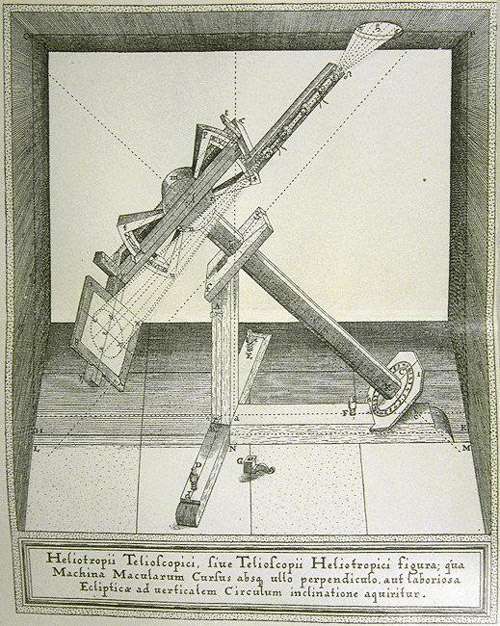
As shown in the
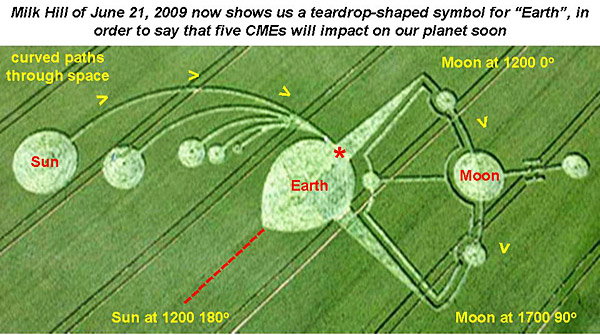
explanatory diagram below, Part I of Milk Hill on June 21 clearly
looked like a “sextant”,
which has long been used to measure the “altitude” or height above the
horizon of various astronomical objects in Earth’s sky (see
Sextant):

It
also showed a second underlying symbolism for “Earth” and “Moon”, where
planet Earth was drawn with a "teardrop” shape, while our Moon was drawn
with a standard “dumbbell” shape first noted in the early 1990’s (see
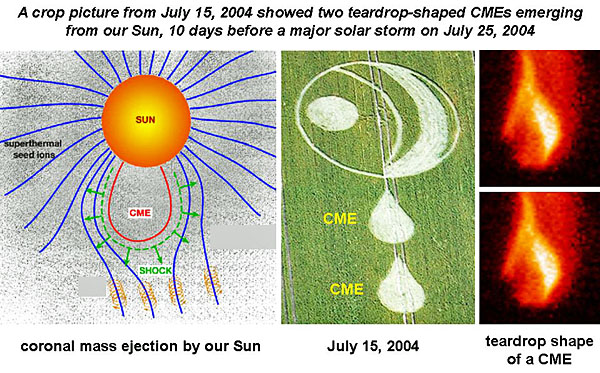
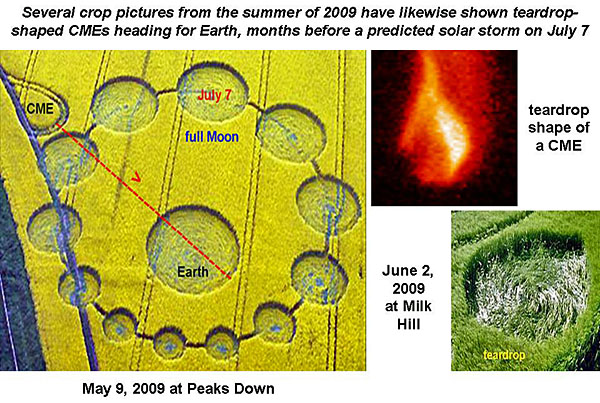
time2007f). That “teardrop”
shape is the usual scientific symbol for a CME or coronal mass ejection
from our Sun (see
milkhill).
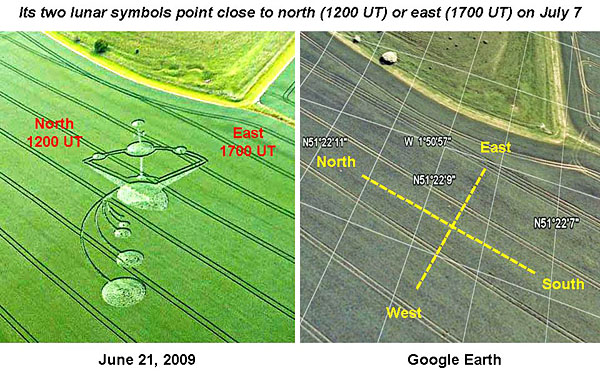
The
two long measuring arms of that “sextant” are aligned in the field close
to due north or due east, which match where our Moon will be located
(under the horizon) at times of 1200 or 1700 UT on an upcoming date of
July 7, 2009.
At
first it might seem bizarre that extra-terrestrials could be showing us
a “sextant” in English fields, but on several occasions from 2003 to
2008 they showed us an “astrolabe”, which is another astronomical
measuring device from Earth’s past (see
time2007x).
Part II of Milk Hill on June 22, 2009 showed the
symbolism of an “orrery”
Part
II of Milk Hill on June 22 also seems to show astronomical symbolism,
and closely resembles an “orrery”, which is a traditional mechanical
device used to illustrate planetary motions (see
Orrery):
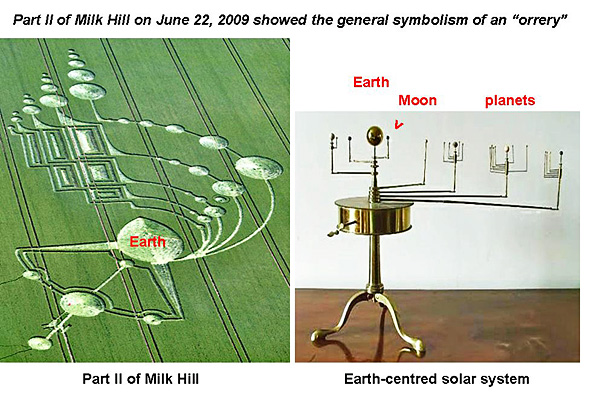
This
particular orrery seems to be based on the Earth-centred model favoured
by Claudius Ptolemy in ancient Alexandria (150 AD), and taught
throughout the Middle Ages, rather than the Sun-centred model introduced
by Copernicus in 1540 AD.
Ptolemy’s Earth-centred model for our solar system
We are all familiar today
with Copernicus’s heliocentric model for our solar system, which places
the Sun at its centre, and nine planets all around. Yet most people
today do not know about Ptolemy’s
geocentric model for our solar system, and that is why we have shown it
below:
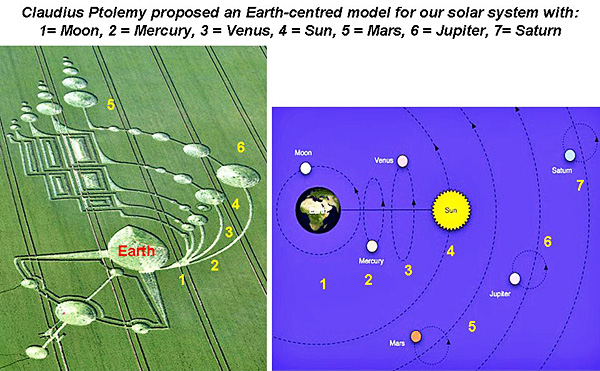
Planet Earth lies at its centre, while five bright planets, the Sun and
Moon rotate around the outside. The relative order of those seven bright
astronomical objects in Ptolemy’s model, when going outward from the
centre, are 1 = Moon, 2 = Mercury, 3 = Venus, 4
= Sun, 5 = Mars, 6 = Jupiter and 7 = Saturn (see
time2007u).
The
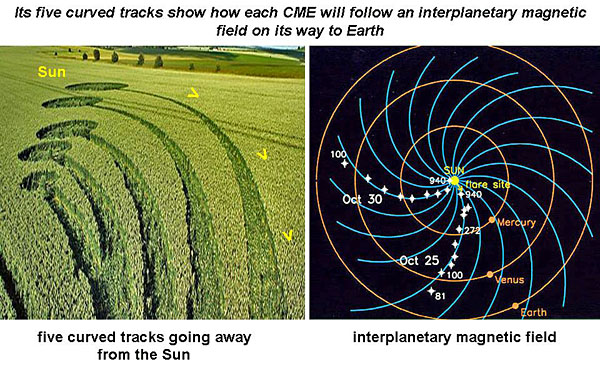
Milk Hill crop picture shows curved orbital paths along the right for
only five of those astronomical objects: namely 1 = Moon, 2
= Mercury, 3 = Venus, 4 = Sun and 6 = Jupiter. We
will discuss below why 5 = Mars and 7 = Saturn may have
been omitted.
Along
the top, that Milk Hill crop picture then shows six of seven planetary
symbols 1-2-3-4-5-6 (when including the outermost curved
line), so as to match six rectangular boxes that were drawn immediately
below. Clearly those “boxes” have some connection to Ptolemy’s
astronomical objects 1-2-3-4-5-6, but what could their relation
be?
Altitudes above or below the local horizon for our
Moon, four planets and the Sun
The
answer to this apparently difficult problem is actually quite simple:
what is the true purpose of a “sextant”, as shown at Milk Hill one day
earlier?
Well,
a sextant tells how
high in the sky any bright astronomical object might be
at a given time of observation, in units of 0o to 90o
relative to the local horizon. In astronomical language, those heights
in the sky are called “altitudes”.
Could
each of those six rectangular boxes be telling us relative altitudes,
for Ptolemy’s six astronomical objects 1-2-3-4-5-6 at some
calendar date in the near future? With that idea in mind, we used an
astronomical almanac (see
almanac) to calculate altitudes for the Sun,
Moon and five bright planets over a wide range of dates during the
summer of 2009. Then we compared those calculated values with the
relative heights of six boxes shown in Part II of Milk Hill.
The
hourly time of observation clearly has to be close to 1200 UT, since one
arm of that “sextant” is aligned south to north, parallel to the crop
tramlines, while our Sun lies due south at noon in southern England. As
shown below, our best theoretical matches to the crop picture were for
upcoming dates of July 6 or 7,
2009:
Table 1.
Altitudes for latitude 51o North, longitude 0o
West at 1200 UT
|
Date in 2009 |
June 21 |
July 1 |
July 4 |
July 5 |
July 6 |
July 7 |
July 8 |
July 9 |
|
Moon |
+60 |
-27 |
-55 |
-61 |
-64 |
-63 |
-58 |
-51 |
|
Mercury |
+54 |
+60 |
+61 |
+62 |
+62 |
+62 |
+62 |
+63 |
|
Sun |
+62 |
+62 |
+62 |
+62 |
+61 |
+61 |
+61 |
+61 |
|
Venus |
+37 |
+40 |
+41 |
+41 |
+42 |
+42 |
+42 |
+42 |
|
Mars |
+39 |
+39 |
+39 |
+39 |
+39 |
+39 |
+39 |
+39 |
|
Saturn |
+13 |
+19 |
+21 |
+21 |
+22 |
+22 |
+23 |
+23 |
|
Jupiter |
-29 |
-35 |
-37 |
-38 |
-38 |
-39 |
-40 |
-40 |
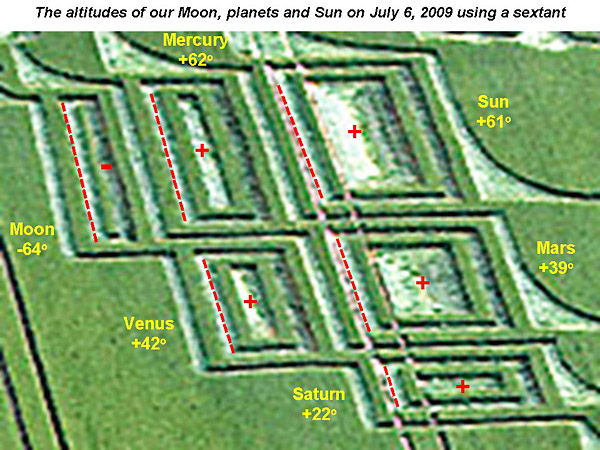
Our
best date of July 6 produces altitudes above or below the local horizon
as Moon = -64o (not visible), Mercury = +62o, Sun
= +61o, Venus = +42o, Mars = +39o or
Saturn = +22o. Planet Jupiter at -39o is not
visible, so is not shown. Any box with one stripe means
"negative altitude" (below the horizon), while any box with two
stripes means "positive altitude" (above the horizon).
On
nearby dates, say July 5 or 8, the negative altitude for our Moon does
not exceed high positive elevations of +62o or +61o
for Mercury or the Sun as required.
The “Sun” in Part II of Milk Hill seems to be
ejecting a small astronomical body in the direction of Earth
Why
would those crop artists go to all the trouble of showing us “sextant”
or :orrery” shapes, then coding that orrery with six rectangular boxes
which mean July 6 or 7, 2009, unless something significant were going to
happen on that day?
The
answer to this question may perhaps be found by studying certain notable
details from Part II of Milk Hill, as shown below:
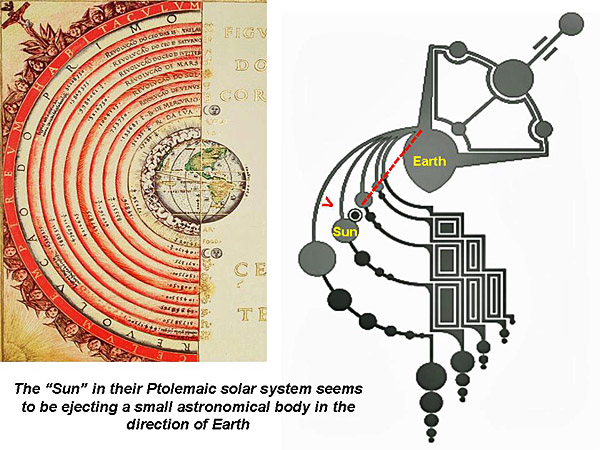
Directly next to their symbol for 4 = Sun, we can see a small,
round, encircled shape (marked by a red arrow) that seems to be aligned
in the general direction of Earth (red dashed line).
A
similar symbol was used to describe Comet 73P Schwassman-Wachmann 3 at
Bishop’s Sutton in 1995 (see
time2007a), or Comet
17P Holmes at Bluebell Hill in 2005 (see
time2007h). But was
it meant here to represent a “comet” or something else?
Coronal mass ejections from our Sun may show either
“teardrop” or “spherical” shapes
If
not a comet, then the next most likely possibility would be a CME or
coronal mass ejection from our Sun. Various stages in the ejection of a
CME are shown below:
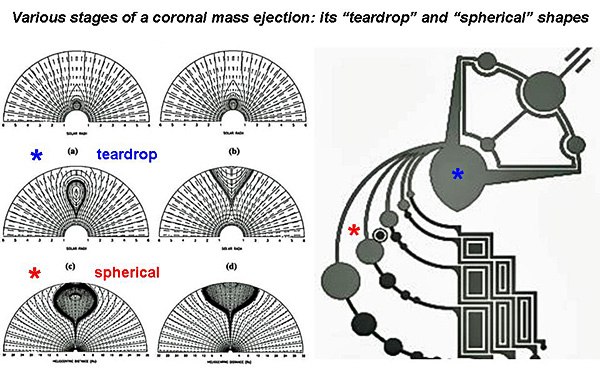
At
early stages in the ejection process, any CME may acquire a “teardrop”
shape, such as that drawn for planet Earth in their “sextant” (marked
with a blue asterisk). At late stages in the ejection process, any CME
may evolve into a “spherical” shape, such as that drawn next to their
“Sun” symbol (marked with a red asterisk).
An
astute observer might even suggest that any late-stage CME looks a bit
like that “fish” shown in crops on June 8, which was surrounded by seven
circles as 1-2-3-4-5-6-7 (see
bishopcannings2009b).
If
Milk Hill Part II is really telling us about a CME (and not a comet),
then that may be why the crop artists omitted 5 = Mars and 7
= Saturn from their curved orbital paths, while including 1-2-3-4-6.
On July 6 or 7, both Mars and Saturn will lie angularly offset from the
other four planets and our Moon, when viewed in terms of a possible
directional ejection by our Sun.
For
the past two years, our Sun has been abnormally quiet between solar
cycles 23 and 24. Within the past month however, it has certainly “woken
up” (see
nasa.gov or
http://spaceweather.com). What if anything might happen shortly?
The CMM Research Group
PS We
would like to thank Olivier Morel, Jack Turner, and
www.cropcircle-archive.com for some of the field photographs
used here. Marina Sassi solved for their "astrolabe", "dragonfly",
"sextant" and "orrery" symbolisms. We would also like to thank Mark
Vidler for his insightful comments concerning Part I (see
milkhill3),
which helped us to make a clearer presentation for Part II. |